
How Much Weight Can a Floor Jack Lift Safely: Sizing and Safe Capacity Guide for 2026
Learn how much weight can a floor jack lift safely for home garage maintenance in November 2026 with essential axle load rules, vehicle ratings, and lifting protocols.
 By Mike Bumbeck
Updated October 13, 2026


Elevating a vehicle for routine garage service requires a thorough understanding of working load limits and dynamic weight distribution. Many car owners wonder exactly how much weight can a floor jack lift safely when preparing to perform oil changes, brake inspections, or seasonal wheel swaps. A floor jack is engineered to lift a designated portion of a vehicle rather than the entire curb weight at once. Understanding how corner weights, axle splits, and suspension droop affect hydraulic load ensures that your lifting equipment operates well within its mechanical boundaries without risking structural failure.
Selecting the appropriate lifting capacity prevents hydraulic strain and keeps your workspace secure during elevated maintenance tasks. While some mechanics weigh the options of comparing vehicle ramps with jack stands for fast underbody access, a hydraulic trolley jack remains the most versatile tool for targeted corner and axle elevation. Floor jacks rated from 1.5 tons up to 3 tons provide distinct operating envelopes designed for specific vehicle footprints. By adhering to proper tonnage calculations and always transferring vehicle weight onto mechanical supports, you protect both your vehicle chassis and personal safety.
| Award | Product | BJL Score About BJL ScoreThe BJL Score is our own rating from 0 to 10, based on performance, design and build, ease of use, and value. It reflects independent research and is never influenced by manufacturers, retailers, or affiliate commissions. Learn more › | |
|---|---|---|---|
| Best Overall |
TONDA 2-Ton Low Profile Floor Jack
|
9.2/10 | Buy |
| Best Budget |
 TONDA 1.5-Ton Hydraulic Floor Jack |
9.1/10 | Buy |
| Best Premium |
 Jack Boss 3-Ton Low Profile Floor Jack |
8.8/10 | Buy |
 Pro-LifT F-2315PE 3000 LBS Hydraulic Trolley Jack |
8.3/10 | Buy | |
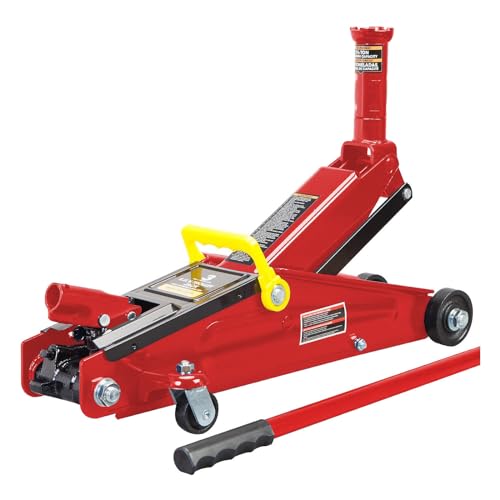 BIG RED T83006 3-Ton Floor Jack |
8.3/10 | Buy | |
| Best Value |
 Pro-Lift 2-Ton Low Profile Floor Jack |
8.3/10 | Buy |
 SATA 3-Ton Aluminum Floor Jack |
8.1/10 | Buy | |
 Road Dawg 3-Ton Low-Profile Floor Jack |
7.8/10 | Buy |
TONDA 2-Ton Low Profile Floor Jack
Built with a hybrid aluminum and steel frame, this compact floor jack reaches down to 3.35 inches to easily slide under low-clearance cars. The dual-pump hydraulic system and rubber-padded saddle provide fast lifting while protecting vehicle frame rails during maintenance.
Pros
- Low 3.35-inch minimum height fits lowered vehicles
- Dual-pump system reaches maximum height quickly
- Rubber saddle protects vehicle pinch welds and paint
- Hybrid aluminum-steel construction aids portability
Cons
- 13.98-inch maximum lift height limits taller vehicle work
- 2-ton capacity excludes heavy full-size trucks
TONDA 1.5-Ton Hydraulic Floor Jack
Weighing under 15 pounds, this compact steel floor jack offers a 3,000-pound capacity for basic garage maintenance and tire rotations. Its 4.9-inch to 11.8-inch lift range and integrated carry handle make it a practical option for owners of compact cars and sedans.
Pros
- Lightweight construction at roughly 15 pounds
- Integrated carry handle for convenient transport
- Built-in bypass valve prevents accidental over-extension
- Swivel casters provide smooth positioning under vehicles
Cons
- Limited 11.8-inch maximum lift height
- 1.5-ton capacity unsuitable for trucks or SUVs
- 4.9-inch minimum clearance cannot fit ultra-low vehicles
Jack Boss 3-Ton Low Profile Floor Jack
Built with a hybrid aluminum and steel frame, this 3-ton floor jack pairs a low 3-15/16-inch minimum clearance with a dual-piston rapid pump. It serves as a versatile lifting solution for low-slung sedans as well as standard SUVs and minivans.
Pros
- Low-profile 3-15/16-inch minimum lifting clearance
- Fast elevation with dual-piston hydraulic pump
- Hybrid aluminum and steel frame construction
- Protective rubber saddle shields vehicle chassis
- Meets rigorous ANSI/ASME PASE safety standards
Cons
- At 58.5 pounds, it remains relatively heavy to transport
- 18-5/16-inch max height may be limiting for lifted trucks
Pro-LifT F-2315PE 3000 LBS Hydraulic Trolley Jack
The Pro-LifT F-2315PE is an 18-pound portable hydraulic trolley jack rated for 3,000 pounds with a 5.25-inch to 12-inch lift range and an included blow-molded case. It is ideal for residential DIYers, mobile mechanics, and car owners seeking a compact, reliable tool for quick tire changes and brake service on passenger vehicles.
Pros
- Compact 18-pound steel chassis and integrated carrying handle make transport and positioning effortless
- Included hard-shell blow-molded case protects against dust, moisture, and fluid mess during transport
- All-welded steel frame provides dependable structural rigidity over lightweight stamped alternatives
- Rear swivel casters ensure smooth maneuverability on level concrete garage floors and paved driveways
Cons
- Maximum lift height of 12 inches limits working clearance and is not suitable for high-clearance trucks or tall SUVs
- Minimum saddle height of 5.25 inches may not clear lowered sports cars without auxiliary drive-on helper ramps
- The 3,000-lb capacity restricts use strictly to corner lifting on lightweight passenger cars and small crossovers
BIG RED T83006 3-Ton Floor Jack
Engineered for high-riding trucks and SUVs, the BIG RED T83006 delivers up to 20-7/8 inches of lift height with an extended saddle neck. Its 6,000-pound capacity and integrated overload bypass provide reliable lifting power for routine garage maintenance.
Pros
- Generous 20-7/8 inch maximum lift height
- Extended saddle neck reaches high truck frames quickly
- Built-in safety bypass valve prevents overloading
- Smooth 360-degree swivel casters ease garage positioning
Cons
- Minimum 5-7/8 inch height is tall for low-profile cars
- Single-piston pump requires more strokes than dual-piston models
Pro-Lift 2-Ton Low Profile Floor Jack
Built for vehicles with minimal ground clearance, this compact floor jack slips beneath chassis as low as 3-3/8 inches. Its solid steel construction and dual safety valves make it a practical option for routine passenger car maintenance.
Pros
- Low minimum clearance fits under lowered vehicles easily
- Patented bypass device prevents damage from over-pumping
- Heavy-duty steel construction provides solid durability
- Built-in safety valve prevents lifting beyond capacity
Cons
- 15-inch maximum lift height limits use on taller vehicles
- Two-ton limit is unsuitable for large trucks or SUVs
SATA 3-Ton Aluminum Floor Jack
Designed for versatile garage work, this aluminum floor jack combines a low 3-3/4-inch clearance with a dual-piston pump for rapid vehicle elevation. Its aluminum construction significantly cuts down on overall weight, making positioning around the shop far less strenuous.
Pros
- Low 3-3/4-inch minimum height accommodates low-clearance vehicles
- Dual-piston system reduces physical pumping effort
- Aluminum body provides good portability around the shop
- Controlled release mechanism eliminates sudden drops
Cons
- Long 28.3-inch frame requires substantial storage room
- 19-1/8-inch maximum lift may not suit high-clearance trucks
Road Dawg 3-Ton Low-Profile Floor Jack
With an expansive 3.86-inch to 30.12-inch lifting range, this heavy-duty hydraulic jack effortlessly transitions between low-clearance sedans and tall offroad trucks. A dual-piston pump and reinforced foldable arm deliver swift, stable lifting for multi-vehicle garages.
Pros
- Unusually wide 3.86 to 30.12-inch lift range
- Fast elevation via dual-piston hydraulic mechanism
- Robust 3-ton capacity suitable for heavy trucks
- Safety overload protection and locking arm pins
- Foam handle bumper protects vehicle paint
Cons
- Extremely heavy at over 102 pounds to maneuver
- Large 31.7-inch footprint requires ample garage storage
Understanding Floor Jack Working Load Limits and Safe Vehicle Elevation
A hydraulic floor jack can safely lift up to its manufacturer-rated working load limit, provided that the equipment is operated on a flat concrete surface and centered under an approved chassis lift point. Safe operation requires understanding that a floor jack should only lift an axle or a single corner rather than hoisting the entire vehicle at once. An axle or corner lift represents roughly fifty to sixty percent of a vehicle’s gross curb weight. Exceeding this working threshold or expecting a single jack to bear an entire automobile risks hydraulic bypass valve blowouts, frame distortion, and dangerous load instability.
The Fundamental Rule: Rated Capacity Versus Total Vehicle Curb Weight
Automotive floor jacks are classified by their working load limit in tons, where one ton equals two thousand pounds. A 1.5-ton jack supports up to three thousand pounds, a 2-ton model supports four thousand pounds, and a 3-ton jack handles up to six thousand pounds. Beginners often mistakenly believe that the jack’s rated capacity must match or exceed the total gross vehicle weight listed on the door jamb sticker. This misconception leads to unnecessary confusion when choosing between different trolley jack ratings for everyday garage maintenance.
In practice, elevating one end of a vehicle means two wheels remain firmly planted on the ground, carrying a large portion of the overall mass. When you elevate the front end of a four-thousand-pound sedan, the floor jack only supports the front axle load. That load is typically between fifty-five and sixty percent of the car’s curb weight, which equals approximately twenty-four hundred pounds. A properly functioning two-ton jack easily manages that twenty-four-hundred-pound front axle load because its capacity threshold sits at four thousand pounds, leaving a comfortable safety buffer.
Calculating Axle Loads and Weight Distribution for Safe Lifting
Front-engine passenger vehicles rarely distribute their total weight evenly between the front and rear axles. In front-wheel-drive sedans and crossovers, the engine, transmission, transaxle, and cooling system sit concentrated over the front suspension. This layout often creates a front-to-rear weight distribution of roughly sixty percent to forty percent. Consequently, raising the front end demands substantially more hydraulic force than raising the rear end of the exact same vehicle.
Pickup trucks and rear-wheel-drive sport utility vehicles present unique weight distribution challenges depending on bed cargo and passenger load. An empty pickup truck carries the vast majority of its weight over the front wheels, leaving the rear axle relatively light. When a truck bed is loaded with construction supplies, tools, or heavy cargo, the rear axle weight increases dramatically. In single-corner lifting scenarios, the jack bears approximately twenty-five to thirty-five percent of the total mass, making proper axle evaluation essential before initiating a lift.
Matching Jack Tonnage to Vehicle Classes from Compacts to Heavy Trucks
Compact cars and lightweight sports coupes typically weigh between twenty-five hundred and thirty-two hundred pounds. For these smaller platforms, a compact 1.5-ton hydraulic trolley jack provides sufficient capacity for routine corner and axle service. Models such as the TONDA 1.5 Ton Hydraulic Car Jack and the Pro-LifT F-2315PE Grey Hydraulic Trolley Jack Car offer lightweight convenience suited for lighter chassis. These compact units provide an accessible solution for straightforward maintenance without requiring heavy shop equipment.
Midsize sedans, sports wagons, and compact crossovers frequently register curb weights between thirty-five hundred and forty-two hundred pounds. A 2-ton floor jack serves as the recommended baseline for these vehicles, providing a dependable working margin. Options like the TONDA 2 Ton Low Profile Floor Jack and the Pro-Lift Low Profile Floor Jack provide four thousand pounds of lifting power. That capacity comfortably handles the twenty-five hundred pound front-axle loads common to popular family crossovers.
Full-size sport utility vehicles, minivans, and half-ton pickup trucks regularly exceed five thousand to six thousand pounds of curb weight. These heavier passenger vehicles require a robust 3-ton floor jack to handle front-axle loads safely. Heavy-duty tools like the Jack Boss 3 Ton Low Profile and the BIG RED Hydraulic Trolley Service/Floor Jack deliver six thousand pounds of lifting capacity. This strength ensures that heavy front differentials, V8 engine blocks, and truck frames are elevated with complete structural confidence.
Minimum Collapsed Profile and Maximum Stroke: Why Height Matters for Safety
Working load capacity means very little if the floor jack cannot physically slide under the vehicle’s factory lift points. Low-slung sports cars, lowered sedans, and vehicles with aggressive aerodynamic splitters often offer less than four inches of ground clearance. A standard service jack with a tall collapsed saddle will contact body cladding or rocker panels before reaching the frame. Low-profile jacks feature lowered chassis designs that slip underneath tight clearances without scratching exterior bodywork.
Tall four-wheel-drive trucks and off-road vehicles present the opposite mechanical challenge due to long-travel suspension designs. When elevating a solid axle or unibody frame rail, the suspension droops significantly as the chassis rises. If a floor jack lacks sufficient maximum lift stroke, the ram reaches full extension before the tire clears the garage floor. When planning high-clearance garage projects, our guide on determining overall lift clearance requirements explains the geometry needed to accommodate long suspension droop. Units like the Road DAWG Low-Profile High-Reach Hydraulic 3 Ton address both extremes by offering low entry clearance combined with high reach for taller chassis designs.
Hydraulic System Mechanics: Internal Bypass Valves and Overload Protection
Hydraulic floor jacks rely on basic fluid dynamics to generate immense mechanical lifting force from modest manual handle input. When the handle pumps downward, a small piston forces anti-foaming hydraulic jack oil through an internal check valve into a larger ram chamber. Because fluid cannot be compressed, the high hydraulic pressure pushes the main ram upward to raise the heavy lift arm. This mechanical advantage allows a single person to lift thousands of pounds with steady, repeatable control.
Every quality service jack incorporates an internal overload bypass valve designed to protect the hydraulic circuit from catastrophic over-pressurization. If an operator attempts to elevate a load that exceeds the jack’s working load limit, the bypass valve opens automatically. This safety mechanism routes pressurized hydraulic oil back into the fluid reservoir rather than forcing the ram past its design threshold. Equipment like the Jack Boss 3 Ton Low Profile and SATA 3-Ton Aluminum Floor Jack are factory overload tested to verify that the internal valves retain a substantial factor of safety.
Frame Rigidity and Metallurgy: Welded Steel Versus Aircraft Aluminum
The materials used in a floor jack chassis directly influence how the frame resists bending and deflection under heavy loads. Traditional service jacks rely on heavy-gauge welded carbon steel side plates and solid steel lift arms. Steel construction delivers exceptional torsional rigidity, keeping the wheels flat on the garage slab while holding massive vehicle weight. The primary trade-off with all-steel jacks is their substantial weight, which can make maneuvering them across rough floors tiring.
Aluminum and hybrid floor jacks have gained widespread popularity among mobile mechanics and track-day drivers who need portability. High-strength aluminum side plates reduce total tool weight significantly compared to all-steel designs. The SATA 3-Ton Aluminum Floor Jack provides a lightweight structure that is much easier to transport in a trunk or truck bed. Meanwhile, the TONDA 2 Ton Low Profile Floor Jack combines lightweight aluminum side plates with a steel arm, delivering strength where stress is highest while keeping the unit easy to position.
Single-Piston Versus Dual-Piston Rapid-Pump Mechanisms Under Load
The pump assembly at the base of the hydraulic cylinder determines how quickly the saddle rises to meet the vehicle frame. Single-piston hydraulic mechanisms utilize one pumping plunger to displace oil into the main ram cylinder. While single-piston jacks like the BIG RED Hydraulic Trolley Service/Floor Jack provide reliable service, they require more handle strokes to elevate the arm to the vehicle contact point. Once the saddle engages the chassis, the single piston continues providing steady lifting force under load.
Dual-piston rapid-pump systems incorporate twin hydraulic plungers that work simultaneously to double the volume of displaced fluid per stroke. When pumping an unloaded jack, dual pistons raise the lift arm to the chassis contact point in just a few quick handle cycles. This rapid rise reduces the physical effort and time spent pumping the handle before actual lifting begins. Dual-piston mechanisms found on models like the Jack Boss 3 Ton and Road DAWG 3 Ton provide smooth fluid flow that minimizes pulsing motions as the vehicle ascends.
Essential Contact Safety: Saddle Diameter, Rubber Pads, and Factory Lift Points
A floor jack can safely bear thousands of pounds only if that force is concentrated on an authorized structural lifting point. Placing a steel saddle directly under thin sheet metal floor pans, oil pans, or suspension control arms can cause catastrophic damage. Automakers clearly outline reinforced lifting points in the owner’s manual, including notched pinch welds, heavy frame rails, and front subframe crossmembers. Positioning the saddle precisely under these reinforced zones ensures the vehicle structure withstands the concentrated lifting load.
The design of the jack saddle plays a critical role in preventing slippage and avoiding cosmetic or structural damage to the underbody. Bare metal saddles with sharp perimeter teeth can gouge protective undercoating, bend delicate unibody pinch welds, or scratch painted surfaces. Modern jacks often include large rubber saddle pads, as seen on the TONDA 2 Ton and Jack Boss 3 Ton models. These vulcanized rubber pads cushion the interface, grip the metal securely, and prevent dangerous off-center load shifting.
Operating Protocol: Why Hydraulic Jacks Must Never Act as Static Supports
The most important safety rule in automotive maintenance is that a hydraulic floor jack is strictly an elevating tool, never a load-holding device. Hydraulic systems depend entirely on fluid pressure contained by rubber O-rings, internal check balls, and precision machined valves. Any minor seal weep, temperature fluctuation, or micro-leakage can cause the hydraulic ram to slowly bleed down under static load. Never place any part of your body underneath a vehicle supported solely by a hydraulic jack.
Even when a quick maintenance job involves lifting one side of a vehicle to change a flat tire or inspect brakes, mechanical supports are mandatory. As soon as the vehicle reaches the desired service height, immediately position properly rated mechanical jack stands beneath factory-approved support points. Jack stands utilize solid steel locking pins or ductile iron ratcheting pawls that provide positive mechanical engagement. Once the stands are set, carefully lower the floor jack until the vehicle rests firmly on the mechanical supports.
In addition to setting mechanical jack stands, always secure the wheels that remain on the ground using heavy-duty wheel chocks. Chock both the front and rear of the grounded tires on the opposite axle to prevent rolling in either direction. Engage the vehicle’s parking brake and place automatic transmissions in Park or manual transmissions in reverse gear. These overlapping safety measures ensure that the vehicle cannot pivot, shift, or roll while elevated on garage equipment.
Safe Lowering Dynamics: Universal Joint Metering Versus Abrupt Release
Controlling how a vehicle descends is just as critical to garage safety as managing the initial lift. Releasing hydraulic pressure too quickly causes the heavy vehicle chassis to drop abruptly, which can damage suspension components or jar jack stands out of position. Sudden drops also generate severe shock loads on the vehicle frame and floor jack structure. A controlled, predictable descent protects your vehicle, garage floor, and personal safety throughout the lowering process.
High-quality floor jacks employ universal-joint release mechanisms that connect the operating handle directly to the hydraulic release valve. A universal joint allows smooth, micro-metered rotation of the handle regardless of the angle at which the handle is positioned. This design enables the operator to open the release valve by fractions of a millimeter, venting pressurized fluid back into the reservoir gradually. Granular control prevents sudden drops and ensures a slow, feather-light vehicle descent.
Practical Sizing Verification Before Elevating Any Vehicle
Determining whether your floor jack can safely lift your vehicle begins with verifying the curb weight on the driver’s door pillar placard. Take that gross curb weight and calculate the sixty-percent front-axle load as your baseline lifting requirement. Add an extra safety buffer to account for aftermarket accessories, cargo, full fuel tanks, and potential dynamic load shifts during elevation. Ensuring that your jack’s rated tonnage comfortably exceeds this calculated axle weight guarantees reliable, low-stress operation.
Next, confirm that the collapsed height of your jack’s saddle easily clears the vehicle’s lowest factory jacking point with tires inflated or deflated. Verify that the maximum hydraulic lift stroke provides sufficient vertical travel to clear the suspension droop of your specific vehicle class. Finally, examine the garage floor surface to ensure the concrete slab is level, solid, and free of cracks that could trap the jack’s steel casters. A flat, clean surface allows the jack to roll slightly forward as it lifts, keeping the saddle centered under the load.
By pairing a properly rated floor jack with reinforced lift points, wheel chocks, and mechanical jack stands, you establish an uncompromising garage safety standard. Modern hydraulic equipment provides the immense mechanical leverage required to elevate heavy vehicles with ease and precision. Understanding your vehicle’s weight distribution and respecting working load limits ensures that every maintenance project remains safe, efficient, and thoroughly controlled.
About the author
Mike Bumbeck is an automotive journalist and hands-on product evaluator with a long-standing interest in classic vehicles, motorcycles, and practical garage equipment. His work brings a grounded perspective to automotive tools, maintenance products, and the details that matter when choosing gear for real-world use.