
Why Long Reached Floor Jacks Are More Durable Than Others: Practical Guide for 2026
Explore why long reached floor jacks are more durable than others for November 2026 to see how reinforced steel chassis designs reduce frame twist and extend shop life.
 By Larry Carley
Updated October 13, 2026


Elevating a vehicle safely requires understanding how chassis geometry and lifting force interact under heavy shop use. Many garage mechanics wonder why long reached floor jacks are more durable than others when comparing standard service jacks against extended-chassis models. A longer chassis profile changes how mechanical leverage acts on the pivot points, distributing dynamic vehicle weight across a larger base. This structural layout minimizes metal fatigue, prevents off-center frame racking, and reduces localized strain on critical hydraulic seals during heavy garage service.
Long-term equipment durability also depends on structural steel thickness, side-plate reinforcement, and hydraulic bypass engineering. While lifting a vehicle with a trolley jack is essential for regular automotive maintenance, understanding proper vehicle support methods and jack stand safety ensures that hydraulic tools are never treated as permanent load-holding devices. Brands like Jack Boss incorporate heavy welded steel frames, dual-piston pump blocks, and overload valves to handle intense mechanical duty. Looking closely at structural metallurgy and hydraulic load paths reveals the exact reasons behind this enhanced durability.
| Award | Product | BJL Score About BJL ScoreThe BJL Score is our own rating from 0 to 10, based on performance, design and build, ease of use, and value. It reflects independent research and is never influenced by manufacturers, retailers, or affiliate commissions. Learn more › | |
|---|---|---|---|
| Best Overall |
Jack Boss 3 Ton Fast Lift Steel Hydraulic Floor
|
9.1/10 | Buy |
| Best Premium |
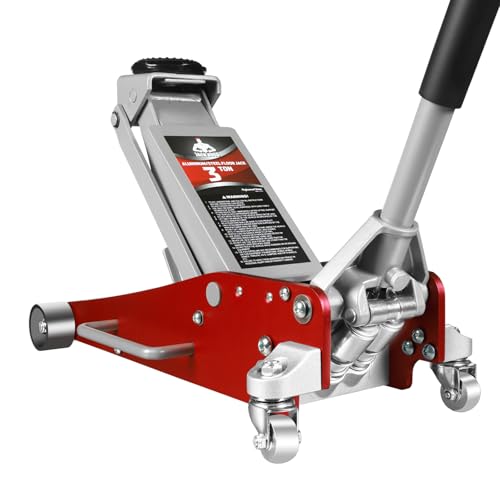 Jack Boss 3-Ton Low Profile Floor Jack |
8.8/10 | Buy |
| Best Budget |
 Jack Boss 1.5-Ton Hydraulic Floor Jack |
8.6/10 | Buy |
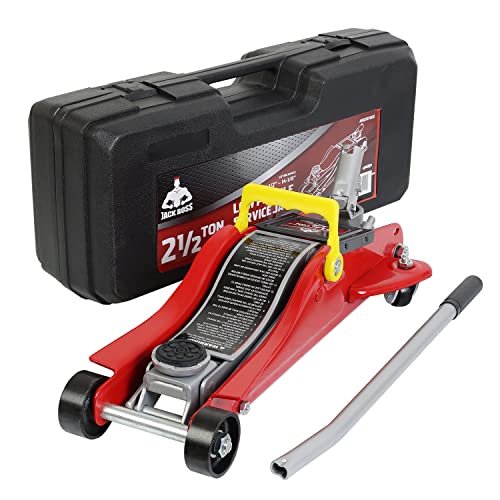 Jack Boss 2.5-Ton Low Profile Floor Jack |
8.6/10 | Buy | |
 Jack Boss 3 Ton Low Profile Floor Jack |
8.4/10 | Buy |
Jack Boss 3 Ton Fast Lift Steel Hydraulic Floor
The Jack Boss 3-ton fast lift hydraulic service jack delivers a 6,600-pound capacity with a working range of 5.15 to 18.3 inches. Built with heavy-duty steel and a precise universal joint release valve, it provides dependable lifting for garage maintenance, trucks, and SUVs.
Pros
- Robust 3-ton (6,600 lb) working load limit suitable for cars, SUVs, and light trucks
- Versatile 5.15-inch to 18.3-inch lifting range provides ample reach for brake and suspension service
- Universal joint release mechanism allows smooth, gradual descent control
- 360-degree rear swivel casters and rigid steel front wheels allow easy positioning under vehicle lift points
- Certified to meet ANSI/ASME PASE safety standards
Cons
- 5.15-inch collapsed height may not clear ultra-low ground clearance or lowered sports cars
- Heavier steel chassis footprint is best suited for garage floors rather than compact roadside storage
- Requires a smooth, firm concrete surface to roll and position safely without sinking
Jack Boss 3-Ton Low Profile Floor Jack
Built with a hybrid aluminum and steel frame, this 3-ton floor jack pairs a low 3-15/16-inch minimum clearance with a dual-piston rapid pump. It serves as a versatile lifting solution for low-slung sedans as well as standard SUVs and minivans.
Pros
- Low-profile 3-15/16-inch minimum lifting clearance
- Fast elevation with dual-piston hydraulic pump
- Hybrid aluminum and steel frame construction
- Protective rubber saddle shields vehicle chassis
- Meets rigorous ANSI/ASME PASE safety standards
Cons
- At 58.5 pounds, it remains relatively heavy to transport
- 18-5/16-inch max height may be limiting for lifted trucks
Jack Boss 1.5-Ton Hydraulic Floor Jack
Designed for sedan owners, this Jack Boss hydraulic jack offers a lifting range of 5.1 to 12.6 inches in a portable 16.6-pound frame. Its welded steel build and included hard storage case make it well-suited for trunk storage and quick tire changes.
Pros
- Lightweight design at under 17 pounds
- Hard blow-mold case included for storage
- Built-in overload safety valve
- Smooth positioning via 360-degree swivel casters
Cons
- Maximum 12.6-inch lift height is relatively low
- Capacity limited to sedans and lighter cars
- Minimum 5.1-inch height cannot accommodate ultra-low vehicles
Jack Boss 2.5-Ton Low Profile Floor Jack
Designed for home garages, this compact hydraulic trolley jack slides easily under low-clearance sedans with its 3.5-inch minimum height. Its 5,500-pound capacity and bundled carrying case make routine tire changes and undercarriage maintenance straightforward to manage and store.
Pros
- Low 3.5-inch minimum height fits low-clearance vehicles
- Includes hard-shell case for organized storage
- Four 360-degree swivel casters allow easy positioning
- Integrated overload valve enhances operating safety
- Padded handle protects vehicle bodywork from damage
Cons
- 14-inch maximum lift height limits high-clearance vehicle use
- Weighs over 35 pounds, making transport somewhat heavy
Jack Boss 3 Ton Low Profile Floor Jack
Built with a dual-pump hydraulic system and heavy-duty steel, this floor jack lifts vehicles from 3-1/8 inches to 20 inches. Its low-profile stance and controlled slow-descent release make it a reliable choice for DIY garage maintenance on cars and SUVs.
Pros
- Dual pumps provide fast lifting action
- Slow descent mechanism lowers vehicles safely
- Low clearance fits low-profile vehicles easily
- Rugged steel build offers long-term durability
- Swivel casters allow smooth garage positioning
Cons
- Heavy steel build is less portable than aluminum
- 20-inch maximum reach may limit taller lifted trucks
Understanding the Structural and Hydraulic Durability of Long-Reach Jacks
Long-reach floor jacks achieve superior long-term durability primarily because their extended physical geometry requires heavier structural reinforcement to counter mechanical deflection. When a lifting arm extends deep beneath a vehicle to contact recessed subframe crossmembers, the physical forces acting on the chassis multiply dramatically. Manufacturers must engineer thicker plate steel side frames, oversized pivot trunnions, and heavy-duty hydraulic assemblies to manage those amplified bending moments. Standard short-body trolley jacks often rely on thinner stamped metal frames because their short reach experiences less leverage, but this leaves them far more vulnerable to frame twist and localized metal fatigue over repeated lifting cycles.
Mechanical Leverage and Bending Moment Distribution in Extended Frames
Every hydraulic service jack functions as a lever system where dynamic load forces travel from the saddle through the lift arm and into the main chassis frame. In a short trolley jack, the pivot pins and side plates absorb vehicle weight over a very compact footprint. This concentrated stress pattern causes localized metal deformation whenever the vehicle is elevated on an imperfectly level garage floor. A long-reach design, by contrast, spreads dynamic operational loads across an extended wheelbase that often exceeds 28 inches in overall frame length.
Dispersing vehicle weight across a broader span significantly reduces the torsional twisting forces that typically destroy cheaper lifting equipment. When a lifting arm rises, the vehicle shifts slightly, creating lateral side-loading on the lift arm pivot assembly. Long-reach frames counteract this lateral torque by utilizing wide-stance boxed side plates and rigid cross-members. Because the frame resists twisting, the internal hydraulic cylinder remains perfectly aligned along its intended stroke axis throughout the entire lifting cycle.
Maintaining perfect cylinder alignment directly protects internal components from premature failure. When a jack chassis flexes under load, the hydraulic ram experiences asymmetric side-loading against the cylinder walls. This uneven contact rapidly scores polished steel piston rods and crushes internal nitrile rubber cup seals. By eliminating chassis deflection through engineered length and structural rigidity, long-reach floor jacks prevent the internal hydraulic blowouts that plague lighter, short-chassis designs.
Heavy-Gauge Drop-Forged Steel and Reinforced Boxed Construction
The materials required to build an extended chassis naturally elevate the tool’s structural integrity. To prevent a long frame from bowing under three tons of static vehicle load, engineers cannot use thin stamped sheet metal. Instead, durable models like the Jack Boss heavy-duty service jacks utilize thick drop-forged alloyed welded steel plates for the primary chassis rails. These heavy steel plates provide exceptional tensile strength, ensuring the side walls do not warp or bow outward when lifting heavy pickups, SUVs, or commercial vans.
Welded steel boxed bracing between the side rails further stiffens the chassis against dynamic flex. During intense shop service, a floor jack repeatedly absorbs sudden load shifts when tires break contact with the floor. Boxed structural cross-members absorb these energy spikes, transferring force directly into the front steel rollers and ground contact points. Cheaper compact trolley jacks often feature bolted cross-braces that loosen over time, leading to sloppy handling and frame distortion.
Corrosion-resistant industrial coatings also play a critical role in preserving the structural metal of these heavy-duty frames. Quality floor jacks feature baked-on enamel or industrial powder coating that seals raw drop-forged steel from moisture, road salt, and harsh automotive chemicals. Preventing surface oxidation ensures that welded joints retain their fatigue resistance over decades of continuous garage use. This robust metallurgical foundation guarantees that the tool remains structurally sound even under rigorous daily lifting schedules.
Hydraulic Ram Sizing, Pressure Dynamics, and Bypass Protection
Internal hydraulic mechanics differ considerably between compact portable jacks and extended service jacks. Because a long-reach lift arm operates with a different mechanical leverage ratio, the hydraulic power unit must generate substantial lifting force smoothly. Manufacturers resolve this challenge by equipping long-reach units with larger-diameter hydraulic cylinders and heavy-duty trunnion pivot mounts. A larger ram diameter allows the hydraulic fluid to operate at lower internal hydrostatic pressures while achieving identical lifting capacity.
Operating at reduced internal hydraulic pressures significantly extends the working lifespan of internal O-rings, check valves, and wiper seals. High-pressure hydraulic spikes in undersized cylinders generate excessive friction heat, degrading synthetic rubber seals and causing fluid aeration. In long-reach jacks equipped with dual-piston pump assemblies, such as the Jack Boss 3 Ton Low Profile model, dual hydraulic plungers displace fluid rapidly while maintaining balanced pressure across the valve block. This efficient pump architecture reduces mechanical wear on pump pistons during rapid elevation strokes.
Internal safety valving provides another layer of mechanical defense against cylinder destruction. Factory-set overload bypass valves automatically open if an operator attempts to elevate a load exceeding the rated working limit, diverting fluid back into the reservoir. Similarly, internal stroke limiter bypass ports prevent the hydraulic ram from being pumped past its maximum designed extension height. These protective mechanisms safeguard both the polished cylinder bore and the mechanical pivot pins from catastrophic over-pressurization.
Wide-Stance Wheelbases and Roll-Under Stability During High Elevation
A crucial factor in floor jack durability is how the tool travels across concrete during the lifting arc. As a hydraulic lift arm rises, the saddle swings backward in a radial arc toward the jack body. To keep the saddle centered directly beneath the vehicle lift point, the entire floor jack must roll forward smoothly under load. Short trolley jacks possess narrow wheelbases with small wheels that can easily catch on concrete expansion joints, small gravel, or garage floor debris.
When a jack gets stuck and fails to roll forward during elevation, immense lateral pulling forces are exerted on the saddle and lift arm. This unnatural tension can bend the main lifting arm, shear pivot bolts, or pull the saddle off the factory lift point entirely. Long-reach jacks eliminate this hazard by pairing heavy solid-steel front rollers with wide-track rear ball-bearing swivel casters. The long chassis provides exceptional rolling leverage, allowing the jack to glide effortlessly forward even when carrying thousands of pounds of vehicle weight.
Front roller width also prevents garage floor gouging and maintains a steady footprint on unsealed surfaces. Wide steel rollers distribute vehicle mass over a broader contact patch, preventing the jack from tipping sideways if a load shifts slightly. Rear 360-degree swivel casters made from solid steel or high-density material ensure precise positioning under tight clearance points. By rolling freely beneath the elevating vehicle, the long-reach chassis absorbs zero unnecessary binding strain, keeping the entire mechanical assembly straight and intact.
Central Subframe Reach Versus Uneven Corner-Lifting Strain
Lifting a vehicle from central structural points rather than individual corners dramatically preserves both the vehicle and the lifting equipment. Compact floor jacks typically lack the physical reach to clear front air dams, deep aerodynamic splitters, or low rocker panels. As a result, DIY mechanics are often forced to lift vehicles one corner at a time using unibody pinch welds. Corner lifting subjects the jack to extreme torsional angles because the vehicle tilts diagonally as the opposite wheels stay grounded.
Extended-reach floor jacks allow technicians to slide the saddle past low bumpers and position it squarely under heavy front engine cradles or rear differential housings. Lifting an entire axle at a central structural point divides vehicle weight symmetrically across both sides of the jack chassis. While some mechanics consider alternative drive-on metal ramps for basic clearance tasks, a long-reach jack provides total versatility by raising the suspension evenly. Symmetrical loading prevents chassis flex, maintains balanced hydraulic pressure, and avoids edge wear on pivot bushings.
Central lifting also halves the number of individual lifting cycles required to elevate a vehicle for axle-wide service. Instead of raising the front left corner, placing a stand, and repeating the process on the front right, a single centered lift elevates the entire front end simultaneously. Reducing total pump cycles by half cuts hydraulic seal friction, valve seat wear, and pivot pin cycling in half over the lifetime of the tool. Fewer operational cycles naturally correlate to years of extended tool longevity in busy home garages.
Universal Joint Release Valves and Controlled Micro-Metered Lowering
Lowering a three-ton vehicle in a smooth, controlled manner is just as critical for equipment longevity as the lifting phase. Cheap trolley jacks frequently utilize simple direct-drive gear pins or fragile friction couplings to operate the hydraulic release valve. These basic mechanisms often bind under load, forcing the user to twist the handle with excessive force. Once the valve abruptly pops open, the vehicle drops rapidly, sending a violent shockwave through the hydraulic circuit and chassis frame.
Long-reach garage service jacks overcome this mechanical flaw by integrating rugged universal joint, or U-joint, release drive mechanisms. A universal joint transmits rotational force smoothly regardless of the operating angle of the long pump handle. This mechanical decoupling enables micro-metered release valve adjustments, allowing the user to dial in an extremely gradual, controlled descent rate. Models such as the Jack Boss 3 Ton Floor Jack incorporate specialized slow-descent valving to guarantee vehicle and tool protection.
Controlled descent eliminates dynamic shock loads that crack weld seams and deform hydraulic valve seats. When a descending load stops suddenly due to an erratic release valve, instantaneous hydrostatic pressure inside the cylinder can spike to double its rated limit. These violent pressure pulses stretch cylinder tie rods and rupture delicate internal seals. Universal joint release drives ensure that hydraulic fluid returns to the reservoir at a controlled velocity, shielding every structural and hydraulic component from destructive pressure spikes.
Workshop Elevation Protocols, Fluid Care, and Mechanical Load Support
Preventative maintenance and safe operating discipline form the final pillar of long-term jack durability. Inside the power unit, anti-foaming ISO VG 22 or ISO VG 32 hydraulic jack oil cushions moving metal parts and prevents cavitation during high-speed pumping. Bleeding trapped air from the hydraulic circuit through the rubber fill plug eliminates spongy strokes and protects internal check valves from shock loading. Introducing improper fluids like motor oil, brake fluid, or transmission fluid will chemically destroy internal nitrile seals within weeks, so only approved hydraulic oil should ever be used.
Regardless of how durable a floor jack is, it must strictly be operated as a lifting mechanism rather than a static support. Relying on hydraulic pressure alone to support an elevated vehicle places unnecessary sustained strain on cylinder seals and invites catastrophic failure. Once a vehicle reaches the required service height, the weight must immediately be transferred onto mechanical, ASME PASE rated jack stands. Exploring home garage vehicle elevation procedures highlights how mechanical stands guarantee both technician safety and hydraulic seal preservation.
Surface staging and contact protection also preserve the mechanical integrity of the jack and vehicle undercarriage. Elevating a vehicle must always occur on a flat, level concrete surface with unlifted wheels securely chocked in both directions. Using vulcanized rubber saddle pads or slotted pinch-weld adapters prevents metal-on-metal gouging that can distort the saddle face or crush body seams. By combining disciplined staging with mechanical jack stand support, operators protect their hydraulic equipment from unnecessary stress, ensuring decades of reliable service.
Selecting the right lifting equipment comes down to matching chassis reach, minimum collapsed clearance, and maximum lift height to your vehicle fleet. Verifying that a floor jack clears low rocker panels while reaching full extension past suspension droop guarantees seamless garage maintenance. The engineered durability of long-reach jacks stems directly from their reinforced steel frames, oversized pivot hardware, and reduced hydraulic strain under load. Investing in a structurally rigid, long-reach model delivers dependable performance, superior stability, and peace of mind through every vehicle service project.
About the author
Larry Carley is an experienced automotive technical writer and editor with more than four decades of work covering vehicle diagnostics, repair procedures, and automotive technology. His extensive technical writing helps readers understand mechanical systems, maintenance decisions, and the importance of accurate information when working on vehicles.