
Floor Jack vs Car Jack of 2026 Lifting Guide
Floor Jack Vs Car Jack guidance for November 2026: compare hydraulic garage options, lift capacities, and safety stand setups for smooth maintenance.
 By Christian Hazel
Updated November 23, 2026


Crawling across cold garage concrete to wedge a flimsy emergency scissor tool under damaged pinch welds quickly ruins a weekend maintenance project. Compact scissor units included with spare tire kits work fine for emergency roadside flats, yet their narrow footprints and wobbly screw mechanisms feel unstable on home garage floors. Evaluating the practical differences in floor jack vs car jack designs highlights massive upgrades in stability, hydraulic leverage, and overall lifting speed. A sturdy hydraulic service jack rolls directly into position on steel casters, letting you raise an entire axle smoothly with minimal physical exertion. Regardless of whether you deploy a mobile scissor tool or a heavy steel trolley jack, hydraulic pressure is engineered purely for raising the load, meaning mechanical jack stands must support the vehicle before any work begins.
Ground clearance and overall chassis weight determine which tool fits your garage setup best. Low-slung performance sedans require an ultra-shallow entry height to avoid crushing rocker panels, whereas tall pickups demand extended lift travel to pull massive tires off the floor. Investigating manufacturer specifications for frame materials, bypass valves, and saddle reach prevents costly buying mistakes. If you are comparing lifting gear for simple drive-up service, reviewing are car ramps safer than jack stands helps clarify when wheel platforms make more sense than rolling jacks. Pairing a dependable trolley jack with a dedicated pinch weld adapter ensures secure contact points while safeguarding your undercarriage paint from scratches and dents.
| Award | Product | BJL Score About BJL ScoreThe BJL Score is our own rating from 0 to 10, based on performance, design and build, ease of use, and value. It reflects independent research and is never influenced by manufacturers, retailers, or affiliate commissions. Learn more › | |
|---|---|---|---|
| Best Overall |
TONDA 1.5-Ton Hydraulic Floor Jack
|
9.1/10 | Buy |
| Best Budget |
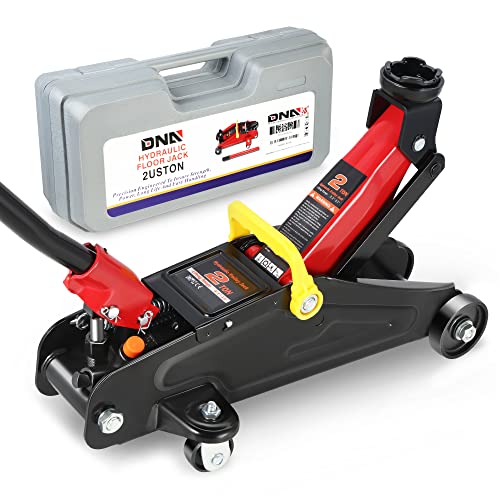 DNA Motoring TOOLS-00234 2-Ton Hydraulic Trolley |
8.8/10 | Buy |
| Best Premium |
 Jack Boss 3-Ton Low Profile Floor Jack |
8.8/10 | Buy |
| Best Value |
 AV Steel 2.5-Ton Low Profile Floor Jack |
8.4/10 | Buy |
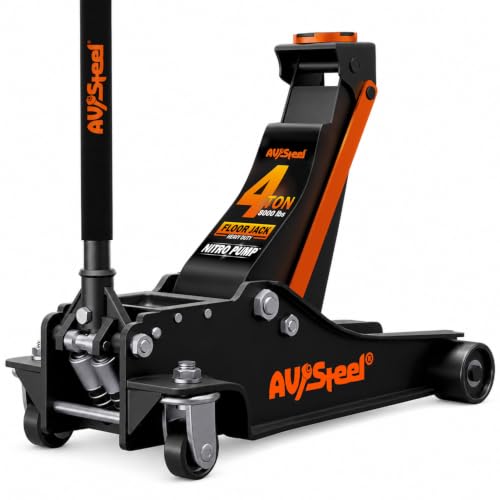 AV Steel 4 Ton Heavy-Duty Hydraulic Floor Jack |
8.3/10 | Buy | |
 TONDA 4.92-Inch Rubber Floor Jack Pad |
8.1/10 | Buy | |
 Maxority 3-Ton Low Profile Floor Jack |
8.0/10 | Buy | |
 AV Steel 3-Ton Hydraulic Floor Jack |
7.8/10 | Buy |
TONDA 1.5-Ton Hydraulic Floor Jack
Weighing under 15 pounds, this compact steel floor jack offers a 3,000-pound capacity for basic garage maintenance and tire rotations. Its 4.9-inch to 11.8-inch lift range and integrated carry handle make it a practical option for owners of compact cars and sedans.
Pros
- Lightweight construction at roughly 15 pounds
- Integrated carry handle for convenient transport
- Built-in bypass valve prevents accidental over-extension
- Swivel casters provide smooth positioning under vehicles
Cons
- Limited 11.8-inch maximum lift height
- 1.5-ton capacity unsuitable for trucks or SUVs
- 4.9-inch minimum clearance cannot fit ultra-low vehicles
DNA Motoring TOOLS-00234 2-Ton Hydraulic Trolley
The DNA Motoring TOOLS-00234 is a compact 2-ton (4,000 lb) hydraulic trolley floor jack featuring a 5.1-inch to 13-inch lifting span and built-in overload protection. Engineered for DIY mechanics servicing passenger sedans and compact cars, it provides rapid vehicle lifting that must be supported with auxiliary mechanical jack stands.
Pros
- Manageable 4,000 lb capacity easily raises compact and mid-size passenger cars for wheel and brake service
- Built-in hydraulic overload valve prevents internal damage if overloaded beyond the rated capacity
- Rear swivel casters allow quick and precise positioning under factory lift points
- Compact frame footprint fits easily in residential garages with restricted floor space
Cons
- Maximum lift height is capped at 13 inches, limiting workspace depth for heavy underbody repairs
- Minimum 5.1-inch collapsed saddle height may not clear heavily lowered or track-tuned sports cars
- Not rated or recommended for full-size pickup trucks, commercial vans, or large three-row SUVs
Jack Boss 3-Ton Low Profile Floor Jack
Built with a hybrid aluminum and steel frame, this 3-ton floor jack pairs a low 3-15/16-inch minimum clearance with a dual-piston rapid pump. It serves as a versatile lifting solution for low-slung sedans as well as standard SUVs and minivans.
Pros
- Low-profile 3-15/16-inch minimum lifting clearance
- Fast elevation with dual-piston hydraulic pump
- Hybrid aluminum and steel frame construction
- Protective rubber saddle shields vehicle chassis
- Meets rigorous ANSI/ASME PASE safety standards
Cons
- At 58.5 pounds, it remains relatively heavy to transport
- 18-5/16-inch max height may be limiting for lifted trucks
AV Steel 2.5-Ton Low Profile Floor Jack
Built specifically for low-clearance sedans and sports cars, this hydraulic jack slides under chassis as low as 3.4 inches. Its 5,000-pound capacity and built-in overload protection provide dependable lifting, though its 14.6-inch maximum reach limits it strictly to passenger cars.
Pros
- Slim 3.4-inch profile fits under low-clearance vehicles
- Sturdy steel frame supports up to 5,000 pounds
- Safety overload valve prevents lifting past capacity
- 360-degree rotating saddle enhances contact stability
- Rear swivel wheels allow smooth repositioning
Cons
- Not designed for trucks, SUVs, or lifted vehicles
- Maximum lift height tops out at 14.6 inches
- Single piston pump requires more strokes to lift
AV Steel 4 Ton Heavy-Duty Hydraulic Floor Jack
The AV Steel 4-ton hydraulic floor jack provides 8,000 lbs of lifting capacity and a 4-1/4-inch to 19-3/4-inch vertical range powered by a rapid dual-piston pump. Built with a rigid 87.3-pound all-steel chassis, it offers home garage mechanics and truck owners dependable lifting strength for standard passenger cars, crossovers, and half-ton pickups.
Pros
- Substantial 4-ton (8,000-lb) capacity easily handles heavy front and rear axle loads on half-ton pickups, large SUVs, and vans.
- Dual-piston rapid pump quickly raises the saddle to chassis contact points with minimal handle pumping strokes.
- Rigid 87.3-pound all-steel frame delivers superior stationary stability on home garage floors.
- Built-in overload protection valve guards the hydraulic cylinder against accidental over-capacity operation.
Cons
- Substantial 87.3-pound gross chassis weight makes vehicle trunk transport or mobile hauling physically demanding.
- Collapsed saddle height of 4-1/4 inches will not clear low-slung sports cars or lowered vehicles without drive-on ramps.
- Maximum lift height of 19-3/4 inches is not designed for lifted 4x4 trucks or long-travel off-road suspensions.
TONDA 4.92-Inch Rubber Floor Jack Pad
The TONDA 4.92-Inch Rubber Floor Jack Pad provides a slotted, waffle-textured cushion designed for 2-3 ton lifting applications on unibody pinch welds. It is an ideal garage accessory for DIY mechanics wanting to prevent bent rocker seams and metal-to-metal gouging during floor jack lifting.
Pros
- Deep cross-slotted grooves seat vehicle pinch welds securely to prevent metal crushing
- Textured waffle pattern enhances contact grip between lifting point and jack saddle
- Heavy-duty rubber composition cushions up to 2-3 ton vehicle lifting applications
- Substantial 4.92-inch diameter spreads contact load across compatible floor jack saddles
Cons
- Pack includes only one pad, requiring an extra purchase if lifting both sides simultaneously
- Wide 4.92-inch diameter may not fit smaller or deeply recessed floor jack saddle cups
- Dense rubber can show compression marks or cosmetic wear under heavy concentrated point loads over time
Maxority 3-Ton Low Profile Floor Jack
The Maxority 3-Ton Low Profile Floor Jack delivers a 6,600-lb rated capacity with an extended-reach chassis and rapid dual-piston hydraulics for residential garage maintenance. Designed for sports cars and passenger vehicles on level concrete without requiring dedicated electrical wiring or permanent anchoring, it is an ideal mobile lifting tool for DIYers who support their vehicles on jack stands for routine service.
Pros
- 6,600-lb (3-ton) rated capacity handles a wide variety of passenger vehicles and sports cars
- Low-profile extended frame provides access beneath lowered vehicles with minimal ground clearance
- Dual-piston rapid pump mechanism minimizes the strokes required to meet the chassis
- High-strength steel construction delivers a sturdy, rigid platform during lifting operations
- Built-in overload protection valve promotes safer hydraulic operation
Cons
- Heavy-gauge steel construction adds physical lifting weight compared to lightweight aluminum racing jacks
- Ships in a random color finish, which may not match specific garage or workshop color schemes
- Requires pairing with appropriately rated mechanical jack stands before performing any under-vehicle maintenance
AV Steel 3-Ton Hydraulic Floor Jack
Built for standard passenger vehicles and light trucks, this heavy steel floor jack delivers a 6,000-pound capacity with a lift range of 5.5 to 18.5 inches. Its built-in overload protection and 360-degree rotating saddle make it a dependable option for routine garage maintenance.
Pros
- Generous 6,000-pound capacity for cars and SUVs
- Solid 5.5-inch to 18.5-inch lift clearance
- Durable all-steel frame ensures maximum stability
- Integrated overload valve prevents accidental over-lifting
- 360-degree rotating saddle aids quick, secure positioning
Cons
- Heavy 63.9-pound weight reduces overall portability
- Single-piston pump requires more strokes to reach height
- Unsuitable for lifted vehicles and heavy-duty trucks
Frequently Asked Questions
What is the core difference in a floor jack vs car jack comparison?
A hydraulic floor jack features a wheeled steel or aluminum chassis with a swinging lift arm for garage service, whereas a typical car jack refers to a compact mechanical scissor or bottle jack built for emergency roadside tire changes. Floor jacks offer wider stances, rolling maneuverability, and smooth hydraulic lifting. Factory car jacks prioritize compact storage in a spare tire compartment over heavy-duty stability.
Can a 2-ton trolley jack safely lift a full-size SUV or truck?
No, a 2-ton jack is generally inadequate for full-size pickups and large SUVs. While a floor jack lifts only one corner or axle at a time, heavier vehicles exceed safe operating margins and require higher stroke limits. Units like the AV Steel Heavy-Duty Floor Jack 4 Ton provide the necessary 8,000-pound capacity and 19-3/4 inch maximum lift height for taller trucks.
Why do mechanics prefer dual-piston hydraulic pumps over single-piston models?
Dual-piston hydraulic systems raise the lift arm to the vehicle contact point in significantly fewer pump strokes than single-piston designs. Rapid pump mechanisms, such as those found on the Jack Boss 3 Ton Low Profile jack, save valuable time and reduce arm fatigue during repetitive maintenance. Single-piston models lift reliably but require more strokes to reach full extension.
What minimum saddle height is required for lowered vehicles?
Lowered cars and low-profile sports sedans typically require a collapsed saddle height between 3.4 inches and 4 inches. Low-profile models like the AV Steel Low Profile Floor Jack 2.5 Ton sit at just 3.4 inches, sliding easily under low body kits and reduced factory clearances where standard 5-inch jacks bind against the frame.
Is a floor jack alone safe for oil changes and underbody repairs?
No, hydraulic floor jacks are lifting devices only and must never be relied on to hold a vehicle while anyone is underneath. Hydraulic seals can fail without warning, causing the vehicle to drop. Always lower the frame onto solid jack stands, or study how to use car ramps at home for stable drive-on elevation during fluid changes.
How does a slotted rubber pad protect factory pinch welds?
A slotted rubber adapter cushions the metal-on-metal contact between the steel jack saddle and the thin factory sheet metal. Accessories like the TONDA Floor Jack Pad feature a deep cross-groove that cradles the pinch weld seam. This prevents bending the lip, cracking undercoating, or chipping paint down to bare metal.
About the author
Christian Hazel is an automotive journalist with extensive experience covering four-wheel-drive vehicles, mechanical upgrades, and off-road equipment. His background includes technical reviews, installation features, and project-vehicle coverage, bringing useful context to equipment choices for trucks, Jeeps, and off-road enthusiasts.