
How to Make Your Own Car Ramps: Practical Engineering Guide for 2026
Learn how to make your own car ramps safely with structural lumber limits, DIY kits, and clearance guidelines in this November 2026 garage lifting guide.
 By Mike Bumbeck
Updated October 10, 2026

Elevating a vehicle in a home garage provides essential working clearance for routine maintenance like oil changes, exhaust inspections, and transmission servicing. Many home mechanics explore how to make your own car ramps out of dimensional lumber or steel brackets to avoid purchasing commercial equipment or dealing with unstable floor jacks. While crafting custom wooden ramps appears straightforward, vehicle curb weight and axle load dynamics demand strict structural engineering to prevent catastrophic failure under load. Drivers interested in alternative setups often evaluate building wooden car ramps using laminated dimensional lumber to achieve safe workspace elevation.
A successful vehicle ramp setup must resist immense compressive force, maintain positive floor traction on smooth concrete, and prevent front bumper scrape during drive-on. Homemade platforms often lack the molded safety cradles, engineered approach angles, and textured friction pads found on commercial composite or steel equipment. Researching practical do-it-yourself car ramp designs helps identify whether raw lumber assemblies can truly match the structural margin of purpose-built service ramps. Prioritizing correct axle weight distribution and redundant mechanical supports ensures that any elevated garage workspace remains secure.
| Award | Product | BJL Score About BJL ScoreThe BJL Score is our own rating from 0 to 10, based on performance, design and build, ease of use, and value. It reflects independent research and is never influenced by manufacturers, retailers, or affiliate commissions. Learn more › | |
|---|---|---|---|
| Best Overall |
Race Ramps Extra-Wide Low-Profile Foam Loading
|
9.2/10 | Buy |
| Best Budget |
 MaxxHaul 51200 Steel Ramp Top Kit |
8.9/10 | Buy |
| Best Premium |
 Race Ramps 4-Inch Low-Profile Foam Trailer Loading |
8.9/10 | Buy |
 DIY 2-Section Ramp Kit with 72-Inch J-Channel |
8.4/10 | Buy | |
|
44-Inch DIY Vehicle Ramp Kit with 48-Inch
|
8.4/10 | Buy | |
 Race Ramps 67-Inch XT 2-Piece Car Service Ramps |
8.3/10 | Buy | |
| Best Value |
 Hydraulic Car Ramps 5-Ton Steel Vehicle Lift Ramps |
8.1/10 | Buy |
 Race Ramps 56-Inch Foam Car Service Ramps |
8.1/10 | Buy |
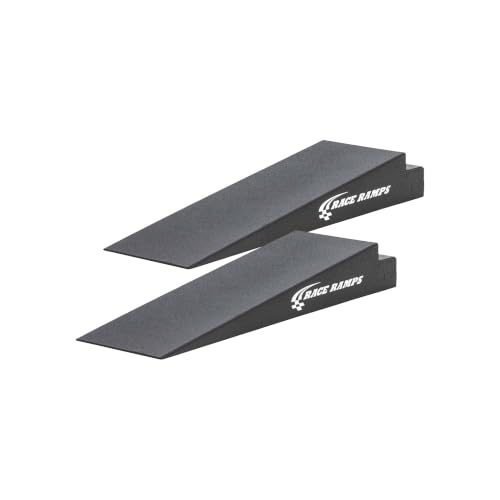
Race Ramps Extra-Wide Low-Profile Foam Loading
Race Ramps Extra-Wide Foam Trailer Loading Ramps deliver an 8-inch vertical rise and a wide 16-inch track built from lightweight solid-core foam. Featuring floor-safe, unscootable base technology, this pair is ideal for lowered sports car owners seeking smooth trailer loading and garage undercarriage clearance without bumper scrape.
Pros
- Extended 54.75-inch length and 8-inch rise create a gradual slope for low-clearance front splitters and air dams
- Extra-wide 16-inch driving surface easily accommodates wide performance and sports car tires
- Weighs only 15 pounds for superior portability compared to heavy welded steel or aluminum ramps
- Unscootable base technology helps prevent ramp slippage while protecting delicate epoxy and trailer floors
Cons
- Premium price point represents a higher initial investment than basic stamped steel or plastic ramps
- Rigid 54.75-inch single-piece footprint does not collapse or fold for storage
- Product data does not list explicit axle or Gross Vehicle Weight Rating (GVWR) figures, requiring buyers to verify load limits before heavy use
MaxxHaul 51200 Steel Ramp Top Kit
The MaxxHaul 51200 Steel Ramp Top Kit converts standard 2-inch by 12-inch lumber into sturdy loading ramps supporting up to 700 pounds per ramp. It is an affordable, customizable solution for DIYers loading lawn tractors, motorcycles, and ATVs onto truck beds.
Pros
- Budget-friendly alternative to bulky pre-fabricated aluminum loading ramp systems
- Supports up to 700 pounds per ramp when paired with standard 2-inch by 12-inch lumber
- Includes non-slip rubber protective pads to shield tailgate paint and metal from damage
- Comes with all necessary mounting hardware and safety pins for secure setup
- Customizable length allows users to tailor the approach slope for low-clearance equipment
Cons
- Requires the separate purchase of 2-inch by 12-inch wooden planks
- Rated capacity of 700 lbs per ramp makes it strictly unsuitable for passenger car drive-on service
- Overall rigidity and weight limits depend heavily on the quality and condition of the lumber used
Race Ramps 4-Inch Low-Profile Foam Trailer Loading
Engineered for low-clearance sports cars and lowered vehicles, this 4-inch-tall Race Ramps pair provides a gentle incline for trailer loading while protecting shop floors. Its lightweight solid-core foam build and unscootable textured base make it an ideal transition solution for track-day haulers and home garages alike.
Pros
- Substantially reduces approach angles for low-profile sports cars loading onto enclosed or open trailers
- Lightweight solid-core foam construction weighs roughly 9 pounds, making carrying and positioning effortless
- Non-marring surface formulation keeps delicate epoxy shop floors and trailer surfaces pristine
- Generous 14.2-inch width supports wide performance tires without a razor-thin margin for error
- Integrated unscootable traction technology helps limit slipping during drive-on vehicle ascent
Cons
- Four-inch lift height is designed specifically for trailer loading transitions rather than full undercarriage creeper access
- Manufacturer listing does not specify an exact numerical Gross Vehicle Weight Rating or per-axle load limit
- Solid 46-inch single-piece profile does not detach or nest into smaller modular segments for compact shelf storage
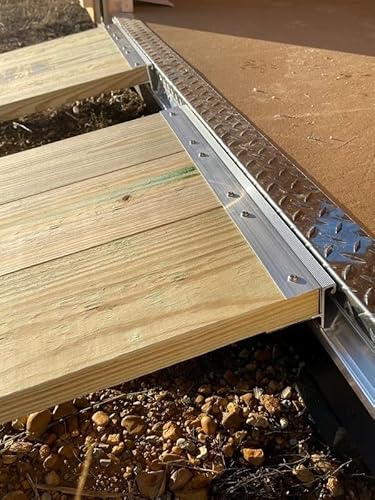
DIY 2-Section Ramp Kit with 72-Inch J-Channel
This DIY ramp hardware kit allows home mechanics and builders to assemble custom 22-inch wide drive-on ramps using standard 2x8 lumber, offering a 1,500-pound load limit per ramp. It is a practical solution for DIYers who need customizable 4-foot to 6-foot incline lengths for tailored equipment elevation.
Pros
- Broad 22-inch width per ramp provides substantial tire track room with minimal risk of edge overhang
- Customizable 4-foot to 6-foot length lets builders tailor the approach angle to prevent vehicle scraping
- 1,500-pound per-ramp capacity accommodates light vehicles, small trailers, and garden tractors
- Two-section configuration offers versatile placement across a standard 72-inch opening
Cons
- Requires sourcing six 2x8 wooden boards and fasteners separately to complete assembly
- Aluminum metal treadplate is not included and must be added separately if metal surface traction is needed
- Not intended for heavy commercial vehicles or three-quarter-ton pickups exceeding 1,500 pounds per ramp
44-Inch DIY Vehicle Ramp Kit with 48-Inch
This DIY ramp kit features a 48-inch J-channel system designed to build two extra-wide 22-inch ramp sections using user-supplied 2x8 lumber. Rated at 1,500 lbs per ramp with an adaptable 4-to-6-foot length, it offers a customizable elevation solution for home garages and utility setups.
Pros
- Generous 22-inch track width per ramp provides substantial margin for error during wheel alignment
- Configurable 4-to-6-foot incline length lets users tailor the slope angle to avoid scraping low bumpers
- Lightweight 5-pound hardware package is easy to handle, store, and transport before assembly
- 1,500-pound per-ramp capacity accommodates light vehicles, lawn tractors, and standard passenger wheel loads
- Straightforward assembly using widely available 2x8 lumber
Cons
- Requires purchasing six 2x8 lumber boards separately and does not include aluminum metal treadplates
- Rated at 1,500 lbs per ramp, making it unsuitable for heavy full-size pickups, commercial vans, or heavy SUVs
- Lacks integrated rubber anti-skid base feet and raised forward wheel stops found on dedicated molded ramps
Race Ramps 67-Inch XT 2-Piece Car Service Ramps
The Race Ramps 67-inch XT two-piece car service ramps provide a gentle 10.8-degree approach angle and a generous 10-inch lift height using solid high-density foam construction. They are ideal for lowered sports cars, performance coupes, and DIY mechanics who need easy undercarriage access without scraping front splitters or scuffing garage floors.
Pros
- Ultra-gentle 10.8-degree incline easily clears low-profile sports cars and aggressive front splitters
- Removable incline section provides unobstructed side creeper access directly behind the front wheel
- Solid high-density foam core will not scuff epoxy floors and weighs only around 17 pounds
- Generous 10-inch lift height gives ample room for oil changes and transmission maintenance
- Built-in raised forward stop helps prevent tire overrun when mounting the ramps
Cons
- Significant 67-inch overall length requires adequate longitudinal garage floor space during vehicle setup
- Weight rating of 1,500 pounds per ramp is not intended for heavy-duty three-quarter-ton pickups or large commercial vans
- Higher initial cost compared to entry-level stamped steel or hollow plastic service ramps
Hydraulic Car Ramps 5-Ton Steel Vehicle Lift Ramps
This welded steel hydraulic car ramp set combines a drive-on ramp with integrated hydraulic cylinders, lifting vehicles from 9.8 to 15 inches with an 11,065-pound capacity. It is a capable elevation setup for DIY mechanics seeking generous underbody clearance for oil changes and chassis work without wrestling separate floor jacks and stands.
Pros
- Dual built-in hydraulic jacks elevate vehicles up to 15 inches, delivering significantly more undercarriage working clearance than fixed ramps
- Heavy-gauge welded steel build rated for up to 11,065 pounds provides solid structural stability for trucks and SUVs
- Equipped with automatic mechanical locking safety pins to maintain elevated height without resting solely on hydraulic pressure
- Triangular limit baffles and anti-slip track treads inspire driver confidence during vehicle drive-up
Cons
- At 84.42 pounds for the set, these steel ramps are heavy and unwieldy to move or store compared to lightweight molded polymer ramps
- The 9.8-inch starting platform height may still present approach angle challenges for extremely low sports cars with aggressive front splitters
- Hydraulic mechanisms require periodic inspection for seal integrity and fluid levels unlike maintenance-free solid ramps
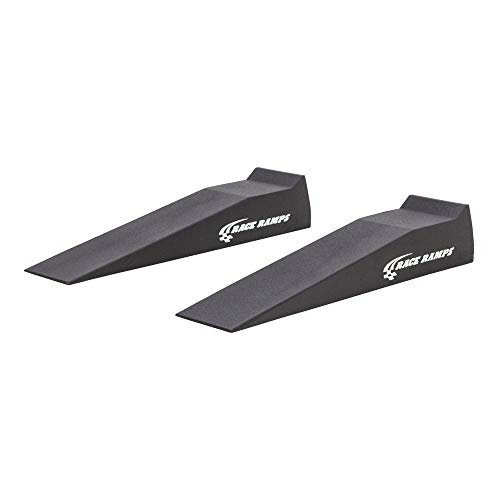
Race Ramps 56-Inch Foam Car Service Ramps
The Race Ramps 56-inch single-piece service ramps feature a gentle 10.75-degree incline and an 8-inch lift designed specifically for low-clearance sports cars and lowered vehicles. With a solid polyurea-coated foam build supporting 1,500 pounds per ramp and weighing only 10 pounds each, they are ideal for home mechanics seeking floor-safe, low-effort vehicle elevation.
Pros
- Gentle 10.75-degree incline angle helps clear low-profile front splitters and bumpers
- Ultralight design at approximately 10 pounds per ramp for effortless transport
- High-density polystyrene core with polyurea coating will not scratch or mark finished garage floors
- Generous 8-inch vertical lift provides open access for routine oil changes and maintenance
- Includes integrated carry straps for straightforward garage handling and storage
Cons
- Weight limit of 1,500 lbs per ramp is strictly intended for passenger cars and excludes heavy-duty trucks or large full-size SUVs
- Single-piece 56-inch solid design cannot be detached for side creeper access like two-piece modular models
- Substantial 56-inch length requires dedicated wall or floor storage space in compact home garages
Engineering Realities, Construction Methods, and Safety Boundaries for Homemade Car Ramps
Constructing automotive service ramps at home requires a clear understanding of vehicle mass, dynamic load transfer, and material failure points. Many home mechanics consider raw lumber or bracket kits to tailor their ramp slope to low splitters or save money on garage equipment. However, supporting several thousand pounds overhead leaves zero margin for improper fastening, low-grade wood, or uncalculated approach angles. Evaluating homemade builds alongside purpose-built composite and hydraulic service ramps reveals critical engineering factors that every garage mechanic must respect.
Structural Physics and Vehicle Weight Distribution on DIY Ramps
Every vehicle exerts significant static and dynamic downward force when ascending and resting on service ramps. Although a vehicle Gross Vehicle Weight Rating (GVWR) indicates total certified mass, the front axle typically bears 50% to 60% of that weight on front-engine vehicles. A 4,000-pound sedan concentrates roughly 2,000 to 2,400 pounds on the front axle, distributing 1,000 to 1,200 pounds directly onto each individual ramp. Calculating these loads requires a minimum 2x engineering safety factor to absorb dynamic bounce and acceleration forces as tires crest the ramp.
Lumber behaves anisotropically, meaning its structural strength depends entirely on the orientation of the wood grain relative to the applied load. Compressive strength along the grain is substantially higher than shear strength across the grain or resistance to splitting along radial growth rings. Internal knots, grain runout, moisture content, and hidden dry rot drastically reduce the load-bearing capacity of standard construction-grade lumber like spruce, pine, or fir. When an elevated tire concentrates high pressure on a small contact patch, internal wood flaws can trigger sudden structural cleavage without warning.
The Stacked Lumber Method: Layered Solid Planks Versus Hollow Frames
The only structural method widely recognized among hobbyists for homemade wood ramps is laminating solid dimensional lumber planks. Builders typically layer 2×10 or 2×12 planks directly on top of one another in stepped lengths, creating a solid timber pyramid that eliminates open cavities. Hollow ramps built from angled 2×4 framing, plywood skins, or mitered stringers introduce catastrophic buckling risks that can fold under drive-on lateral thrust. A solid wood stack relies entirely on direct compressive resistance, making it far sturdier than hollow assemblies.
Fastener selection makes a substantial difference in whether stacked planks act as a cohesive structural unit or separate under vehicle torque. Standard drywall screws or thin deck screws possess low shear strength and will snap cleanly when drive tires push rearward against individual plank steps. Professional timber builds require structural construction screws, heavy timber lag bolts, or counter-sunk threaded rod paired with polyurethane wood construction adhesive between each layer. Saturating mating surfaces with waterproof structural glue prevents horizontal plank slippage, while recessed screws ensure metal heads never puncture tire treads during ascent.
Dimensional lumber also carries practical weight penalties that affect daily garage usability and handling. A pair of solid five-tier ramps built from pressure-treated 2×10 planks can easily exceed 80 pounds, making them cumbersome to lift, position, and store. Moisture absorption over time further increases their heft while accelerating internal wood decay if stored on damp concrete slabs. While stacked lumber offers solid compressive support when properly constructed, the physical bulk and long-term storage demands often surprise builders expecting a lightweight garage tool.
Hardware Bracket Kits and Modular Lumber Systems
Commercial ramp top hardware offers a hybrid compromise between raw lumber carpentry and pre-engineered metal fittings. Products like the MaxxHaul 51200 Steel Ramp Top Kit provide formed steel lip plates that bolt directly onto standard 2×12 wooden planks. The manufacturer rates these steel tops for up to 700 pounds per ramp, including protective pads to prevent surface scratching and bolts to secure the assembly. However, a 700-pound individual rating limits these setups primarily to lawn equipment, ATVs, and lightweight utility haulers rather than full-size passenger automobiles.
Other modular hardware solutions, such as the 44″ DIY Ramp Kit – Build Your Own Ramp Kit and its counterpart the 44″ DIY Ramp Kit – Build Your Own Ramp Kit, utilize metal J-channel tracks designed for 2×8 boards. These kits specify a 1,500-pound weight limit per ramp when built with recommended four to six foot spans, requiring six 2×8 boards across their two-section design. While these steel channels bundle multiple boards into a wide 22-inch platform, users must supply their own metal treadplate for full center coverage. Relying on wooden spans without center supports requires strict adherence to length limits to avoid excessive deflection under wheel load.
Selecting lumber for ramp top hardware demands strict visual inspection of lumber quality before cutting and assembly. DIY builders should choose dense, straight boards free from large knots, edge splits, or cupping that could warp under localized tire contact. Applying exterior-grade wood sealer protects structural fibers against oil saturation, brake fluid spills, and humidity changes that degrade timber strength over seasonal cycles. Ensuring that all included through-bolts and locking safety pins are torqued down snugly prevents dangerous movement when rolling equipment onto the raised platform.
Approach Angle Trigonometry and Preventing Front Splitter Scraping
Vehicle ground clearance and front bodywork overhang dictate whether a car can ascend an incline without scraping its front fascia. The geometric vehicle approach angle is calculated using the formula: Approach Angle = arctan(Front Ground Clearance / Front Overhang Distance). If the ramp slope exceeds this angle, the lowest edge of the front bumper, air dam, or splitter will scrape against the ramp incline before tire treads make contact. Low-profile passenger cars and sports vehicles frequently possess approach angles under 10 degrees, creating severe clearance headaches on steep ramp transitions.
Homemade stepped lumber ramps inherently present a series of sharp 1.5-inch vertical risers corresponding to standard two-inch board thickness. When a low-clearance bumper approaches the first or second step, these blunt wooden edges can catch on delicate undertrays, flexible valences, or aerodynamic splitters. Tapering the leading edges of heavy lumber with a circular saw or hand planer helps soften the incline, but achieving a uniform low-angle taper across wide boards requires advanced woodworking tools. Uneven cuts between paired ramps can cause one tire to climb ahead of the other, twisting the chassis and complicating alignment.
Engineered commercial alternatives resolve clearance hurdles through carefully modeled approach inclines and gradual transition profiles. For instance, the Race Ramps 2-Piece 67″ XT Car Service Ramp features a gentle 10.8-degree approach angle designed specifically for low-profile vehicles while lifting tires 10 inches off the floor. Similarly, the Race Ramps Single-Piece Foam Car Service Ramps provide a 10.75-degree incline that clears low bumper bodywork smoothly. In extreme low-clearance trailering scenarios, products like the Race Ramps Foam Trailer Loading Ramps and the Race Ramps Extra-Wide Foam Trailer Loading Ramps provide four to eight inch elevation aids that eliminate low-splitter contact entirely.
Garage Floor Friction, Traction Dynamics, and Ramp Kick-Out
Ramp slippage during vehicle ascent represents one of the most hazardous failure modes encountered in home garages. When the drive wheels of a front-wheel-drive car or the pushed front tires of a rear-wheel-drive car meet a ramp incline, rotational torque exerts horizontal backward thrust. On slick polyaspartic coatings, painted epoxy floors, or smooth troweled concrete, dry lumber exhibits a low coefficient of static friction. Without aggressive mechanical anchoring or high-tack rubber backing, wooden ramps can easily kick out backward, slamming the vehicle chassis directly onto the concrete floor.
Countering ramp skidding on homemade builds requires installing dedicated traction materials along the bottom contact surface. Mechanics often screw dense textured rubber matting, horse-stall rubber strips, or non-slip conveyor belting directly into the base of the lowest wooden plank. Another mechanical solution involves extending a thin plywood tongue or heavy rubber lead-in flap out in front of the ramp bottom. As the vehicle rolls forward, its own tire weight pins down the lead-in strip before the tire climbs the incline, physically anchoring the ramp against kick-out forces.
Engineered service ramps incorporate specialized polymer coatings and non-skid technology to prevent slippage across slick residential garage surfaces. Solid high-density foam ramps utilize proprietary polyurea coatings that grip smooth concrete slabs firmly without scratching or marring high-end epoxy finishes. The textured base creates consistent surface contact across the entire footprint, eliminating localized sliding points common to rigid wooden planks. Reviewing standard safe drive-on ramp protocols emphasizes that regardless of ramp material, floor surfaces must be swept clean of loose dirt, grit, and oil before positioning any lifting equipment.
Critical Drive-Over Prevention and Wheel Stop Fabrication
Accidentally driving over the forward crest of a ramp poses severe risks to vehicle bodywork, suspension links, and personal safety. When a front tire crests a flat wooden platform, dropping over the front edge can instantly high-center the car on its rocker panels or puncture the oil pan. Unlike commercial units with molded wheel pockets and raised lips, flat-top timber stacks provide minimal tactile feedback to the driver. Without a definitive mechanical barrier, feathering the throttle up the incline can easily cause the tire to roll past the safe resting zone.
Constructing an effective wheel stop on a DIY wooden ramp requires bolting a robust vertical block securely to the top platform. A solid hardwood or dimensional 4×4 block fastened with through-bolts creates a raised safety lip that alerts the driver when tires reach full elevation. In addition, carving a shallow concave cradle into the upper plank allows the tire contact patch to settle naturally into a centered resting position. Builders must ensure that wheel stop blocks are tall enough to arrest wheel momentum without being so high that they strike low bumper valences during ascent.
Commercial service ramps integrate raised forward lips and contoured cradles into their core architecture to deliver positive stop feedback. The raised end stop on foam service ramps acts as a reliable tire stop, signaling the driver through the brake pedal and steering wheel when the crest is reached. Welded steel hybrid ramps take safety containment further by incorporating triangular limit baffles and deep tire channels that physically trap the wheel footprint. These engineered contours eliminate the guesswork of throttle modulation, ensuring the vehicle rests securely in the intended center of gravity.
Commercial Service Ramps Versus Homemade Wood Assemblies
Evaluating whether to build homemade ramps or invest in commercial equipment requires weighing material lifespan, workspace accessibility, and total weight capacity. Commercial options span diverse architectures, from high-density solid foam to heavy-duty welded steel platforms. For heavy vehicle servicing, the 2 Pcs Hydraulic Car Ramp integrates dual 5-ton hydraulic jacks directly into fully welded steel ramps, supporting up to 11,065 pounds with an adjustable lift range from 9.8 to 15 inches. This steel system incorporates automatic locking pins and non-slip treads that far exceed the vertical clearance of standard lumber.
Underbody service accessibility represents another major advantage of modern modular ramps over monolithic wooden stacks. Solid timber ramps create tall, unbroken wooden walls along both sides of the front tires, obstructing lateral access for mechanics working on garage creepers. By contrast, two-piece modular foam ramps allow the lower incline ramp to detach completely once the vehicle is elevated, leaving the tire safely supported on a standalone riser. Removing the incline section opens up generous side clearance, making it effortless to slide underbody drain pans, reach exhaust heat shields, and unbolt transmission crossmembers.
Material durability and environmental resistance also separate commercial polymers from organic timber builds over extended ownership. High-density expanded foam coated with polyurea resists automotive fluids, engine oil, brake fluid, road salt, and moisture without rotting, warping, or cracking. Homemade wood ramps stored in humid garages or damp basements gradually degrade, developing hidden fastener corrosion and internal rot that compromise structural load limits. When comparing car ramps and floor jacks or weighing DIY wood versus factory-tested platforms, factory-engineered load ratings offer peace of mind that unverified carpentry cannot replicate.
Mandatory Underbody Redundancy Protocols Before Crawling Underneath
Regardless of whether a vehicle rests on handcrafted lumber stacks or factory-certified composite ramps, redundant safety equipment is strictly non-negotiable. Elevating a vehicle shifts its balance, meaning that relying solely on drive-on platforms creates unacceptable single-point failure hazards during underbody maintenance. Before crawling under the chassis to drain oil or inspect suspension links, mechanics must establish multiple mechanical backups on level concrete. Following layered safety procedures prevents accidental vehicle rollout, platform slippage, or structural settling from causing severe injury.
Securing the elevated vehicle begins the moment the tires settle into the center of the upper ramp platform. The driver must immediately shut down the engine, firmly engage the emergency parking brake, and place automatic transmissions in Park or manual gearboxes in first gear or reverse. Solid rubber wheel chocks must be wedged tightly behind both grounded rear tires on the shop floor to prevent roll-back. Positioning chocks on clean, textured concrete ensures that any dynamic rocking motion while unbolting stubborn suspension hardware cannot overcome vehicle resting inertia.
The final and most critical safety layer requires positioning secondary backup jack stands directly beneath structural chassis frame rails or reinforced factory pinch welds. These jack stands should be adjusted to rest just millimeters beneath the solid steel frame, ready to catch vehicle mass instantly if a ramp suffers sudden structural yield. Mechanical locking safety pins on hydraulic ramps, such as those on welded steel ramp combos, must be pinned firmly through structural uprights to relieve hydraulic cylinder pressure. Establishing these redundant supports ensures that home mechanics perform their garage maintenance under complete physical security.
Building homemade car ramps can satisfy specific dimensional needs for light machinery when constructed with solid layered timber, heavy-duty hardware kits, and high-shear fasteners. However, the substantial physical weight, vulnerability to internal wood flaws, and lack of certified axle load testing make raw lumber a serious liability for regular passenger car maintenance. For most home mechanics, purpose-built structural foam or welded steel service ramps deliver lighter handling, proven load ratings, and built-in anti-skid safety that homemade timber cannot match. Maintaining rigorous safety redundancy with wheel chocks and backup jack stands guarantees that every underbody service task remains safe, predictable, and secure.
About the author
Mike Bumbeck is an automotive journalist and hands-on product evaluator with a long-standing interest in classic vehicles, motorcycles, and practical garage equipment. His work brings a grounded perspective to automotive tools, maintenance products, and the details that matter when choosing gear for real-world use.