
How Deep Concrete for Car Lift: Practical Answers for 2026
Learn how deep concrete for car lift installations must be in November 2026, covering slab thickness, PSI ratings, and anchor embedment.
 By Emily Markham
Updated October 10, 2026


Installing a vehicle hoist in a residential garage or workshop requires absolute confidence in your floor before drilling the first anchor hole. Knowing exactly how deep concrete for car lift installations require is the primary structural hurdle every homeowner and mechanic faces before bolting down heavy equipment. While portable scissor units rest across broad ground contact points, heavy two-post and four-post lifts concentrate massive tensile and compressive stresses into small baseplate footprints. Setting up a reliable home residential car lift demands strict verification of your slab thickness and structural integrity.
Standard residential garage slabs often measure four inches thick on paper, but actual poured depths can taper unpredictably across the bay floor. Pouring or verifying an adequate foundation prevents dangerous anchor pullout under full vehicle gross weight ratings. Most standard surface-mounted hoists operating hydraulic car lift systems demand a minimum of four inches of solid, reinforced slab cured to a minimum compressive rating of 3,000 PSI. Understanding how your specific hoist style interacts with your concrete ensures that your lifting operations remain stable and completely secure.
| Award | Product | BJL Score About BJL ScoreThe BJL Score is our own rating from 0 to 10, based on performance, design and build, ease of use, and value. It reflects independent research and is never influenced by manufacturers, retailers, or affiliate commissions. Learn more › | |
|---|---|---|---|
| Best Overall |
Rueekfil 7000 LBS Portable Car Lift
|
9.2/10 | Buy |
| Best Value |
 KATOOL 10,000 Lbs 2-Post Floor Plate Car Lift |
9.2/10 | Buy |
| Best Premium |
 WEIZE 11,000 lb Two-Post Car Lift with 220V 3HP |
9.1/10 | Buy |
 MutsMover 11,000 LBS 4-Post Car Lift |
9.1/10 | Buy | |
| Best Budget |
 Real Relax 7000 LBS Portable Car Lift with 11-Inch |
8.9/10 | Buy |
 Albott 7000 LBS Portable Scissor Car Lift |
8.6/10 | Buy | |
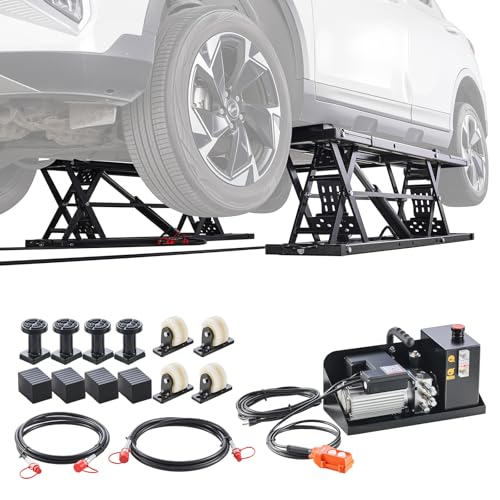 VEVOR Portable Scissor Car Lift |
8.1/10 | Buy | |
 Motool Technology 15,000 lb Heavy-Duty 2-Post |
8.0/10 | Buy |
Rueekfil 7000 LBS Portable Car Lift
The Rueekfil 7000 LBS Portable Car Lift is a heavy-duty, frame-engaging hydraulic vehicle lift designed for home garage DIYers and mobile mechanics seeking up to 28 inches of working clearance without drilling into concrete. Built from Q235B carbon steel with positive mechanical safety locks and wall-mount storage handles, it provides a stable platform for servicing unibody sedans, SUVs, and light trucks.
Pros
- Substantial 7,000-pound lifting capacity easily handles heavier passenger cars, midsize trucks, and modern electric vehicles
- Unanchored portable frame design operates without requiring permanent anchor bolts or structural slab modifications
- Mechanical safety locks provide rigid structural engagement at working height before undercarriage service begins
- Comes packaged with 11-inch extension plates, adjustable height columns, and rubber lift pads for versatile chassis contact
- Built-in nylon rolling wheels and wall-mount handles simplify workshop repositioning and vertical off-the-floor storage
Cons
- Total crated package weight of 418 pounds requires a helper or mechanical assistance during freight delivery and unboxing
- Safety locks require manual physical disengagement on both independent lift frames before lowering the vehicle
- Maximum 26.8 to 28-inch lift height requires creeper access rather than providing full upright standing headroom
KATOOL 10,000 Lbs 2-Post Floor Plate Car Lift
The KATOOL 10,000-lb Two-Post Floor-Plate Lift provides heavy vehicle hoisting with a 110.25-inch column clearance suited for low-ceiling home garages and service bays. Operating on a 220V hydraulic power unit with dual chain-drive cylinders and symmetric arms, it delivers up to 70.75 inches of rise height for full-size pickups, SUVs, and cars.
Pros
- Substantial 10,000-lb capacity handles heavy half-ton and one-ton pickups, commercial SUVs, and daily drivers with ease
- Floor-plate design with an overall height of 110.25 inches accommodates garages with low 9.5-to-10-foot ceilings
- Provides up to 70.75 inches of rise height, creating comfortable standing working room underneath elevated vehicles
- Dual chain-drive hydraulic cylinders deliver steady, synchronized ascent without top-beam cable routing
Cons
- Floor-plate threshold creates a raised steel drive-over crossbar that rolling tool carts and ultra-low vehicles must negotiate
- Requires a dedicated 220V single-phase electrical hookup and separate sourcing of hydraulic fluid prior to operation
- Heavy 1,250-pound freight shipment requires an on-site forklift or flatbed wrecker for delivery, or arrangements for local terminal pickup
WEIZE 11,000 lb Two-Post Car Lift with 220V 3HP
The WEIZE 11,000-lb two-post automotive lift combines a high-output 220V 3HP hydraulic power unit with an open-floor layout for home garage mechanics and light commercial service bays. Requiring a dedicated 220V circuit, structural concrete slab, and dual-point lock disengagement, it offers substantial lifting capacity for sedans, SUVs, and work trucks.
Pros
- High 11,000-lb capacity easily handles heavier half-ton and three-quarter-ton trucks
- Wide 110.23-inch drive-through clearance makes vehicle positioning simple and stress-free
- Rugged 220V 3 HP hydraulic motor delivers dependable lifting muscle
- Clear-floor layout leaves garage floor completely open for transmission jacks and fluid drains
Cons
- Dual-point safety release requires walking to both columns to disengage locks before lowering
- Requires a dedicated 220V single-phase electrical hookup and an appropriate concrete foundation
- Heavy 1,426-lb shipping package requires a forklift, trailer ramp, or helpers for freight delivery offloading
MutsMover 11,000 LBS 4-Post Car Lift
The MutsMover 11,000 LBS 4-Post Car Lift provides an impressive 84.25-inch maximum rise height powered by a standard 110V 3.0HP hydraulic system, making it an ideal vehicle stacking solution for residential garages with high ceilings. Built from Q345 powder-coated steel with a single-point manual lock release, two drip trays, and a jack tray, it suits truck, SUV, and classic car owners looking to maximize vertical storage.
Pros
- High 11,000-lb capacity handles full-size trucks, SUVs, and passenger vehicles with ease.
- Convenient 110V 3.0HP motor avoids the need for dedicated 220V electrical installation in residential garages.
- Tall 84.25-inch maximum rise provides ample headroom for under-vehicle access and stacking taller lower vehicles.
- Single-point manual lock release eliminates running around to each column to trip individual latches.
- Ships with practical accessories including two drip trays and a sliding jack tray.
Cons
- Substantial 2,117-lb shipping crate measuring over 16 feet long mandates on-site forklift unloading, a tractor, or terminal pickup.
- Ceiling height requirement is demanding, as utilizing the full 84-inch lift height with a vehicle on top demands substantial vertical overhead clearance.
- Hydraulic fluid is not included in the package and must be purchased separately prior to initial bleeding and operation.
Real Relax 7000 LBS Portable Car Lift with 11-Inch
The Real Relax 7000 LBS Portable Car Lift delivers dependable, unanchored vehicle lifting for home mechanics working under standard residential ceilings. Rated for up to 7,000 lbs with heavy-duty Q235B steel construction, mechanical safety locks, and integrated transport wheels, it is an ideal maintenance solution for DIYers servicing sedans, light trucks, and SUVs without drilling into concrete.
Pros
- Substantial 7,000-lb rated lifting capacity accommodates both passenger cars and light-duty trucks
- Unanchored, portable utility eliminates the need for concrete anchor bolts or permanent bay modification
- Included 11-inch extension plates expand the support footprint for extended-wheelbase models
- Integrated nylon wheels and dual storage handles facilitate mobility and wall-mounted stowage
Cons
- Requires a minimum vehicle load of approximately 220 lbs to lower the hydraulic cylinders
- Overall unit weight of roughly 425 lbs requires physical effort when maneuvering or hanging on walls
- Hydraulic fluid (No. 46 hydraulic oil) is not pre-filled and must be sourced separately before use
Albott 7000 LBS Portable Scissor Car Lift
The Albott 7000 LBS Portable Car Lift delivers reliable frame-engaging lifting power with a 28-inch maximum rise height, making it an excellent unanchored solution for low-ceiling residential garages. Built from high-strength Q235B steel, it suits DIY mechanics and car enthusiasts tackling brake jobs, tire rotations, and chassis maintenance on level concrete.
Pros
- Substantial 7,000-lb capacity easily handles most domestic sedans, sports cars, and midsize SUVs
- Mobile four-wheel design eliminates permanent concrete drilling and fits well under standard 8-to-10-foot residential ceilings
- Includes extension panels and multi-height adapter blocks to reach factory frame contact points across different wheelbases
- Multiple mechanical locking positions allow safe, stable under-vehicle working heights off hydraulic pressure
Cons
- Maximum 28-inch rise height does not provide full standing headroom underneath the vehicle
- Weighs 401 pounds, which requires moderate physical effort to reposition or wheel across uneven garage thresholds
- Requires a minimum load of approximately 220 pounds on the frames to compress the return springs and initiate descent
VEVOR Portable Scissor Car Lift
The VEVOR 9,000 lb portable electric-hydraulic vehicle lift delivers up to 28 inches of working height on a standard 120V residential circuit without requiring permanent floor anchoring. It is an ideal mid-rise lifting solution for home garage DIYers, truck and SUV owners, and shops with standard 8-to-10-foot ceilings.
Pros
- Substantial 9,000 lb rating safely handles heavier modern trucks, crossovers, and electric vehicles
- Plugs into standard 120V household outlets for straightforward residential garage installation
- Reaches up to 28 inches of working height, ideal for low 8-to-10-foot residential garage ceilings
- Includes four non-slip rubber pads and four taller frame-contact extension columns in the box
Cons
- Total crated package weight of over 450 lbs requires multiple sets of hands or equipment to unload
- Requires sourcing ISO 46 hydraulic oil separately and bleeding the system before initial operation
- The 6.1-inch collapsed profile may require drive-on helper boards for aggressively lowered sports cars
Motool Technology 15,000 lb Heavy-Duty 2-Post
The Motool Technology 15,000-pound two-post clear-floor lift provides heavy-duty capacity and an unobstructed bay floor for servicing commercial trucks and fleet vehicles. Featuring a 176.8-inch overall height, single-point safety lock release, and 116-inch drive-through clearance, it is tailored for commercial bays, fleet garages, and tall pole barns equipped for tractor or forklift delivery offloading.
Pros
- Massive 15,000-pound rated lifting capacity handles heavy commercial trucks and fleet work vehicles
- Clear-floor design eliminates floor-plate obstacles for easy transmission jack and tool cart mobility
- Single-point safety lock release simplifies lowering operations without manual walking between columns
- Wide 116-inch passing width easily accommodates broad utility trucks and dually axle profiles
Cons
- Requires significant overhead clearance to accommodate the 176.8-inch (14.7-foot) column structure
- Demands dedicated heavy machinery such as a forklift or tractor for on-site freight delivery offloading
- Demands an engineered high-strength concrete foundation well beyond standard light residential garage slabs
Concrete Depth and Foundation Requirements for Car Lifts
Determining proper foundation depth is the most critical safety calculation you will perform before installing automotive shop equipment in your garage. Standard passenger car hoists rated up to ten thousand pounds generally mandate a minimum concrete thickness of four inches, while heavy commercial units require six inches or more of reinforced concrete. Pouring or bolting onto a slab that lacks sufficient depth risks structural breakout, loose anchor bolts, or catastrophic column failure under full load. Testing the true depth and condition of your floor ensures that your equipment functions reliably throughout years of heavy service.
Minimum Slab Thickness Requirements by Lift Architecture
Different lift designs transfer vehicle weight into the ground through completely different mechanical principles. Surface-mounted two-post lifts generate enormous tensile leverage against anchor bolts, pulling upward on the column baseplates whenever a vehicle is raised. Because of this mechanical leverage, entry and mid-tier models like the KATOOL 10000lbs 2 Post Lift Car Lift Auto Vehicle require a concrete slab at least four inches thick. Stepping up to severe-duty commercial equipment, such as the Motool Technology 15000lbs Heavy Duty 2 Post Lift, increases required slab thickness to a minimum of six inches to handle extreme bending moments. Thicker slabs provide the necessary deadweight and shear resistance to prevent the concrete matrix from pulling upward around the expanding anchor collars.
Four-post parking and service racks distribute weight across four separate vertical posts, changing how forces enter the floor. A four-post hoist like the MutsMover 11,000 LBS 4-Post Car Lift applies predominantly compressive, downward pressure rather than continuous outward prying forces. A four-inch slab with standard compressive ratings easily manages these compressive loads, whether the lift is permanently anchored or resting free on a flat floor. Matching your concrete depth to the specific lifting mechanism prevents premature slab cracking and costly structural repairs.
Concrete Compressive Strength and 28-Day Curing Standards
Thickness alone does not guarantee that concrete will withstand the stresses generated by heavy vehicle hoists. Automotive lift manufacturers consistently specify that concrete must provide a compressive strength of at least 3,000 pounds per square inch (PSI). Standard residential driveways and shed floors are occasionally poured with weaker 2,500 PSI mixes that crumble easily under localized anchor tension. High-strength concrete mixes utilize graded aggregates and proper water ratios that lock mechanical wedge anchors firmly in place.
Cure age plays an equally vital role in determining whether a concrete slab can support mechanical anchors. Freshly poured concrete requires a mandatory minimum of 28 days of curing time before any drilling or anchoring can take place. Green concrete retains excess moisture and has not achieved its full structural compressive strength, which can cause wedge anchors to slip or crack the surrounding matrix under torque. Allowing the slab to achieve full chemical hydration ensures that the anchor threads and expansion collars bite securely into cured rock.
Two-Post Lift Mechanics: Tensile Leverage and Anchor Embedment
Two-post frame-engaging lifts present the most demanding concrete anchoring challenge in the automotive maintenance industry. When a vehicle rests on swing arms, the columns act as giant levers attempting to tip toward the vehicle center of gravity. This pulling action creates severe upward tension on the rear anchor bolts while forcing the front edge of the baseplate downward into the floor. A balanced clear-floor hoist like the WEIZE 11000lbs Two Post Car Lift relies entirely on the mechanical grip of these embedded anchors to prevent catastrophic column detachment. Insufficient concrete depth allows these tensile forces to crack the slab from the bottom upward, leading to sudden anchor loosening.
Wedge anchors specified for two-post columns generally measure three-quarters of an inch in diameter and require precise embedment depths. In a standard four-inch slab, anchors typically embed between three and one-quarter to three and one-half inches, leaving minimal clearance above the underlying subbase. If concrete depth drops below four inches, drilling through the bottom of the slab ruins anchor holding capacity and exposes the fastener to subsurface ground moisture. Maintaining correct embedment depth guarantees that the expanding collar engages solid concrete with sufficient resistance to upward pullout forces. Always follow specified torque values using a calibrated torque wrench to ensure proper collar expansion without stripping the concrete hole.
Four-Post Hoist Foundation Demands and Free-Standing Operation
Four-post storage lifts offer unique foundation flexibility because each post shares a quarter of the total structural load. When exploring broader heavy duty car lift setups for vehicle parking, compressive strength remains the dominant engineering requirement. Columns on these units direct the combined weight of the steel runways and vehicle downward against wide footprint plates. Because the frame forms a self-supporting rectangle, outward tilting forces remain minimal during standard vehicle storage cycles.
Many residential vehicle collectors choose to operate four-post lifts without anchoring them to the concrete floor at all. Units like the MutsMover 11,000 LBS 4-Post Car Lift frequently accept mobile caster kits, allowing owners to roll the entire unloaded structure around the workshop. However, unanchored lifts can slowly walk or shift across slick, sealed concrete floors as vehicles drive on and off the approach ramps. Anchoring at least two columns into a four-inch slab prevents unwanted movement and maintains straight runway alignment over decades of seasonal storage.
Portable and Scissor Lifts: Ground Support Without Anchor Drilling
Portable low-rise and mid-rise vehicle lifts eliminate the need for drilled wedge anchors entirely, making them popular for rented shops and standard home bays. Devices like the Rueekfil Heavy-Duty Portable Car Lift 7000 LBS and the Albott 7000 LBS Portable Car Lift with Extension utilize broad steel ground contact frames. Because these units rest directly on the surface, they disperse vehicle mass over several square feet of concrete. This distributed load profile allows them to operate reliably on standard residential floors without modifying the existing slab.
Even though portable models like the 7000 LBS Portable Car Lift with Extension Plates do not require deep anchor holes, floor condition remains paramount. These scissor frames demand a solid, flat concrete surface capable of supporting heavy rolling wheels and lifting columns without flexing. Manufacturers strictly warn that operating a portable scissor frame on slopes exceeding four degrees introduces dangerous tipping hazards. Heavy portable models like the VEVOR Portable Car Lift, 9000 lbs Capacity require an uncracked, level concrete foundation to ensure that internal mechanical locks engage synchronously on both sides. Inspecting your floor for cracks, spalling, or expansion joint gaps prevents uneven loading across the scissor linkages.
Anchor Edge Distances, Expansion Joints, and Saw Cut Setbacks
Positioning column baseplates relative to expansion joints and edges is just as critical as overall slab depth. When expanding wedge anchors exert lateral outward pressure inside drill holes, nearby edges can easily shear off under load. Automotive lift engineering standards mandate that anchor holes remain at least six inches away from any slab edge, expansion joint, or relief cut. Placing a column too close to a control joint invites concrete blowout, destroying the structural anchor point instantly.
Garage floor perimeters where the slab meets foundation stem walls or driveway thresholds frequently present hidden thickness taper. Contractors often bevel or thin the edges of garage slabs, leaving only two or three inches of concrete near exterior openings. Measuring clearances carefully before snapping column layout chalk lines keeps all fasteners within the thick, continuous core of the floor. Respecting these spatial boundaries prevents localized concrete fractures when columns experience full dynamic vehicle loading.
How to Test Existing Garage Slab Depth and Soundness
Assuming your garage floor is four inches thick based on visual inspection or builder estimates is a dangerous mistake. Construction crews regularly pour uneven subgrades, resulting in floor sections that vary between three and five inches within the same bay. The most reliable way to verify actual concrete thickness involves drilling a small test hole using a rotary hammer and masonry drill bit. After breaking through the bottom of the slab, inserting a bent piece of wire allows you to hook the underside and accurately measure true depth.
Homeowners evaluating various auto car lift options must also determine whether their slab contains post-tension reinforcement cables. Post-tension slabs feature high-tensile steel cables stretched under extreme mechanical pressure inside the concrete pour. Drilling into an active post-tension tendon can cause catastrophic structural failure and severe bodily injury. If your garage slab contains stamped warnings or exterior anchor pocket plugs, hiring a professional ground-penetrating radar scanning service is mandatory before striking the concrete.
Remediation Solutions for Thin or Damaged Concrete Floors
Discovering that your garage floor measures under four inches thick does not mean you must abandon plans for a two-post lift. Garage owners facing thin or deteriorated concrete frequently cut out dedicated sections of floor beneath each planned column position. Excavating two distinct four-foot by four-foot pads down to a depth of twelve inches creates robust independent footers. Pouring these footers with high-strength concrete and rebar grids provides more structural capacity than a standard four-inch residential slab.
Heavy-duty commercial lifts like the Motool Technology 15000lbs Heavy Duty 2 Post Lift often require specialized foundation footers even in newer buildings. When commercial trucks and fleet vans approach maximum lifting limits, standard slab sections simply lack the mass to resist dynamic cantilever stresses. Pouring reinforced concrete pads tied into the existing floor with steel dowels establishes an unyielding anchor base. This remediation work requires proper curing time, but it guarantees absolute safety under the heaviest allowable vehicle ratings.
Floor Levelness, Shimming Limits, and Equalization Balancing
Residential garage floors are intentionally poured with a slight downward slope toward overhead doors to drain melted snow and water. Lift columns must stand completely plumb, requiring installers to compensate for floor slope using horseshoe-shaped steel shims under baseplates. Manufacturers typically limit shim stack height to one-half inch total to prevent bending stresses on anchor bolt shanks. If a bay floor slopes excessively, pouring a leveled concrete pad or using specialized baseplate grout becomes necessary to maintain vertical column alignment.
Proper column plumbness directly affects how smoothly lifting carriages travel along their internal vertical tracks. Out-of-plumb columns cause carriages to bind, accelerate slider block wear, and cause unequal tension on dual steel equalization cables. Balancing cable tension ensures that both lifting arms rise at identical speeds, engaging mechanical ladder locks simultaneously on both sides. Verifying floor levelness and plumbing your posts accurately during anchor installation prevents persistent mechanical binding and premature component fatigue.
Verifying that your garage floor provides at least four inches of solid, 3,000 PSI concrete gives you a dependable structural foundation for safe automotive maintenance. Whether you choose a permanent two-post service lift, a free-standing four-post storage rack, or a portable scissor frame, foundation soundness remains the cornerstone of workshop safety. Taking time to test drill your floor, scan for hidden post-tension cables, and measure anchor edge clearances guarantees that your equipment operates flawlessly for decades to come. Following these concrete guidelines protects both your vehicle and your workspace during every lifting cycle.
About the author
Emily Markham is an automotive aftermarket editor who has covered professional tools, workshop equipment, and the businesses that support vehicle repair since 2019. Her editorial background gives her a practical understanding of how technicians and shop owners evaluate equipment, product value, and long-term support.