
How Big Is a Car Lift: Garage Clearance and Dimensions Guide for 2026
Plan your garage layout by checking how big is a car lift dimensions, ceiling clearance formulas, and slab requirements for your workshop in October 2026.
 By Peter Nelson
Updated October 10, 2026
By Peter Nelson
Updated October 10, 2026

Garage bay measurements dictate equipment choices long before any equipment arrives at your driveway. Determining how big is a car lift requires evaluating overhead ceiling height, exterior column width, and overall bay depth to avoid costly structural interference. Standard residential two-car garages often feature ceiling clearances between eight and ten feet, which heavily influences whether a full-height two-post hoist or a low-profile portable frame lift fits your workshop. Exploring dedicated residential car lift options allows homeowners to match exact bay dimensions with appropriate lifting equipment without sacrificing walking space.
Vertical clearance calculations must account for the vehicle roof height, total lift rise, and required safety lock travel margins. Frame-engaging two-post units and drive-on four-post platforms have vastly different structural footprints that alter how vehicles enter and exit the bay. Modern hydraulic car lifts range from compact portable scissor frames measuring seventy-five inches long to massive four-post storage racks standing over seven feet tall. Understanding these physical dimensions protects your ceiling drywall, door tracks, and structural concrete from unforeseen placement errors.
| Award | Product | BJL Score About BJL ScoreThe BJL Score is our own rating from 0 to 10, based on performance, design and build, ease of use, and value. It reflects independent research and is never influenced by manufacturers, retailers, or affiliate commissions. Learn more › | |
|---|---|---|---|
| Best Overall |
WEIZE 11000lbs Two Post Car Lift
|
9.1/10 | Buy |
| Best Premium |
 MutsMover 11,000 LBS 4-Post Car Lift
|
9.1/10 | Buy |
| Best Budget |
 Albott 7000 LBS Portable Car Lift with Extension
|
8.6/10 | Buy |
 Albott 7000 lb Portable Car Lift with Extension
|
8.1/10 | Buy | |
| Best Value |
 Albott 8000 LBS Portable Car Lift Quick Jack
|
8.1/10 | Buy |
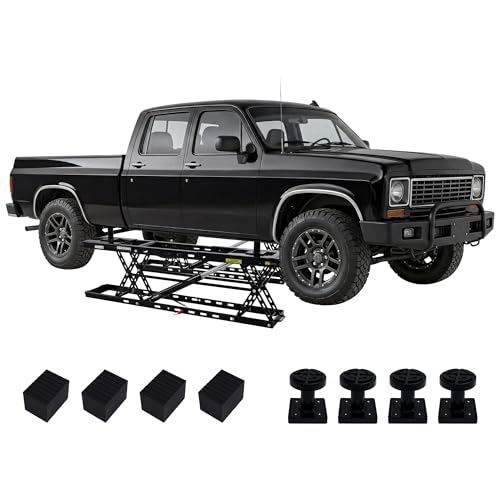 Albott 8000 LBS Portable Car Lift for Home Garage
|
7.8/10 | Buy |
Understanding Car Lift Dimensions and Garage Clearance Requirements
Determining how big is a car lift depends entirely on the design architecture of the lift and the physical layout of your garage bay. Vehicle lifts vary dramatically in scale, ranging from low-profile portable frames that collapse to three inches in height to towering commercial clear-floor hoists standing nearly twelve feet tall. Knowing these physical measurements before selecting equipment ensures your vehicle clears overhead ceiling joists while maintaining adequate walking room around the perimeter. Taking precise measurements of your garage bay eliminates surprises during installation and ensures safe mechanical operation.
Typical Dimensions Across Major Car Lift Categories
Two-post surface-mounted lifts represent the most common repair shop hoists, typically demanding significant vertical and horizontal clearance. The WEIZE 11000lbs Two Post Car Lift illustrates these dimensional demands, featuring an overall column height of 109 inches and an overall exterior width of 137 inches. This width provides a drive-through clearance of 110.23 inches between the columns, allowing full-size pickup trucks and passenger sedans to navigate into position easily. Clear-floor two-post models with overhead crossbeams often require even more overhead room, frequently reaching 140 to 150 inches to accommodate the overhead shutoff bar assembly.
Four-post lifts require substantial floor space due to their heavy drive-on runways and four corner support columns. Units such as the MutsMover 11,000 LBS 4-Post Car Lift deliver an extra-tall lifting height of 84.25 inches, making them popular for double-parking vehicles in residential garages. These parking structures generally measure between 100 and 115 inches in total exterior width and extend from 175 to over 200 inches in total length when approach ramps remain attached. Exploring dedicated four-post storage lifts can clarify how these dimensional footprints interact with long-wheelbase vehicles in residential settings.
Portable frame-engaging vehicle lifts provide a compact alternative for homeowners working with restricted floor plans or low ceilings. The Albott 7000 LBS Portable Car Lift with Extension reaches a maximum lifting height of 28 inches while maintaining a low-profile stance when fully lowered. Similar portable units, such as the Albott 8000 LBS Portable Car Lift for Home Garage, feature frame lengths between 70.7 and 75 inches when equipped with extended contact plates. These portable frames weigh roughly 120 to 130 pounds per lifting unit, enabling users to slide them underneath rocker panels or hang them on wall mounts when floor space is needed for regular parking.
Garage Ceiling Height Calculations and Vertical Clearance Formulas
Calculating the necessary ceiling height for a vehicle lift requires more than simply measuring column height. For four-post vehicle stacking, operators must use a proven mathematical formula: lower vehicle height plus upper vehicle height plus runway structural thickness plus four to six inches of safety lock clearance. A full-size SUV measuring 70 inches parked beneath a sedan measuring 55 inches on four-inch runways requires a minimum ceiling clearance of 135 inches. Forgetting the additional safety lock disengagement margin prevents the top carriage from lifting off its mechanical lock ladder, trapping the vehicle on the elevated runway.
Two-post lifts demand vertical clearance that accounts for the vehicle roofline when the carriage reaches maximum lift stroke. The WEIZE 11000lbs Two Post Car Lift achieves a maximum lifting height of 70.87 inches at the lifting pad. When hoisting a modern pickup truck with a 75-inch cab height, the total required vertical space quickly exceeds 145 inches from the concrete floor. Garages with standard nine-foot or ten-foot ceilings cannot accommodate a full-rise two-post lift without limiting the types of vehicles serviced or halting the carriage mid-stroke on lower mechanical locks.
Overhead garage components create unexpected physical restrictions that interfere with calculated ceiling clearances. Horizontal garage door tracks, center-mounted drawbar openers, light fixtures, and ceiling fans often hang twelve to twenty-four inches below the finished drywall ceiling. Installing high-lift or vertical-lift door track hardware moves the door panels closer to the ceiling rafters, regaining critical overhead space. Replacing a traditional ceiling opener with a side-mounted jackshaft opener clears the central bay area, allowing vehicles on elevated lifts to rise without colliding with steel track brackets.
Floor Space, Column Width, and Drive-Through Clearances
Total exterior column width determines how comfortably a car lift fits inside a standard residential bay. The WEIZE 11000lbs Two Post Car Lift spans 137 inches from the outer edge of one baseplate to the other, requiring an absolute minimum bay width of twelve feet. Squeezing a lift of this size into a tight ten-foot bay leaves no perimeter clearance for walking, tool carts, or hydraulic fluid servicing. Maintaining at least two to three feet of open floor space outside each column ensures safe passage and access to manual lock release mechanisms.
Drive-through width dictates whether wide vehicles can safely pass between the columns without scraping mirrors or tires. A drive-through opening of 110.23 inches provides generous margin for standard passenger vehicles and modern full-size pickup trucks measuring roughly 80 inches wide without mirrors. Asymmetric two-post lift configurations angle the columns slightly rearward and utilize multi-stage telescoping arms with varied lengths. This asymmetric geometry positions the vehicle center of gravity rearward, permitting vehicle doors to swing open past the columns for comfortable cabin access during interior repairs.
Overall bay depth becomes a primary constraint when positioning a four-post parking lift inside a residential garage. A four-post lift runway measuring 165 to 180 inches requires additional clearance for front tire stops and rear drive-on approach ramps. Ramps can add thirty to forty inches to the overall footprint during vehicle entry, requiring total bay depths of twenty to twenty-two feet. Removable drive-on approach ramps help alleviate depth restrictions, allowing the garage door to close securely once the vehicle is positioned on the elevated platform.
Concrete Foundation and Structural Slab Thickness Demands
Anchor stability depends completely on the structural integrity of the underlying concrete floor. Surface-mounted two-post lifts transfer immense tensile and bending forces to their baseplates when suspending vehicles overhead. Manufacturers routinely require a minimum concrete slab thickness of four inches with a compressive strength of at least 3,000 PSI cured for twenty-eight days. Homeowners should perform core drilling in several prospective column locations to measure slab thickness directly, as residential garage floors often taper toward the exterior edges.
Wedge anchor bolts must penetrate deep into the foundation to achieve specified tension ratings and prevent pullout under heavy vehicle loads. Standard three-quarter-inch wedge anchors demand at least three to four inches of solid concrete embedment, torqued according to precise manufacturer specifications. Anchors installed too close to expansion joints, control cuts, or slab edges risk cracking the surrounding concrete during tightening. Maintaining a minimum setback distance of six to eight inches from any concrete seam preserves the holding strength of the anchor cluster.
Post-tension concrete slabs represent a severe structural hazard that requires specialized detection before drilling. Cutting or drilling into a tensioned steel tendon inside a post-tension slab can cause explosive foundation failure and severe structural damage. Garages built on post-tension slabs must be professionally scanned using ground-penetrating radar to map cable trajectories before anchor holes are bored. When dealing with unverified slabs or post-tension designs, unanchored four-post storage lifts provide a safer alternative because vehicle weight is supported purely across four compression columns.
Power Units, Dedicated Electrical Circuits, and Motor Sizing
Hydraulic power units demand specific electrical supply parameters to operate reliably under full rated lifting capacity. Motor voltage options generally split between standard 110V single-phase power and 220V single-phase commercial-grade connections. The MutsMover 11,000 LBS 4-Post Car Lift utilizes a powerful 3.0HP motor configured for 110V operation, offering convenient plug-in flexibility for garages lacking higher-voltage service. Conversely, the WEIZE 11000lbs Two Post Car Lift employs a 220V 3HP motor designed to draw lower operating amperage while delivering consistent hydraulic flow.
Circuit breaker capacity must match motor horsepower to prevent nuisance tripping during high-load lift startup. A 3.0HP hydraulic pump running on a 110V circuit draws substantial startup amperage, requiring a dedicated 20-amp or 30-amp branch circuit with proper wire gauge sizing. Attempting to share this circuit with air compressors, bench grinders, or fluorescent garage lighting causes voltage drops that overheat the motor windings. Consulting with a licensed electrician ensures your service panel can support continuous motor draws without risking breaker trips mid-rise.
Motor voltage significantly influences hydraulic cycle speeds and overall duty cycle ratings. A 220V hydraulic power unit typically lifts an 11,000-pound load to full height in forty-five to fifty-five seconds with minimal heat buildup. Lower-voltage motors may take slightly longer to complete a full lifting stroke under maximum gross vehicle weight. Reviewing detailed engineering guides for heavy-duty shop lifts helps equipment buyers select power units that match their expected workflow and electrical infrastructure.
Portable Frame-Engaging Lifts for Low-Ceiling and Compact Garages
Compact garages with standard eight-foot ceilings often cannot accommodate full-size two-post or four-post columns. Portable scissor frames resolve these dimensional limits by resting flat on the concrete floor between vehicle tires. The Albott 7000 lb Portable Car Lift with Extension utilizes high-strength Q355B steel to deliver 7,000 pounds of lifting capacity without vertical columns. These systems elevate vehicles between twenty and twenty-eight inches, providing sufficient clearance for brake service, suspension overhauls, and transmission fluid changes.
Chassis contact spacing requires flexible frame adjustments to safely reach designated vehicle jacking points. The Albott 8000 LBS Portable Car Lift Quick Jack includes an 8.3-inch extension plate that expands overall contact length to 75 inches. This extended reach accommodates long-wheelbase pickup trucks and modern unibody SUVs with widely spaced rocker panel lift points. Adjustable rubber riser blocks fit inside the tray channels, bridging the gap between the steel lift rails and vehicle pinch welds without damaging underbody paint.
Mobility remains a major operational benefit of portable vehicle hoists in multi-use residential workshops. Integrated steel wheels and lightweight sub-frames allow operators to roll the lifting units under vehicles or slide them against a wall when finished. Each lifting unit in the Albott 7000 and 8000-pound portable series weighs approximately 120 to 130 pounds, making them manageable for individual positioning. Built-in dual mechanical safety lock pins secure the frames at multiple height intervals, ensuring technicians never rely exclusively on hydraulic cylinder pressure.
Delivery Logistics, Site Access, and Equipment Receiving
Receiving a full-size automotive lift requires careful logistical planning prior to freight truck arrival. Complete two-post and four-post lift assemblies ship in steel crates that measure ten to fifteen feet long and weigh between 1,500 and 2,500 pounds. Freight carriers transport these oversized packages via standard less-than-truckload flatbed trailers or box vans without hydraulic lift gates. Residential street widths, low-hanging tree branches, and steep driveway inclines can prevent large freight trucks from making curbside deliveries directly to your home garage.
Unloading heavy crated steel requires dedicated handling equipment arranged by the purchaser before delivery day. The MutsMover 11,000 LBS 4-Post Car Lift manufacturer explicitly notes that buyers must provide a forklift or tractor with lifting forks for unloading. Arranging for a local rollback flatbed tow truck to slide the shipping crate off the freight trailer offers a practical alternative for homeowners without heavy agricultural machinery. Selecting freight terminal pickup allows equipment buyers to trailer crated lift packages home on their own schedules.
Staging the crated components in a clean, covered workspace streamlines the assembly process and protects sensitive parts. Hydraulic power units, equalization wire ropes, hydraulic hoses, and hardware packs should be unpacked and inventoried against the manufacturer parts manifest. Inspecting steel columns and crossbeams for shipping damage before signing delivery receipts protects warranty coverage and replacement claims. Taking time to organize the workspace ensures that column layout, chalk lining, and anchor drilling proceed smoothly without spatial clutter.
Measuring your garage bay accurately is the most critical step when determining how big is a car lift for your workshop. Comparing ceiling height, exterior column width, and concrete slab thickness against manufacturer specifications prevents equipment interference and costly installation delays. Whether choosing an expansive four-post storage rack, a heavy-duty two-post service lift, or a compact portable frame, proper space planning guarantees safe vehicle maintenance and reliable long-term performance.
About the author
Peter Nelson is an automotive writer whose published work includes off-road jacks, power tools, vehicle maintenance, and garage equipment. His coverage connects product features with practical applications, helping readers think through equipment choices for everyday repairs, project vehicles, and off-road situations.