
How Tall Is a 4 Post Car Lift: Garage Clearance and Height Guide for 2026
Review how tall is a 4 post car lift, measure ceiling clearance, and evaluate two-car stacking formulas for your home workshop setup in November 2026.
 By Peter Nelson
Updated October 10, 2026
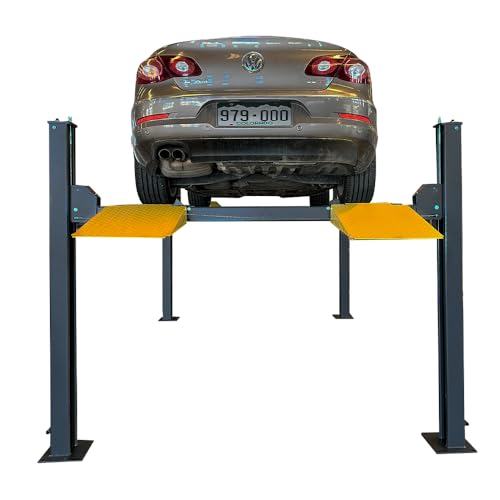

Garage ceiling clearance and overhead door travel create the most critical boundaries when planning vehicle storage or shop hoists. Residential spaces often present tight vertical restrictions where rafter tails, overhead garage door tracks, and garage door openers limit usable room. Knowing exactly how tall is a 4 post car lift helps prevent costly collisions between a vehicle roof and ceiling drywall while ensuring your structure can physically accommodate the equipment. Exploring modern residential car lift options allows homeowners to visualize footprint dimensions and column uprights before taking delivery.
Most standard four-post units feature column uprights ranging between 84 inches and 94 inches, but overall equipment height tells only half the story. The total vertical envelope depends on the thickness of the drive-on runways, the mechanical safety lock spacing, and the height of both parked vehicles. Evaluating your garage foundation, dedicated power connections, and overhead clearance before installation ensures that stacking a sports car or SUV remains smooth, predictable, and structurally sound.
| Award | Product | BJL Score About BJL ScoreThe BJL Score is our own rating from 0 to 10, based on performance, design and build, ease of use, and value. It reflects independent research and is never influenced by manufacturers, retailers, or affiliate commissions. Learn more › | |
|---|---|---|---|
| Best Overall |
AUTOKATO KT-4H850 8,500-lb Four-Post Car Storage
|
9.2/10 | Buy |
| Best Budget |
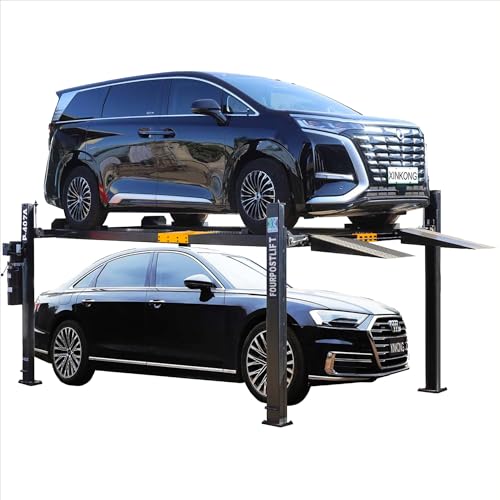 XK 8000 lb 4-Post Portable Parking Lift |
9.1/10 | Buy |
| Best Premium |
 KATOOL 9,500 lb 4-Post Car Lift with 110V 3.0HP |
9.1/10 | Buy |
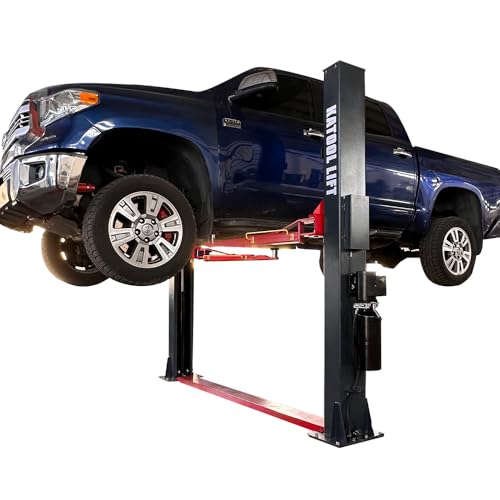 KATOOL 12,000-lb Heavy-Duty 2-Post Car Lift |
8.9/10 | Buy | |
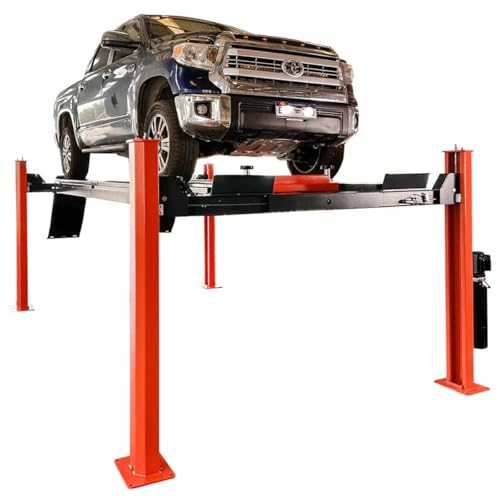 MutsMover 15,000 LBS 4-Post Car Lift |
8.8/10 | Buy | |
| Best Value |
 KATOOL 8,500 lb 4-Post Portable Car Lift |
8.6/10 | Buy |
 APlusLift 8SXLT 8,000 lb Extra Tall & Wide 4-Post |
8.6/10 | Buy | |
 KATOOL 8,500 lbs 4-Post Portable Car Lift Review |
8.3/10 | Buy | |
 AUTOKATO KT-4H950 9,500-Lb Four-Post Car Storage |
8.0/10 | Buy |
AUTOKATO KT-4H850 8,500-lb Four-Post Car Storage
The AUTOKATO KT-4H850 is an 8,500-lb capacity four-post parking and service lift engineered for car collectors and home garage DIYers seeking to double their parking footprint. Featuring an included caster mobility kit, a 3.0HP hydraulic power unit with 110V or 220V options, and single-point safety lock release, it provides versatile utility for residential workshops.
Pros
- Included caster kit provides convenient workshop mobility when the lift is unloaded
- Single-point manual lock release eliminates walking around all four posts to lower the vehicle
- Dual safety lock mechanism features primary and secondary latches on every column
- Flexible 3.0HP power unit options supporting residential 110V or dedicated 220V single-phase power
Cons
- Freight delivery requires specialized offloading coordination due to long, heavy crated components
- Hydraulic fluid is not included and must be sourced separately prior to commissioning
- Continuous runways require separate bottle jacks or jack bridge trays for wheel-off brake or suspension service
XK 8000 lb 4-Post Portable Parking Lift
The XK P-407A is an 8,000-lb capacity four-post portable parking lift engineered for residential garages and auto collectors seeking double-decker vehicle storage. Featuring a convenient 110V hydraulic power unit, integrated caster wheel mobility kit, and included drip trays, it provides a practical solution for doubling garage floor space without requiring permanent floor anchoring.
Pros
- Standard 110V electrical compatibility makes installation straightforward in typical residential home garages
- Included four-caster wheel kit enables shop mobility when repositioning the unloaded lift across flat concrete
- Comes packaged with practical storage accessories including fluid drip trays and a movable tool tray
- Generous 36-month parts replacement policy provides added peace of mind for residential DIY mechanics
Cons
- Hefty 1,469-pound shipping weight requires planning for freight offloading, typically needing a forklift, rollback, or helper crew
- Like most commercial hydraulic lifts, operating hydraulic fluid is not pre-filled and must be sourced separately before initial operation
- Drive-on runway layout restricts wheel and suspension access unless auxiliary bottle jacks or dedicated jack trays are utilized
KATOOL 9,500 lb 4-Post Car Lift with 110V 3.0HP
The KATOOL 9,500-lb four-post car lift features a 110V 3.0HP power unit, reaching up to 84 inches of lift height to maximize residential parking and undercar service. Complete with a caster moving kit, aluminum approach ramps, jack tray, and drip trays, it provides a turnkey storage and maintenance platform for DIY mechanics and vehicle collectors.
Pros
- Robust 9,500-lb capacity handles a broad variety of passenger cars, vintage classics, and light trucks.
- Plugs into standard 110V household circuits, avoiding the added cost of a dedicated 220V line installation.
- Impressive 84-inch maximum rise height provides ample clearance for walking underneath or parking taller vehicles below.
- Complete accessory package includes aluminum approach ramps, rolling caster kit, jack tray, and drip trays right in the box.
- Reaches 79 inches of rise in roughly 50 seconds for prompt, efficient positioning.
Cons
- Freight delivery requires on-site forklift equipment for unloading the 2,117-lb crate, or scheduling customer pickup at a regional freight terminal.
- Hydraulic fluid is not included in the package and must be purchased separately prior to initial bleeding and operation.
- Achieving full 84-inch lift height with a vehicle loaded demands substantial overhead garage ceiling and garage door opener clearance.
KATOOL 12,000-lb Heavy-Duty 2-Post Car Lift
The KATOOL 12,000-lb two-post automotive lift delivers heavy-duty lifting capacity powered by a robust 4.0 HP 220V motor, symmetric arms, and single-point lock release. It is an ideal solution for independent shops and home mechanics servicing full-size trucks, SUVs, and passenger vehicles with appropriate slab and electrical support.
Pros
- High 12,000-lb lifting capacity readily handles heavy diesel trucks, work vans, and fleet vehicles.
- Single-point safety lock release streamlines daily shop workflow for solo mechanics.
- Supplied with screw-on pads and 100mm height extension adapters right in the crate.
- Generous 70.86-inch maximum rise height provides ample undercarriage working room.
Cons
- Crated shipping weight of 1,379 lbs requires a forklift on-site for offloading or customer freight terminal pickup.
- Carries European CE certification rather than third-party Automotive Lift Institute (ALI) gold label certification.
- Requires a dedicated 220V single-phase electrical supply and user-sourced hydraulic oil prior to initial startup.
MutsMover 15,000 LBS 4-Post Car Lift
The MutsMover 15,000-lb 4-post automotive lift provides heavy-duty vehicle lifting and parking storage with a 77-inch maximum rise, Q345 structural steel framing, and an included 6,000-lb rolling jack. Powered by a 4.0HP 220V single-phase motor with a single-point manual safety lock release, it is built for fleet operators, diesel truck owners, and vehicle collectors with generous garage bay space.
Pros
- Massive 15,000-lb lifting capacity easily handles heavy-duty one-ton trucks, dually pickups, and fleet work vans
- Comes standard with a 6,000-lb capacity rolling bridge jack for wheel and suspension service
- Single-point manual lock release eliminates having to walk around the lift to disengage each corner individually
- Constructed from heavy-gauge Q345 structural steel weighing 4,850 lbs for high operational stability
- Full 77-inch maximum lift rise offers comfortable underbody walk-through headroom for taller mechanics
Cons
- Extremely heavy 4,850-lb freight delivery requires on-site forklift unloading or flatbed terminal pickup
- Requires a dedicated 220V single-phase electrical circuit and a spacious bay accommodating its 20-foot length
- Hydraulic fluid is not included in the crate and must be purchased separately prior to setup
KATOOL 8,500 lb 4-Post Portable Car Lift
The KATOOL 8,500-lb 4-post lift is a versatile vehicle storage and maintenance solution featuring an integrated caster kit, dual-lock safety mechanisms, and a 110V 3.0 HP power unit. It is designed for residential garage owners and car collectors seeking to stack vehicles or carry out underbody inspections without rewiring for 220V power.
Pros
- Standard 110V 3.0 HP hydraulic motor allows convenient operation from typical residential household power.
- Comes complete with a portable caster wheel kit to reposition the unloaded lift when garage layout needs shift.
- Primary and secondary safety locks on all four columns paired with an accessible single-point manual release lever.
- Provides up to 70.87 inches of vertical clearance to make underside inspections and vehicle stacking straightforward.
Cons
- Freight delivery requires on-site forklift unloading equipment or coordinating customer pickup at a regional freight terminal.
- Hydraulic fluid is not included in the shipment and must be purchased separately before initial system priming.
- Drive-on runway design requires optional rolling bridge jacks or auxiliary bottle jacks to perform wheel-free brake and suspension jobs.
APlusLift 8SXLT 8,000 lb Extra Tall & Wide 4-Post
The APlusLift 8SXLT is an 8,000-pound capacity extra tall and wide four-post car lift designed for residential vehicle storage, double parking, and DIY underbody service. Featuring an 82-inch lifting height, 99-inch drive-through width, and a standard 110V 1.5HP power unit, it is an ideal choice for home garage collectors seeking spacious clearance and complete accessory support.
Pros
- Convenient 110V 1.5HP power unit with included power cord operates on standard residential garage circuits without requiring 220V wiring
- Generous 82-inch rise height and 99-inch drive-through clearance accommodate taller vehicles and provide comfortable underbody standing headroom
- Arrives fully bundled with high-value accessories including a mobile caster kit, sliding jack tray, aluminum ramps, and drip trays
- Four-post drive-on configuration offers freestanding parking stability on level residential concrete without mandatory permanent floor anchors
- Supported by a comprehensive 3-year warranty along with CE safety evaluation documentation
Cons
- Heavy crated shipping weight of 1,850 pounds requires coordinated LTL freight offloading with an engine hoist, forklift, or wrecker service
- Carries European CE structural certification rather than third-party Automotive Lift Institute (ALI) gold label certification
- Hydraulic fluid is not included in the shipping package and must be purchased separately prior to pump priming and system bleeding
KATOOL 8,500 lbs 4-Post Portable Car Lift Review
The KATOOL 8,500 lbs 4-post car lift delivers a 70.87-inch lifting height, 110V plug-in convenience, and an included caster mobility kit for easy repositioning. Featuring a single-point manual release dual-lock safety design, it is an ideal solution for home garage enthusiasts looking to double vehicle storage and perform undercarriage maintenance.
Pros
- Convenient 110V electrical compatibility allows plug-in operation on typical residential garage circuits
- Included caster kit provides workshop mobility to reconfigure garage bay layouts when the lift is unloaded
- Dual mechanical safety locks per column with a centralized single-point manual release lever
- 70.87-inch maximum rise height allows comfortable underbody clearance and lower-vehicle parking clearance
- Substantial 8,500-lb gross load capacity handles common passenger vehicles and light utility trucks
Cons
- Substantial 1,820-lb crated freight shipment requires an on-site forklift or local freight terminal pickup for offloading
- Hydraulic oil is not pre-filled and must be sourced and added separately before commissioning
- evaluation claims represent manufacturer dynamic and static load reviews rather than third-party Automotive Lift Institute (ALI) gold label certification
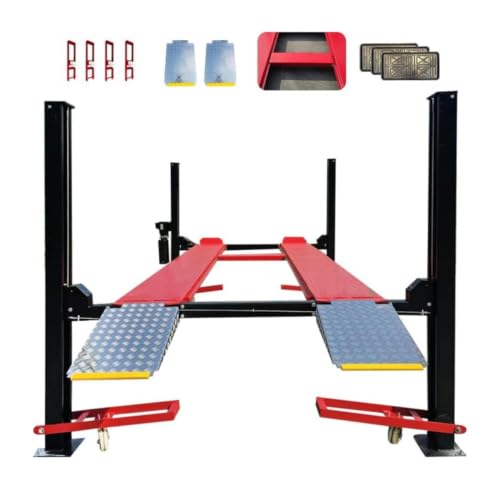
AUTOKATO KT-4H950 9,500-Lb Four-Post Car Storage
The AUTOKATO KT-4H950 is a heavy-duty 9,500-lb capacity four-post car and truck parking hoist offering up to 84.5 inches of stand-up clearance and a wide 113-inch footprint. Operating on standard 110V power and equipped with a caster kit, jack tray, and drip trays, it is an ideal vehicle stacking and light service solution for residential garages with sufficient ceiling height.
Pros
- High 84.5-inch maximum lift height provides comfortable standing room under raised vehicles
- Standard 110V 3.0HP power unit integrates easily into home garages without electrical rewiring
- All-inclusive accessory package with aluminum ramps, casters, jack tray, and fluid drip trays
- Generous 9,500-lb capacity handles heavy domestic trucks and sport-utility vehicles
Cons
- Freight delivery requires buyer to provide an on-site forklift or coordinate pickup at a local LTL terminal
- Substantial vertical clearance is required to take full advantage of top locking positions and vehicle stacking
- Hydraulic fluid is not pre-filled and must be sourced separately prior to initial setup
Comprehensive Guide to 4-Post Car Lift Dimensions and Ceiling Requirements
Determining the true vertical profile of a four-post parking and service lift requires evaluating multiple dimensions rather than a single column specification. While the vertical steel posts establish the baseline footprint, maximum runway rise, runway structural thickness, and vehicle heights determine whether a hoist will fit inside your garage. Home mechanics frequently confuse overall column height with under-runway working clearance, leading to unexpected installation challenges. Reviewing these dimensions in detail ensures your garage provides adequate vertical headroom for safe vehicle storage and ergonomic underbody maintenance.
Standard Column Heights Across 4-Post Lift Designs
Column height on typical residential four-post lifts generally falls between 84 inches and 95 inches, depending on lifting capacity and manufacturer design. Standard home storage units, such as an 8,000-pound or 8,500-pound model, often utilize columns standing roughly 7 feet to 7.5 feet high to clear standard garage door headers. Taller units, including extra-tall variants or heavy commercial hoists, feature column heights reaching 94 inches or higher to allow taller technicians to walk underneath without hunching. The APlusLift 8SXLT, for example, specifies an overall column height of 94 inches, while compact models often keep columns closer to 84 inches.
Commercial-grade four-post units designed for fleet maintenance or full-size pickup trucks often feature taller columns to support extended hydraulic cylinder strokes. Units like the MutsMover 15,000-pound capacity lift incorporate massive uprights to handle broad frame structures and long suspension travel. On these larger models, steel posts extend upward to accommodate robust crossbeams and multi-position safety ladders. Choosing between standard and extended column heights directly influences how high you can elevate a vehicle before the top mechanical lock engages.
Column Height Versus Under-Runway Working Clearance
Distinguishing between total column height, maximum runway rise, and clearance beneath the runways is essential when planning a hoist installation. The overall column height represents the physical top of the steel posts standing on your concrete floor. Maximum runway rise indicates how high the top surface of the drive-on platforms can travel when the hydraulic cylinder reaches full extension. The under-vehicle clearance, however, measures the distance from the garage floor to the underside of the runways, which determines whether you can walk or sit comfortably underneath.
In many popular 8,500-pound to 9,500-pound home storage lifts, maximum lifting height reaches between 70.8 inches and 84.5 inches. The KATOOL and AUTOKATO 9,500-pound platforms, for instance, offer lifting heights between 79 inches and 84.5 inches, giving ample room for full standing height. However, the drive-on runway structure itself is typically 4 to 5 inches thick due to internal crossmembers and steel reinforcing gussets. Subtracting the runway thickness from the top-of-runway elevation gives your true under-runway clearance, which is the actual space available for parking a lower vehicle.
The Two-Car Stacking Formula: Calculating Ceiling Clearance
Calculating whether your residential garage can safely accommodate two stacked vehicles requires a straightforward mathematical formula. The primary equation combines the lower vehicle height, the upper vehicle height, the runway structural thickness, and a safety margin for mechanical lock engagement. Written out, the formula is: Lower Vehicle Height plus Upper Vehicle Height plus Runway Thickness plus Safety Margin equals Total Minimum Ceiling Height. Applying this formula ensures you never attempt to raise a vehicle beyond the physical limits of your garage drywall or roof trusses.
Consider a realistic example where a homeowner wishes to store a sports coupe underneath an everyday compact crossover. If the lower sports car measures 52 inches tall and the upper crossover measures 66 inches tall, those vehicles alone require 118 inches of vertical room. Adding 5 inches for the steel runway structure brings the combined height to 123 inches. Including an essential 4-inch buffer for locking clearance results in a required ceiling height of 127 inches, which is approximately 10 feet and 7 inches.
If you intend to stack two low-slung sports cars, the vertical clearance requirement becomes significantly more manageable for standard residential garages. Two vehicles measuring 50 inches in height combined with a 5-inch runway and a 4-inch lock buffer require only 109 inches, or roughly 9 feet and 1 inch of ceiling clearance. Evaluating these dimensions using verified vehicle specifications prevents surprises during initial operation. Many homeowners exploring hydraulic car lift systems discover that minor variations in roof pitch or ceiling drywall framing determine whether their planned two-car configuration is feasible.
Factoring In Safety Lock Ladder Travel and Release Clearance
Mechanical safety locks are fundamental to four-post lift design, preventing catastrophic vehicle descent in the event of hydraulic pressure loss. These safety systems utilize heavy steel lock ladders welded or fitted inside each column, paired with spring-loaded locking dogs on the crossbeams. When you raise a vehicle to a desired parking position, you must elevate the runways slightly past the target lock ladder tooth to allow the mechanical latch to drop into place. Once the latch swings clear, you gently lower the hydraulic pressure so the entire load rests securely on the steel column stops.
This overtravel requirement demands that your garage ceiling provide at least 2 to 4 inches of clearance above the final parked position of the top vehicle. If your ceiling height exactly matches the combined height of the two vehicles and runways, you will not have sufficient room to lift the carriage above the lock latch. Attempting to force the power unit against ceiling joists can dent vehicle sheet metal or damage garage framing. Always factor this necessary lock-clearing stroke into your vertical ceiling measurements before choosing a four-post parking lift.
Single-point manual lock release systems, featured on lifts from brands like AUTOKATO and KATOOL, simplify lowering by disengaging all four corner latches simultaneously. When lowering the hoist, the operator raises the carriages an inch or two to unload the latches before pulling the manual release lever. Without adequate overhead clearance, releasing the mechanical locks becomes impossible because the top vehicle cannot rise to clear the ladder teeth. Maintaining a generous overhead buffer guarantees safe, bind-free engagement and disengagement during daily operation.
Overhead Garage Door Track and Opener Obstructions
Ceiling height measurements must never be taken solely from the center of an empty garage floor without considering overhead equipment. In residential garages, the open garage door and its horizontal steel tracks represent the lowest physical barrier in the room. A garage with an 11-foot finished ceiling might only offer 8 feet of usable clearance beneath the horizontal tracks when the overhead door is rolled back. Center-mounted garage door openers and ceiling-mounted fluorescent lighting also introduce substantial overhead hazards that can contact the roof of a raised vehicle.
Converting standard garage doors to high-lift configurations is one of the most effective methods for regaining wasted vertical headroom. Standard garage doors typically curve inward at approximately 7 to 8 feet above the floor, hanging horizontally across valuable overhead airspace. A high-lift track conversion extends the vertical door tracks closer to the ceiling drywall before curving into the horizontal position. Pairing this track adjustment with a wall-mounted jackshaft opener removes the central hanging motor, opening valuable vertical clearance directly above the lift columns.
Concrete Slab Depth, Compressive Strength, and Floor Slope
Structural foundation integrity is vital for long-term safety, even though four-post lifts distribute vehicle weight across four wide baseplates. Most manufacturers recommend installing a four-post hoist on a concrete floor with a minimum thickness of 4 inches and a compressive strength of at least 3,000 PSI cured for 28 days. Although four-post lifts generate lower anchor pull-out stresses than two-post surface-mounted lifts, an unreinforced or crumbling slab remains a severe hazard. Test-drilling your concrete in an inconspicuous spot helps verify slab depth before assembling heavy steel uprights.
Floor slope is another critical variable that impacts column plumbness, runway levelness, and mechanical lock alignment. Most residential garage floors are intentionally poured with a slight slope toward the main overhead door to facilitate water drainage. If the floor slope exceeds manufacturer tolerances, the lift crossbeams may bind in the column channels or safety locks may engage unevenly. Steel horseshoe shims placed beneath column baseplates allow you to plumb the posts and achieve a level runway plane across all four corners.
Dedicated Electrical Circuit Requirements: 110V Versus 220V
Power unit electrical specifications dictate operational convenience, lift cycle speeds, and necessary garage wiring upgrades. Many residential four-post storage lifts, including units from XK, APlusLift, and KATOOL, operate on standard 110V single-phase electrical power. A 110V hydraulic power unit generally requires a dedicated 20-amp circuit breaker to handle motor startup amperage without tripping home breakers. Operating on 110V power eliminates the expense of installing new electrical subpanels, making setup straightforward for home garage hobbyists.
Larger commercial models and high-capacity units frequently utilize 220V to 240V single-phase motors to achieve rapid ascent speeds and higher hydraulic pressures. Heavy-duty units such as the 15,000-pound MutsMover rely on 220V power to drive a 4.0-horsepower motor, lifting full-size trucks effortlessly. Choosing a 220V system reduces overall motor heat buildup during repetitive cycling, which is advantageous for busy repair and restoration shops. When shopping among heavy-duty car lifts, evaluating your electrical panel’s spare breaker capacity helps avoid surprise electrical contracting expenses.
Mobility and Anchoring: Caster Kit Dynamics Versus Floor Bolting
One of the greatest practical advantages of four-post lifts is their capability to function as freestanding, movable platforms. Models from AUTOKATO, XK, and KATOOL frequently include heavy-duty polyurethane caster kits that attach directly to the crossbeams. When the runways are lowered, the crossbeams lever against the caster wheels, lifting the steel column baseplates off the concrete floor. This allows a single person to push and maneuver the entire lift around an empty garage bay to reconfigure parking arrangements.
While mobile caster kits offer tremendous flexibility, leaving a four-post lift permanently unanchored carries specific operational tradeoffs. Unanchored lifts can slowly walk or shift across smooth concrete floors as vehicles repeatedly drive on and off the runways. If you plan to work on heavy commercial trucks, conduct aggressive suspension repairs, or use rolling bridge jacks frequently, bolting the columns to the concrete floor provides superior structural rigidity. Anchor bolts prevent column movement, ensure strict plumb alignment, and stabilize the lift against incidental vehicle contact.
Freight Delivery Logistics and Residential Receiving Realities
Preparing for the physical arrival of a four-post lift is a crucial aspect of the purchasing process that many buyers underestimate. These hoists ship via less-than-truckload freight as massive steel bundles weighing anywhere from 1,700 pounds to over 4,000 pounds. Freight delivery carriers deliver using full-size 53-foot semi-truck trailers that often cannot navigate narrow residential suburban streets or steep rural driveways. Furthermore, standard residential delivery options rarely include liftgate offloading because the crated runways exceed standard liftgate platform dimensions.
Buyers must generally provide equipment to unload the heavy crate, such as a forklift, tractor with pallet forks, or an arranged rollback tow truck. If mechanical offloading equipment is unavailable at your residence, opting for terminal pickup at the local freight shipping depot is often the safest alternative. At the freight terminal, dock workers can load the crate directly onto your open utility trailer or flatbed pickup truck. Inspecting the metal crating for shipping damage and signing the bill of lading with clear notation of any freight distress protects your warranty rights.
Accurately determining hoist dimensions and vertical clearance transforms an ambitious garage storage plan into a successful installation. Always verify your total garage ceiling height, subtract overhead door track intrusions, and execute the two-car stacking formula using your exact vehicle measurements. Remember to reserve at least 4 inches of clearance above the upper vehicle to enable smooth mechanical safety lock disengagement. Double-checking concrete condition, electrical circuit capacity, and freight receiving logistics ensures your four-post lift provides decades of dependable vehicle storage and ergonomic mechanical service.
About the author
Peter Nelson is an automotive writer whose published work includes off-road jacks, power tools, vehicle maintenance, and garage equipment. His coverage connects product features with practical applications, helping readers think through equipment choices for everyday repairs, project vehicles, and off-road situations.