
How Wide Is a 4 Post Car Lift? Dimensions and Space Guide for 2026
How Wide Is A 4 Post Car Lift ranges from 106 to 113 inches overall. Learn bay clearances, drive-through widths, and layout requirements for November 2026.
 By Peter Nelson
Updated October 10, 2026
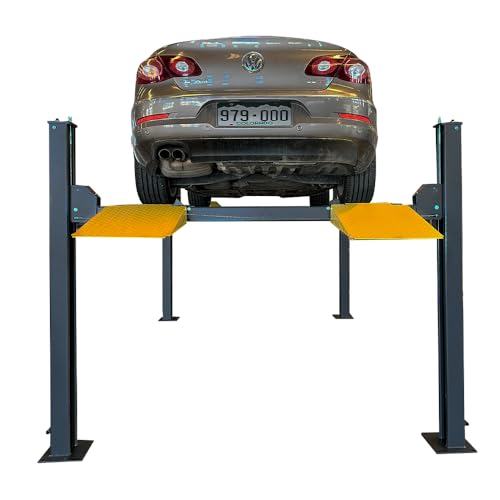

Measuring garage bay dimensions accurately prevents costly layout surprises when installing freestanding automotive service equipment. Home mechanics and car collectors frequently ask how wide is a 4 post car lift before committing valuable floor space in a residential garage or workshop. While overall exterior widths generally range between 106 and 113 inches for standard hobbyist models, the total space required involves several distinct dimensional factors. Examining column footprints, drive-through clearance, and side-mounted power units helps ensure your vehicle fits comfortably between the posts. Selecting suitable residential vehicle lifts requires balancing storage stacking goals with convenient daily access.
Usable garage space diminishes quickly once you account for perimeter walking aisles and wall clearances. Modern full-size trucks and sport utility vehicles demand wide drive-through openings so side mirrors clear the steel columns without damage. Furthermore, hydraulic motor assemblies mounted to the exterior column can add significant lateral width to the listed frame footprint. Checking concrete slab integrity, ceiling heights, and door clearances alongside equipment width ensures safe installation and effortless vehicle maneuvering. Reviewing real-world equipment specifications allows you to plan an efficient layout that accommodates your vehicles while preserving accessible workspace.
| Award | Product | BJL Score About BJL ScoreThe BJL Score is our own rating from 0 to 10, based on performance, design and build, ease of use, and value. It reflects independent research and is never influenced by manufacturers, retailers, or affiliate commissions. Learn more › | |
|---|---|---|---|
| Best Overall |
AUTOKATO KT-4H850 8,500-lb Four-Post Car Storage
|
9.2/10 | Buy |
| Best Budget |
 XK 8000 lb 4-Post Portable Parking Lift |
9.1/10 | Buy |
| Best Premium |
 KATOOL 9,500 lb 4-Post Car Lift with 110V 3.0HP |
9.1/10 | Buy |
| Best Value |
 APlusLift HW-8S 8000LB 4-Post Storage Lift |
8.8/10 | Buy |
 MutsMover 15,000 LBS 4-Post Car Lift |
8.8/10 | Buy | |
 KATOOL 8,500 lb 4-Post Portable Car Lift |
8.6/10 | Buy | |
 APlusLift 8SXLT 8,000 lb Extra Tall & Wide 4-Post |
8.6/10 | Buy | |
 KATOOL 8,500 lbs 4-Post Portable Car Lift Review |
8.3/10 | Buy | |
 AUTOKATO KT-4H950 9,500-Lb Four-Post Car Storage |
8.0/10 | Buy |
AUTOKATO KT-4H850 8,500-lb Four-Post Car Storage
The AUTOKATO KT-4H850 is an 8,500-lb capacity four-post parking and service lift engineered for car collectors and home garage DIYers seeking to double their parking footprint. Featuring an included caster mobility kit, a 3.0HP hydraulic power unit with 110V or 220V options, and single-point safety lock release, it provides versatile utility for residential workshops.
Pros
- Included caster kit provides convenient workshop mobility when the lift is unloaded
- Single-point manual lock release eliminates walking around all four posts to lower the vehicle
- Dual safety lock mechanism features primary and secondary latches on every column
- Flexible 3.0HP power unit options supporting residential 110V or dedicated 220V single-phase power
Cons
- Freight delivery requires specialized offloading coordination due to long, heavy crated components
- Hydraulic fluid is not included and must be sourced separately prior to commissioning
- Continuous runways require separate bottle jacks or jack bridge trays for wheel-off brake or suspension service
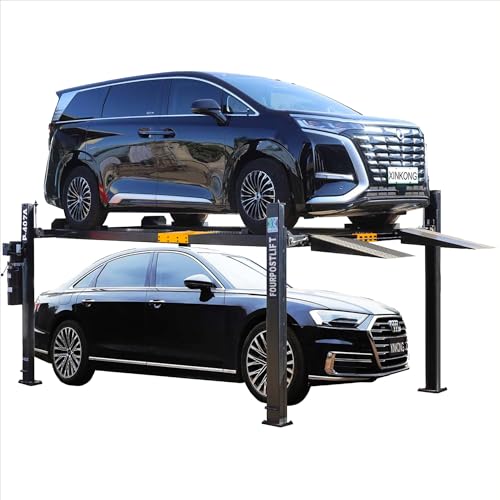
XK 8000 lb 4-Post Portable Parking Lift
The XK P-407A is an 8,000-lb capacity four-post portable parking lift engineered for residential garages and auto collectors seeking double-decker vehicle storage. Featuring a convenient 110V hydraulic power unit, integrated caster wheel mobility kit, and included drip trays, it provides a practical solution for doubling garage floor space without requiring permanent floor anchoring.
Pros
- Standard 110V electrical compatibility makes installation straightforward in typical residential home garages
- Included four-caster wheel kit enables shop mobility when repositioning the unloaded lift across flat concrete
- Comes packaged with practical storage accessories including fluid drip trays and a movable tool tray
- Generous 36-month parts replacement policy provides added peace of mind for residential DIY mechanics
Cons
- Hefty 1,469-pound shipping weight requires planning for freight offloading, typically needing a forklift, rollback, or helper crew
- Like most commercial hydraulic lifts, operating hydraulic fluid is not pre-filled and must be sourced separately before initial operation
- Drive-on runway layout restricts wheel and suspension access unless auxiliary bottle jacks or dedicated jack trays are utilized
KATOOL 9,500 lb 4-Post Car Lift with 110V 3.0HP
The KATOOL 9,500-lb four-post car lift features a 110V 3.0HP power unit, reaching up to 84 inches of lift height to maximize residential parking and undercar service. Complete with a caster moving kit, aluminum approach ramps, jack tray, and drip trays, it provides a turnkey storage and maintenance platform for DIY mechanics and vehicle collectors.
Pros
- Robust 9,500-lb capacity handles a broad variety of passenger cars, vintage classics, and light trucks.
- Plugs into standard 110V household circuits, avoiding the added cost of a dedicated 220V line installation.
- Impressive 84-inch maximum rise height provides ample clearance for walking underneath or parking taller vehicles below.
- Complete accessory package includes aluminum approach ramps, rolling caster kit, jack tray, and drip trays right in the box.
- Reaches 79 inches of rise in roughly 50 seconds for prompt, efficient positioning.
Cons
- Freight delivery requires on-site forklift equipment for unloading the 2,117-lb crate, or scheduling customer pickup at a regional freight terminal.
- Hydraulic fluid is not included in the package and must be purchased separately prior to initial bleeding and operation.
- Achieving full 84-inch lift height with a vehicle loaded demands substantial overhead garage ceiling and garage door opener clearance.
APlusLift HW-8S 8000LB 4-Post Storage Lift
The APlusLift HW-8S is an 8,000-lb capacity four-post storage and service lift featuring an 84-inch column height, 72-inch lifting height, and a 110V 1.5HP hydraulic power unit. Complete with a caster kit, aluminum ramps, drip trays, and a jack tray, it is an ideal parking stacker and maintenance hoist for home garage DIYers and classic car collectors.
Pros
- Operates on standard 110V household electrical power with an included power cord, eliminating expensive 220V rewiring
- Includes complete accessory package: caster wheel kit, aluminum approach ramps, jack tray, and fluid drip trays
- Compact 84-inch column height allows installation in garages with lower ceiling clearances
- Provides 93 inches of drive-through width, offering ample clearance for passenger cars and light trucks
- Backed by an extensive 3-year (36-month) manufacturer warranty covering structure and hydraulic components
Cons
- Heavy freight shipping weight of 1,750 pounds requires a forklift, flatbed wrecker, or freight terminal pickup for offloading
- Hydraulic fluid is not included in the shipping crate and must be purchased separately prior to initial operation
- Carries European CE structural certification rather than third-party Automotive Lift Institute (ALI) gold label certification
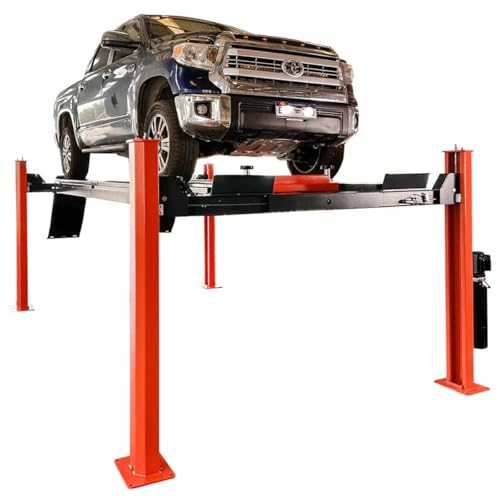
MutsMover 15,000 LBS 4-Post Car Lift
The MutsMover 15,000-lb 4-post automotive lift provides heavy-duty vehicle lifting and parking storage with a 77-inch maximum rise, Q345 structural steel framing, and an included 6,000-lb rolling jack. Powered by a 4.0HP 220V single-phase motor with a single-point manual safety lock release, it is built for fleet operators, diesel truck owners, and vehicle collectors with generous garage bay space.
Pros
- Massive 15,000-lb lifting capacity easily handles heavy-duty one-ton trucks, dually pickups, and fleet work vans
- Comes standard with a 6,000-lb capacity rolling bridge jack for wheel and suspension service
- Single-point manual lock release eliminates having to walk around the lift to disengage each corner individually
- Constructed from heavy-gauge Q345 structural steel weighing 4,850 lbs for high operational stability
- Full 77-inch maximum lift rise offers comfortable underbody walk-through headroom for taller mechanics
Cons
- Extremely heavy 4,850-lb freight delivery requires on-site forklift unloading or flatbed terminal pickup
- Requires a dedicated 220V single-phase electrical circuit and a spacious bay accommodating its 20-foot length
- Hydraulic fluid is not included in the crate and must be purchased separately prior to setup
KATOOL 8,500 lb 4-Post Portable Car Lift
The KATOOL 8,500-lb 4-post lift is a versatile vehicle storage and maintenance solution featuring an integrated caster kit, dual-lock safety mechanisms, and a 110V 3.0 HP power unit. It is designed for residential garage owners and car collectors seeking to stack vehicles or carry out underbody inspections without rewiring for 220V power.
Pros
- Standard 110V 3.0 HP hydraulic motor allows convenient operation from typical residential household power.
- Comes complete with a portable caster wheel kit to reposition the unloaded lift when garage layout needs shift.
- Primary and secondary safety locks on all four columns paired with an accessible single-point manual release lever.
- Provides up to 70.87 inches of vertical clearance to make underside inspections and vehicle stacking straightforward.
Cons
- Freight delivery requires on-site forklift unloading equipment or coordinating customer pickup at a regional freight terminal.
- Hydraulic fluid is not included in the shipment and must be purchased separately before initial system priming.
- Drive-on runway design requires optional rolling bridge jacks or auxiliary bottle jacks to perform wheel-free brake and suspension jobs.
APlusLift 8SXLT 8,000 lb Extra Tall & Wide 4-Post
The APlusLift 8SXLT is an 8,000-pound capacity extra tall and wide four-post car lift designed for residential vehicle storage, double parking, and DIY underbody service. Featuring an 82-inch lifting height, 99-inch drive-through width, and a standard 110V 1.5HP power unit, it is an ideal choice for home garage collectors seeking spacious clearance and complete accessory support.
Pros
- Convenient 110V 1.5HP power unit with included power cord operates on standard residential garage circuits without requiring 220V wiring
- Generous 82-inch rise height and 99-inch drive-through clearance accommodate taller vehicles and provide comfortable underbody standing headroom
- Arrives fully bundled with high-value accessories including a mobile caster kit, sliding jack tray, aluminum ramps, and drip trays
- Four-post drive-on configuration offers freestanding parking stability on level residential concrete without mandatory permanent floor anchors
- Supported by a comprehensive 3-year warranty along with CE safety evaluation documentation
Cons
- Heavy crated shipping weight of 1,850 pounds requires coordinated LTL freight offloading with an engine hoist, forklift, or wrecker service
- Carries European CE structural certification rather than third-party Automotive Lift Institute (ALI) gold label certification
- Hydraulic fluid is not included in the shipping package and must be purchased separately prior to pump priming and system bleeding
KATOOL 8,500 lbs 4-Post Portable Car Lift Review
The KATOOL 8,500 lbs 4-post car lift delivers a 70.87-inch lifting height, 110V plug-in convenience, and an included caster mobility kit for easy repositioning. Featuring a single-point manual release dual-lock safety design, it is an ideal solution for home garage enthusiasts looking to double vehicle storage and perform undercarriage maintenance.
Pros
- Convenient 110V electrical compatibility allows plug-in operation on typical residential garage circuits
- Included caster kit provides workshop mobility to reconfigure garage bay layouts when the lift is unloaded
- Dual mechanical safety locks per column with a centralized single-point manual release lever
- 70.87-inch maximum rise height allows comfortable underbody clearance and lower-vehicle parking clearance
- Substantial 8,500-lb gross load capacity handles common passenger vehicles and light utility trucks
Cons
- Substantial 1,820-lb crated freight shipment requires an on-site forklift or local freight terminal pickup for offloading
- Hydraulic oil is not pre-filled and must be sourced and added separately before commissioning
- evaluation claims represent manufacturer dynamic and static load reviews rather than third-party Automotive Lift Institute (ALI) gold label certification
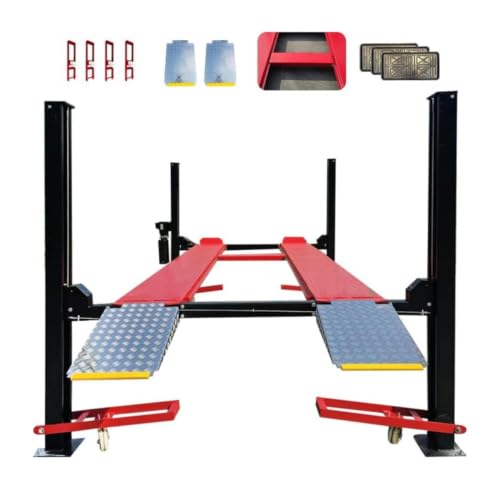
AUTOKATO KT-4H950 9,500-Lb Four-Post Car Storage
The AUTOKATO KT-4H950 is a heavy-duty 9,500-lb capacity four-post car and truck parking hoist offering up to 84.5 inches of stand-up clearance and a wide 113-inch footprint. Operating on standard 110V power and equipped with a caster kit, jack tray, and drip trays, it is an ideal vehicle stacking and light service solution for residential garages with sufficient ceiling height.
Pros
- High 84.5-inch maximum lift height provides comfortable standing room under raised vehicles
- Standard 110V 3.0HP power unit integrates easily into home garages without electrical rewiring
- All-inclusive accessory package with aluminum ramps, casters, jack tray, and fluid drip trays
- Generous 9,500-lb capacity handles heavy domestic trucks and sport-utility vehicles
Cons
- Freight delivery requires buyer to provide an on-site forklift or coordinate pickup at a local LTL terminal
- Substantial vertical clearance is required to take full advantage of top locking positions and vehicle stacking
- Hydraulic fluid is not pre-filled and must be sourced separately prior to initial setup
Comprehensive Dimensional Breakdown for Four-Post Vehicle Lifts
Establishing the exact width of a four-post parking and service lift requires evaluating several distinct measurements rather than relying on a single overall specification. Equipment buyers must differentiate between the structural column footprint, the clear drive-through opening, the runway track width, and the total operational envelope created by external accessories. Reviewing how these dimensional layers interact allows garage owners to place their equipment accurately, prevent vehicle damage during entry, and ensure safe walking access throughout the workshop bay.
Exterior Column Width Versus Operational Footprint
The primary specification published by equipment manufacturers is the overall exterior width measured across the outside edges of the upright columns. Standard residential parking lifts typically exhibit an exterior width between 106 inches and 113 inches. Compact models designed for tight residential bays, such as the APlusLift HW-8S, measure roughly 106 inches across the outside of the steel structure. Larger consumer units like the APlusLift 8SXLT expand to 112 inches, while wide-format platforms like the AUTOKATO KT-4H950 reach approximately 113 inches across the upright frame.
Published column dimensions do not account for the lateral footprint of the hydraulic power unit assembly. On virtually all four-post lifts, the motor pump reservoir mounts directly to the exterior face of one designated column. This side-mounted hydraulic power unit typically projects an additional 8 to 12 inches beyond the column upright. If your lift frame measures 110 inches wide, the true working width required to clear the motor assembly expands closer to 120 inches. Failing to calculate this extra motor clearance often results in the power unit pressing against drywall or colliding with storage shelving.
Baseplate flaring represents another exterior structural factor that affects positioning relative to walls and adjacent bays. The heavy steel baseplates at the bottom of each column provide structural stability and feature pre-drilled holes for concrete wedge anchors. These mounting plates extend several inches beyond the profile of the vertical columns in every direction. When planning equipment placement, mechanics must measure from the outermost edge of the steel baseplate rather than the column body. This precise measurement prevents unanchored units from rubbing against foundation stem walls or structural framing studs.
Drive-Through Clearance and Vehicle Mirror Spacing
Drive-through width describes the clear, unobstructed distance between the inside faces of the two entry columns. This dimension represents the real-world threshold that your vehicle must navigate every time you pull onto the lift runways. On standard residential lifts, drive-through widths typically span from 93 inches to 99 inches. The APlusLift HW-8S provides a 93-inch drive-through opening, whereas extended-frame models offer 99 inches of clearance. While 93 inches accommodates sports cars and compact sedans easily, larger passenger vehicles demand careful alignment.
Modern half-ton and three-quarter-ton pickup trucks feature substantial track widths and oversized side mirrors that test narrow drive-through tolerances. A contemporary full-size pickup often measures between 80 and 82 inches in body width, but extended towing mirrors can push total mirror-to-mirror width beyond 96 inches. Driving a wide truck through a 93-inch opening forces the driver to fold side mirrors manually before entering the bay. Selecting an extra-wide four-post lift with at least 99 inches of drive-through clearance reduces driver stress and prevents mirror strikes.
Door-opening clearance represents another practical challenge associated with narrow drive-through configurations. Unlike two-post lifts where the vehicle chassis rests between open posts, four-post platforms position columns near the corners of the runways. Drivers must exit the vehicle while parked atop the elevated runways between the vertical posts. If the drive-through width is excessively tight, opening the driver door wide enough to step down comfortably becomes awkward. Wider column spacing provides superior door swing margins, allowing comfortable vehicle egress onto the garage floor or runway deck.
Runway Spacing and Tire Track Width Geometry
The width of the horizontal drive-on runways directly influences which vehicles your platform can safely support. Most residential four-post hoists feature formed steel runways that measure between 18 and 21 inches in individual width. These generous runway surfaces provide ample tire contact area for passenger car radials, low-profile performance rubber, and wide all-terrain truck tires. The space between the inner edges of the two runways generally measures between 37 and 43 inches on standard residential models.
Vehicle track width must align securely with the centerline of both runways to prevent tire sidewall overhang. Narrow vintage sports cars and compact subcompacts feature narrow track widths that approach the inner boundary of standard runways. Conversely, wide commercial utility vans and modified off-road trucks push tire contact toward the outer runway lips. Many four-post designs feature one fixed runway housing the hydraulic cylinder and equalization cables, alongside an adjustable secondary runway. Exploring versatile four-post storage lifts can clarify how adjustable runway tracks accommodate diverse automotive fleets.
Underbody accessibility depends heavily on the open gap maintained between the elevated runways. A wider gap facilitates unobstructed access to the vehicle exhaust system, driveshaft, transmission pan, and differential during service routines. However, widening the runway spacing excessively can prevent narrower collector cars from driving onto the platform safely. Mechanics who service both classic roadsters and full-size trucks must confirm that the runway spacing accommodates the narrowest axle track in their collection. Removable aluminum jack trays and sliding bridge jacks also bridge this center span to support wheel-free suspension repairs.
Residential Bay Footprints and Perimeter Working Clearance
Translating equipment dimensions into a practical garage layout requires evaluating overall bay width against required walking corridors. A standard single-car residential garage bay typically measures between 10 and 12 feet wide, which equals 120 to 144 inches. Installing a 106-inch or 112-inch four-post lift in a 10-foot bay leaves less than 14 inches of total lateral clearance split between both sides. Such tight margins eliminate comfortable walking paths and make servicing wheels or maneuvering tool carts exceptionally frustrating.
Automotive equipment guidelines recommend maintaining at least 24 to 36 inches of unobstructed buffer space around the perimeter of the lift columns. This generous walking corridor permits unhindered movement when carrying diagnostic tools, oil drain pans, or replacement brake rotors around the vehicle. In a standard two-car residential garage measuring 20 to 24 feet wide, positioning a four-post lift along one wall preserves accessible workspace. Placing the lift off-center leaves adequate room for a second daily driver to park without door collisions.
Wall obstructions such as electrical subpanels, hose reels, workbenches, and structural pilasters further restrict usable bay width. When establishing chalk layout lines, you must measure available width from the furthest inward wall projection rather than bare drywall. If a foundation stem wall or water heater encroaches into the parking stall, the lift column footprint must shift inward accordingly. Planning adequate perimeter clearance ensures that technicians can access the single-point safety lock release lever located on the primary operational column without squeezing into tight recesses.
Longitudinal Length and Approach Ramp Clearances
Evaluating equipment width without considering overall length can create severe garage door interference during daily operations. A typical four-post parking hoist features an overall structural length ranging from 175 inches on standard frames to 190 inches or more on extended-wheelbase units. Removable drive-on approach ramps extend this longitudinal footprint by an additional 30 to 36 inches during vehicle loading. In a shallow residential garage measuring 20 feet deep, an extended lift can consume virtually the entire bay from wall to garage door.
Approach ramp design significantly impacts how easily low-profile vehicles can transition onto the elevated runways. Traditional steel approach ramps are heavy and feature steep entry angles that can scrape front splitters or low rocker panels. Modern premium lifts often incorporate lightweight removable aluminum approach ramps with gentle incline angles to prevent ground-clearance damage. Once the vehicle is parked atop the runways, operators can detach these aluminum ramps to free up floor space behind the lift. Removing the drive-on ramps allows overhead garage doors to close without striking equipment hardware.
Garage door clearance also involves vertical roll-up pathways and horizontal track positioning. Standard overhead garage door tracks curve inward into the bay, often crossing directly through the vertical airspace occupied by the rear lift columns. Homeowners stacking vehicles frequently convert standard door hardware to high-lift tracks paired with wall-mounted jackshaft door openers. This conversion routes the door panels tightly against the ceiling drywall, keeping the space above the lift runways completely open. Understanding hydraulic lift systems helps garage owners coordinate horizontal bay length with overhead structural clearances.
Mobility Kits, Unanchored Shifting, and Concrete Foundation Rules
Freestanding four-post storage lifts offer unique versatility because many consumer models do not require permanent anchor bolts into the concrete floor. Manufacturers frequently include heavy-duty polyurethane caster moving kits that pin into the crossbeams, allowing users to roll the unweighted lift across the shop floor. Mobile capability enables homeowners to reposition the lift laterally to create temporary space for large welding or carpentry projects. However, rolling the hoist requires completely flat concrete free of severe slope or deep expansion joints.
Unanchored operation introduces the risk of structural walking or minor lateral shifting across slick concrete surfaces over time. As heavy vehicles drive onto the approach ramps and apply braking pressure on the runways, the entire steel structure experiences lateral thrust. Over multiple parking cycles, an unbolted hoist can creep several inches toward an adjacent wall or vehicle stall. Inspecting column positions regularly against marked floor guides ensures the lift maintains safe perimeter buffer zones. If bay margins are exceptionally tight, securing the baseplates with wedge anchor bolts eliminates shifting entirely.
Concrete slab structural specifications remain critical whether a four-post lift is anchored or operated on mobile casters. Garage floors must feature a minimum concrete thickness of 4 inches and a compressive strength rating of at least 3,000 PSI cured for 28 days. When anchoring the baseplates, technicians must drill into structurally sound concrete at least 6 inches away from slab edges or control joints. Drilling into post-tension concrete slabs requires professional ground-penetrating radar scanning to prevent catastrophic tendon strikes. Verifying slab integrity ensures the foundation supports both the equipment weight and stacked vehicle loads safely.
Heavy-Duty Commercial Width and Chassis Variations
Commercial-grade four-post lifts engineered for heavy fleet maintenance feature substantially wider structural dimensions than consumer hobbyist hoists. Heavy-duty platforms, such as the 15,000-pound capacity MutsMover four-post lift, utilize heavy Q345 structural steel columns with broader crossbeams to support large commercial vehicles. These heavy-duty platforms often expand overall exterior widths well beyond 120 inches to accommodate commercial box trucks, utility chassis, and ambulances. Heavy crossbeams distribute significant vehicle mass across the foundation while resisting structural deflection under maximum rated capacity.
Commercial chassis geometry requires wider runways and expanded drive-through clearances to support dual-rear-wheel configurations. Dual-rear-wheel work trucks feature rear axle track widths that easily exceed standard 93-inch residential drive-through openings. Commercial lifts address this requirement by providing drive-through clearances exceeding 100 inches alongside reinforced, extra-wide steel runways. These professional platforms also incorporate heavy rolling bridge air jacks with 6,000 pounds of lifting capacity to perform wheel and brake service at full working elevation. Heavy-duty lifting tasks require matched equipment width to ensure safe tire seating.
Electrical requirements on commercial-grade hoists often reflect their larger physical scale and heavier hydraulic demands. While consumer models like the KATOOL 8500-pound and APlusLift HW-8S operate conveniently on standard 110V 1.5HP to 3.0HP power supplies, commercial units frequently mandate 220V single-phase power. Dedicated 220V electrical circuits allow heavy-duty hydraulic pumps to raise massive loads smoothly without overheating motor windings. Selecting the appropriate platform width therefore ties directly into your available electrical panel capacity, structural space, and vehicle weight ratings. Matching commercial width to heavy vehicle track dimensions ensures dependable fleet maintenance.
Step-by-Step Layout Verification for Residential Installations
Executing a thorough physical layout audit before equipment delivery prevents costly installation errors and positioning headaches. Begin by marking the four column baseplate footprints directly onto your garage floor using chalk or painter tape. Include the additional 8 to 12 inches of width required on the designated motor column to verify power unit clearance. Drive your widest vehicle between the marked lines to confirm adequate door swing room and comfortable driver entry. This simple physical mock-up reveals spatial bottlenecks that theoretical paper measurements often conceal.
Vertical clearances must be verified in tandem with lateral floor width to ensure safe multi-vehicle stacking. Calculate your required ceiling height using the established formula: lower vehicle height plus upper vehicle height plus runway thickness plus 4 to 6 inches for lock overtravel. Four-post lifts require lifting slightly past the chosen mechanical safety lock ladder rung before settling downward onto positive mechanical stops. Confirming that vehicle roofs clear overhead drywall, garage door opener tracks, and lighting fixtures prevents roof crushing accidents during lifting cycles.
Receiving freight delivery presents the final practical logistical hurdle when purchasing a four-post parking hoist. Equipment shipments arrive via commercial LTL flatbed freight carriers packaged in massive steel shipping bundles weighing thousands of pounds. Freight carriers do not provide liftgate services for heavy, extra-long crates, requiring buyers to arrange terminal pickup or on-site unloading with a forklift or tow truck. Confirming unloading logistics and validating bay dimensions ahead of time ensures a smooth, safe installation process. Careful planning guarantees that your four-post lift functions as an efficient, space-saving centerpiece in your home workshop.
About the author
Peter Nelson is an automotive writer whose published work includes off-road jacks, power tools, vehicle maintenance, and garage equipment. His coverage connects product features with practical applications, helping readers think through equipment choices for everyday repairs, project vehicles, and off-road situations.