
Can a Floor Jack Saddle Damage Your Car? Undercarriage Protection Guide for 2026
Can a floor jack saddle damage your car during lifting? Learn how bare saddles bend pinch welds and how to protect your chassis in October 2026.
 By Larry Carley
Updated October 13, 2026

Positioning a hydraulic lifting arm under an automobile requires exact alignment, because an unprotected lifting cup concentrates thousands of pounds of pressure onto a few square inches of sheet metal. When DIY enthusiasts or home mechanics lift a vehicle, can a floor jack saddle damage your car? The short answer is yes, particularly when bare steel teeth press directly against delicate unibody pinch welds, rocker panels, or floor pans. A rigid metal saddle can easily gouge factory e-coat primers, bend vertical seam welds, or puncture thin floor stampings if placed improperly or used without proper cushioning.
Modern passenger cars and crossover SUVs rely heavily on lightweight unibody construction rather than thick, boxed truck frames. Lifting these vehicles without protective rubber interfaces or slotted adapters often results in permanent cosmetic and structural harm, ranging from creased rocker moldings to accelerated corrosion along sheared seams. Before beginning any underbody service, mechanics frequently weigh alternative elevation options, such as comparing ramps and jack stands for quick inspections. Understanding how a floor jack saddle interacts with chassis metal remains the most effective defense against expensive body shop repairs.
| Award | Product | BJL Score About BJL ScoreThe BJL Score is our own rating from 0 to 10, based on performance, design and build, ease of use, and value. It reflects independent research and is never influenced by manufacturers, retailers, or affiliate commissions. Learn more › | |
|---|---|---|---|
| Best Overall |
VEVOR 2.5 Ton Low Profile Steel Floor Jack
|
9.2/10 | Buy |
| Best Premium |
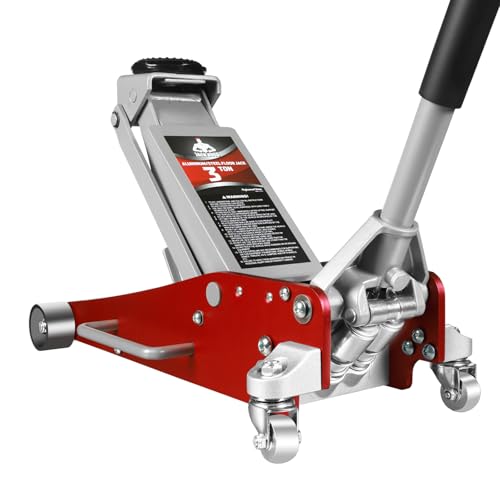 Jack Boss 3-Ton Low Profile Floor Jack |
8.8/10 | Buy |
| Best Value |
 2 Pack 4 Tons Floor Jack Saddle Rubber Pads |
8.3/10 | Buy |
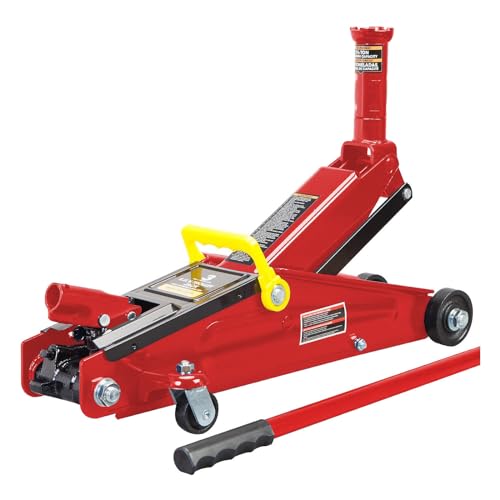 BIG RED T83006 3-Ton Floor Jack |
8.3/10 | Buy | |
| Best Budget |
 TONDA 4.92-Inch Rubber Floor Jack Pad |
8.1/10 | Buy |
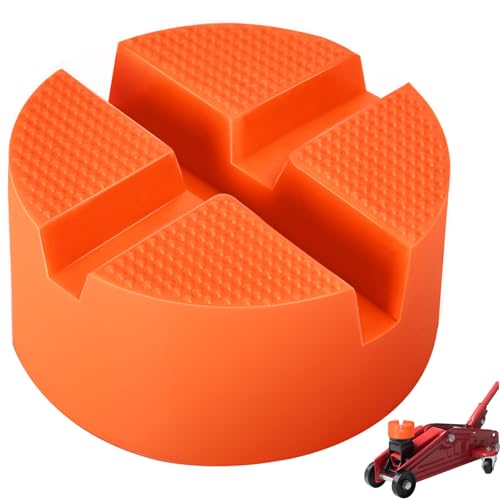 AKSOVA 5-Ton Pinch Weld Jack Pad |
8.1/10 | Buy | |
 Yesland 4.8-Inch Floor Jack Saddle (2-Pack) |
8.0/10 | Buy | |
 Maxority 3-Ton Low Profile Floor Jack |
8.0/10 | Buy |
VEVOR 2.5 Ton Low Profile Steel Floor Jack
The VEVOR 2.5 Ton Low Profile Floor Jack delivers a 5,500-lb capacity with an ultra-low 3.35-inch minimum height, making it well-suited for lowered sports cars and standard unibody vehicles. Built to ASME PALD-2014 safety standards with an all-steel chassis, it offers reliable mobile lifting for DIY garage enthusiasts.
Pros
- Ultra-compact 3.35-inch collapsed profile accesses low factory lift points without needing drive-on helper blocks
- Durable all-steel frame and steel casters handle rough shop floors better than lightweight aluminum alternatives
- Certified to ASME PALD-2014 safety standards with built-in hydraulic overload protection
- Detachable 360-degree rubber saddle pad prevents underbody gouging and slips on factory jacking seams
Cons
- Maximum rise height of 14.96 inches may limit utility on lifted four-wheel-drive trucks and high-clearance full-size SUVs
- Single-piston hydraulic pump requires more pumping strokes to reach full extension than rapid-rise dual-piston units
- Hydraulic pressure is designed strictly for lifting; secondary mechanical jack stands must always be deployed before performing under-car maintenance
Jack Boss 3-Ton Low Profile Floor Jack
Built with a hybrid aluminum and steel frame, this 3-ton floor jack pairs a low 3-15/16-inch minimum clearance with a dual-piston rapid pump. It serves as a versatile lifting solution for low-slung sedans as well as standard SUVs and minivans.
Pros
- Low-profile 3-15/16-inch minimum lifting clearance
- Fast elevation with dual-piston hydraulic pump
- Hybrid aluminum and steel frame construction
- Protective rubber saddle shields vehicle chassis
- Meets rigorous ANSI/ASME PASE safety standards
Cons
- At 58.5 pounds, it remains relatively heavy to transport
- 18-5/16-inch max height may be limiting for lifted trucks
BIG RED T83006 3-Ton Floor Jack
Engineered for high-riding trucks and SUVs, the BIG RED T83006 delivers up to 20-7/8 inches of lift height with an extended saddle neck. Its 6,000-pound capacity and integrated overload bypass provide reliable lifting power for routine garage maintenance.
Pros
- Generous 20-7/8 inch maximum lift height
- Extended saddle neck reaches high truck frames quickly
- Built-in safety bypass valve prevents overloading
- Smooth 360-degree swivel casters ease garage positioning
Cons
- Minimum 5-7/8 inch height is tall for low-profile cars
- Single-piston pump requires more strokes than dual-piston models
TONDA 4.92-Inch Rubber Floor Jack Pad
The TONDA 4.92-Inch Rubber Floor Jack Pad provides a slotted, waffle-textured cushion designed for 2-3 ton lifting applications on unibody pinch welds. It is an ideal garage accessory for DIY mechanics wanting to prevent bent rocker seams and metal-to-metal gouging during floor jack lifting.
Pros
- Deep cross-slotted grooves seat vehicle pinch welds securely to prevent metal crushing
- Textured waffle pattern enhances contact grip between lifting point and jack saddle
- Heavy-duty rubber composition cushions up to 2-3 ton vehicle lifting applications
- Substantial 4.92-inch diameter spreads contact load across compatible floor jack saddles
Cons
- Pack includes only one pad, requiring an extra purchase if lifting both sides simultaneously
- Wide 4.92-inch diameter may not fit smaller or deeply recessed floor jack saddle cups
- Dense rubber can show compression marks or cosmetic wear under heavy concentrated point loads over time
AKSOVA 5-Ton Pinch Weld Jack Pad
Molded from heavy-duty composite rubber, this adapter shields vehicle frame rails and painted pinch welds from bending or scratching during maintenance. Its 1.9-inch height and textured cross-groove surface add clearance and prevent slippage when using a floor jack.
Pros
- Robust 5-ton weight rating
- Cross-groove design cushions pinch welds effectively
- Resistant to high and low temperature deformation
- Granular surface texture provides reliable friction
- Adds nearly two inches of vertical lift clearance
Cons
- May exhibit cosmetic flaws like scratches or color spotting
- Single-pack design requires buying extra for multiple jacks
Yesland 4.8-Inch Floor Jack Saddle (2-Pack)
Built to replace worn lift pads, this two-pack from Yesland equips hydraulic jacks with a wide 4.8-inch rubber-cushioned surface and a sturdy 4-ton rating. The 1-1/8-inch stem provides a secure drop-in fit for compatible jacks while safeguarding vehicle undercarriages against marring.
Pros
- Robust 4-ton load rating for trucks and cars
- Protective rubber coating prevents slippage and scratches
- Wide diameter distributes lifting pressure effectively
- Two-pack provides an immediate spare replacement saddle
Cons
- Incompatible with jacks requiring stems other than 1-1/8 inches
- Rubber surface can experience wear under frequent heavy contact
Maxority 3-Ton Low Profile Floor Jack
The Maxority 3-Ton Low Profile Floor Jack delivers a 6,600-lb rated capacity with an extended-reach chassis and rapid dual-piston hydraulics for residential garage maintenance. Designed for sports cars and passenger vehicles on level concrete without requiring dedicated electrical wiring or permanent anchoring, it is an ideal mobile lifting tool for DIYers who support their vehicles on jack stands for routine service.
Pros
- 6,600-lb (3-ton) rated capacity handles a wide variety of passenger vehicles and sports cars
- Low-profile extended frame provides access beneath lowered vehicles with minimal ground clearance
- Dual-piston rapid pump mechanism minimizes the strokes required to meet the chassis
- High-strength steel construction delivers a sturdy, rigid platform during lifting operations
- Built-in overload protection valve promotes safer hydraulic operation
Cons
- Heavy-gauge steel construction adds physical lifting weight compared to lightweight aluminum racing jacks
- Ships in a random color finish, which may not match specific garage or workshop color schemes
- Requires pairing with appropriately rated mechanical jack stands before performing any under-vehicle maintenance
Understanding How Jack Saddles Damage Vehicles and How to Protect Your Chassis
Every vehicle lifted by a hydraulic floor jack transfers roughly half of its total curb weight through the lifting pad. An aggressive metal saddle concentrates extreme forces onto the contact point, creating immense localized stress. Whether working on a lowered sports car or a full-size SUV, recognizing the failure modes of bare saddles protects both your vehicle undercarriage and your garage safety. Proper lifting technique combined with protective saddle adapters prevents hundreds of dollars in unnecessary body repair bills.
The Mechanics of Saddle Contact: Metal-on-Metal Point Loading
Standard hydraulic service jacks feature circular lifting cups with raised steel teeth designed to grip commercial truck axles and cast iron suspension arms. These serrated perimeters prevent the saddle from sliding across greasy steel beams under heavy loads. However, when those hardened steel teeth meet the thin sheet metal of a modern unibody chassis, the force profile changes dramatically. The sharp metal ridges act as chisels under extreme hydraulic pressure, focusing several thousand pounds of vehicle weight onto millimeter-wide contact patches. This severe concentration of dynamic load easily exceeds the yield strength of automotive sheet steel.
Because sheet metal lacks the structural density of a solid axle housing, it deforms rapidly when subjected to concentrated point loading. The initial contact point begins to yield before the hydraulic ram even reaches full extension. As the jack arm rises through its curved lifting arc, this point load experiences lateral shear forces as well as vertical compression. Without an interface to distribute the vehicle mass evenly across the saddle face, sheet metal yields, buckles, and fractures under the immense strain. A flat steel contact area without cushioning inevitably creates deep dents that weaken surrounding structural stampings.
Unibody Pinch Welds Versus Body Panels: Where Damage Happens Most
Pinch welds represent the primary lifting points along the rocker panels of modern unibody vehicles. These vertical flanges consist of two or three stamped steel body panels spot-welded together to form a structural seam. While pinch welds offer strong vertical resistance when supported evenly along their base, they possess minimal lateral strength against twisting or side-loading forces. When a flat or shallow metal jack saddle presses directly against the bottom edge of a pinch weld, the flange frequently folds over like a sheet of paper. Once a pinch weld crushes sideways, restoring its original structural integrity requires extensive metal straightening.
Accidental placement against non-structural body panels produces even more catastrophic results. Floor pans, inner rocker panels, and plastic aerodynamic rocker covers sit mere inches away from reinforced lifting points. Placing a floor jack saddle just two inches inward from the reinforced notch will crush the passenger floorboard upward into the cabin. This error can fracture interior floor insulation, deform wiring harness channels, and tear underlying heat shields. Repairing a caved-in floor pan or cracked fiberglass rocker panel often costs thousands of dollars at a professional body shop.
Undercarriage Coating Failure and Accelerated Corrosion
Automakers coat vehicle underbodies with electrophoretic deposition primer, seam sealer, and thick rubberized undercoating to resist road salt, gravel, and moisture. A bare steel jack saddle scrapes through these protective layers the moment it contacts the chassis under load. Even if the pinch weld does not bend noticeably, the serrated teeth strip the paint down to bare steel. The sliding friction generated during elevation grinds metal shavings into the seam, opening minute pathways for moisture intrusion. This hidden trauma frequently goes unnoticed until rust bubbles appear on the exterior rocker panels.
Exposed steel along the undercarriage begins oxidizing within days in humid or winter driving conditions. Road salt and road spray collect inside the microscopic grooves and crushed seams created by the saddle teeth. Over several seasons, this localized paint damage progresses into severe galvanic rust that rots the rocker panels from the inside out. Corroded structural seams lose their load-bearing capacity, making future maintenance significantly more hazardous. Once rust compromises a pinch weld, the vehicle can no longer be safely supported using emergency roadside jacks.
Bare Steel Saddles Versus Vulcanized Rubber Pads and Slotted Adapters
Preventing undercarriage damage requires eliminating direct metal-on-metal friction and distributing lifting pressure across a broader surface area. Many modern hydraulic units, including the Jack Boss 3 Ton Low Profile and the VEVOR 2.5 Ton Low Profile Heavy-Duty Steel Racing jack, come equipped with built-in or removable rubber saddle pads. These dense vulcanized rubber cushions deform slightly under load, molding to the contours of the chassis while creating a high-friction barrier that prevents slippage. The rubber compound absorbs surface irregularities, protecting paint while maintaining a stable interface.
For unibody vehicles with pronounced pinch weld flanges, specialized slotted adapters offer the ultimate protective solution. Accessories like the TONDA Floor Jack Pad, Pinch Weld Jack Adapter and the AKSOVA Pinch Weld Jack Pad feature deep cross-grooves designed to straddle the vertical seam. By seating the weld flange inside the slot, the adapter transfers vehicle weight directly to the reinforced floor structure adjacent to the seam rather than crushing the vertical lip. This recessed design preserves factory paint and eliminates lateral bending forces entirely.
Heavy-duty replacement saddles provide another route for retrofitting older or industrial jacks. Hardware options such as the Yesland 2 Pack Floor Jack Saddle with Rubber Pad or the Lemecima 2 Pack 4 Tons Floor Jack Saddle Rubber Pads replace bare metal cups with padded steel platforms. These replacement units offer wide diameters and durable rubber coatings capable of supporting substantial tonnage while insulating painted chassis metal. Upgrading to a rubber-padded saddle ensures that shop equipment remains versatile across both unibody cars and heavy truck frames.
Identifying Structural Lift Points Versus Weak Undercarriage Zones
Avoiding saddle damage begins with locating factory-designated lift points specified in the vehicle owner manual. On unibody cars, these zones appear as small notches, reinforced tabs, or stamped arrows along the pinch weld seam behind the front wheels and ahead of the rear wheels. Solid-axle trucks and SUVs feature different lifting geography, requiring saddle placement under solid axle tubes or boxed frame crossmembers. Misidentifying these critical areas represents the primary reason drivers crush floor pans or bend exterior rocker trim.
Never position a jack saddle beneath oil pans, transmission housings, thin suspension control arms, or steering linkages. Aluminum engine cradles and cast suspension components can crack instantly under point loading, resulting in catastrophic fluid loss or mechanical failure. When dealing with exceptionally low vehicles where spotting lift points is difficult, some drivers utilize custom low-profile car ramp solutions to gain enough visual clearance to position the saddle accurately. Taking time to verify saddle alignment with a flashlight prevents disastrous placement mistakes.
Subframe crossmembers and central differential housings often provide excellent central lifting locations for raising an entire axle at once. However, these points demand a wide saddle that seats flat against the structural casting. If a small circular saddle contacts a curved differential housing off-center, the jack can slip sideways, denting the differential cover and damaging internal gears. Inspecting the subframe for reinforced mounting plates guarantees that the chassis can support dynamic lifting forces without warping.
Saddle Slippage and Angular Shift During the Hydraulic Lifting Arc
A common misconception is that a hydraulic floor jack raises a car in a perfectly vertical line. Because trolley jacks lift via a pivoting steel arm, the saddle moves in a slight arc as it extends upward. To maintain alignment directly under the vehicle lift point, the jack chassis must roll forward on its front wheels as the lift arm rises. Any restriction on the floor jack casters directly transfers twisting stress to the contact saddle.
If the jack rolls over cracked concrete, uneven asphalt, or debris that jams the casters, the chassis cannot roll forward smoothly. When the wheels lock up, the saddle is pulled laterally across the vehicle frame as the lift arm arcs upward. This lateral dragging force will bend pinch welds, shear through undercoating, and potentially pull the vehicle completely off the lifting pad. Understanding equipment mechanics and preventing equipment slippage ensures that all lifting devices maintain their intended contact geometry. Keeping your garage floor clean of pebbles and dirt permits the jack frame to track freely under the lifting point.
Matching Jack Saddle Diameter and Depth to Vehicle Chassis Geometry
Floor jack saddles vary significantly in diameter, ranging from compact two-inch cups to wide five-inch industrial platforms. Compact trolley jacks often feature small, deep cups that concentrate pressure into tiny areas, creating high risks of denting sheet metal. Larger service units, such as the Maxority 3-Ton Low Profile Hydraulic jack, utilize broader saddles that distribute load over a much safer footprint. A wider saddle creates a stable foundation that reduces pressure per square inch across the vehicle frame.
Saddle depth also dictates vehicle clearance and contact security. Vehicles equipped with extended aftermarket side skirts or lowered rocker panels require ultra-low-profile saddles that sit nearly flush with the lifting arm. Conversely, high-clearance four-wheel-drive trucks require specialized lift geometry. Jacks like the BIG RED Hydraulic Trolley Service/Floor Jack incorporate extended saddle necks to span the tall vertical distance to the chassis without requiring dangerous wood blocks or unrated shims. Choosing the appropriate saddle height prevents side skirts from being crushed by the lift arm during upward travel.
Always measure the depth of your vehicle pinch weld before selecting a slotted rubber pad. If the slot is shallower than the height of the weld flange, the entire weight of the car will still bear down onto the thin metal edge. The rubber pad must either match the flange depth precisely or feature sufficient recess clearance so the vehicle weight rests on the reinforced shoulder. Using a mismatched adapter can concentrate loads onto the weakest part of the flange, causing the very damage you sought to avoid.
Transitioning from Jack Saddles to Jack Stands Safely
A hydraulic floor jack is strictly an elevating mechanism, never a static holding device. Hydraulic pressure relies on rubber O-rings, check valves, and hydraulic oil, all of which can fail without warning. Resting a vehicle on a jack saddle for extended periods not only increases the risk of catastrophic hydraulic drop, but also places continuous localized strain on the contact metal. Prolonged pressure from a narrow saddle cup can cause slow metal creep in thin unibody stampings.
Immediately after raising the car to the desired service height, position properly rated mechanical jack stands beneath factory-approved support points. Slowly rotate the jack release valve to lower the vehicle onto the stands in a smooth, controlled motion. Universal joint release mechanisms allow for micro-metered lowering, preventing abrupt drops that shock the chassis. Transferring the weight onto wide, load-dispersing jack stand saddles stabilizes the chassis and relieves intense point stress from the hydraulic saddle.
Never place any part of your body beneath an elevated vehicle until mechanical stands are securely engaged and all remaining ground wheels are chocked. Inspect the contact points between the jack stand saddles and the chassis before beginning any repair work. By incorporating rubber saddle pads, slotted adapters, and disciplined lifting habits, you can eliminate undercarriage damage while maintaining garage safety standards. Treating the chassis with care preserves both vehicle value and structural integrity for years to come.
About the author
Larry Carley is an experienced automotive technical writer and editor with more than four decades of work covering vehicle diagnostics, repair procedures, and automotive technology. His extensive technical writing helps readers understand mechanical systems, maintenance decisions, and the importance of accurate information when working on vehicles.