
Best Low Profile Steel Floor Jack of 2026 Garage Picks
Low-clearance vehicles demand the best low profile steel floor jack for safe garage repairs. Compare durable heavy-duty lifting options updated for October 2026.
 By Peter Nelson
Updated October 16, 2026

Slipping a standard hydraulic lift under a lowered car pinch weld often feels impossible when ground clearance doesn’t clear four inches. Scraping rocker panels or denting floor pans causes unnecessary headaches during routine oil changes and brake jobs. That is why finding the best low profile steel floor jack makes all the difference in a home workshop. Heavy-gauge carbon steel chassis provide rigid side plates that resist twisting under heavy loads, giving you rock-solid stability on uneven concrete surfaces. Dual-piston hydraulic pumps raise the lift arm rapidly to reduce physical strain and eliminate pumping fatigue during weekend maintenance. While keeping equipment working smoothly might require tracking down replacement hydraulic floor jack parts after years of tough service, starting with a rugged unit prevents premature hydraulic seal blowout.
Based on our detailed comparison of rated ton capacities, collapsed heights, and user feedback, reliable lifting performance boils down to chassis geometry and valve control. A minimum saddle height under 3.5 inches allows smooth positioning beneath low-riding passenger coupes without needing drive-on ramps. Controlled universal joint releases let you drop vehicles smoothly without sudden drops. Remember that a hydraulic jack isn’t designed to support vehicle weight indefinitely; it’s strictly a temporary lifting device. You must always secure the chassis onto heavy-duty mechanical jack stands before sliding underneath for suspension or exhaust work. Keeping extra heavy-duty garage jack components in reserve can help maintain your equipment, but selecting a high-capacity steel trolley jack ensures dependable lifting power for years to come.
| Award | Product | BJL Score About BJL ScoreThe BJL Score is our own rating from 0 to 10, based on performance, design and build, ease of use, and value. It reflects independent research and is never influenced by manufacturers, retailers, or affiliate commissions. Learn more › | |
|---|---|---|---|
| Best Overall |
Arcan A20003 3-Ton Low Profile Floor Jack
|
9.1/10 | Buy |
| Best Budget |
 AV Steel 2-Ton Low Profile Floor Jack |
8.9/10 | Buy |
| Best Value |
 SATA 3-Ton Heavy-Duty Steel Floor Jack |
8.9/10 | Buy |
 VEVOR 3 Ton Low Profile Floor Jack |
8.8/10 | Buy | |
| Best Premium |
 Jack Boss 3-Ton Low Profile Floor Jack |
8.8/10 | Buy |
 TONEIDER 3-Ton Low Profile Floor Jack |
8.6/10 | Buy | |
 AV Steel 2.5-Ton Low Profile Floor Jack |
8.4/10 | Buy | |
 AV Steel 3-Ton Low Profile Floor Jack |
8.1/10 | Buy | |
 SATA 3-Ton Aluminum Floor Jack |
8.1/10 | Buy | |
 Maxority 3-Ton Low Profile Floor Jack |
8.0/10 | Buy |
Arcan A20003 3-Ton Low Profile Floor Jack
Built with a reinforced high-carbon steel chassis, this 3-ton floor jack easily reaches beneath low-clearance vehicles. It serves as a dependable, heavy-duty lifting option for home mechanics and workshop maintenance.
Pros
- Strong 6,000-pound load capacity
- Low-profile clearance fits low-riding vehicles
- Built-in hydraulic overload protection valves
- Durable high-carbon steel frame construction
- Smooth maneuverability with wide front wheels
Cons
- Heavy 76.8-pound weight makes transport cumbersome
- Bulkier storage footprint than aluminum alternatives
- Limited to a standard one-year warranty
AV Steel 2-Ton Low Profile Floor Jack
Built for sedans and low-clearance sports cars, this hydraulic floor jack features a 3-3/8-inch minimum saddle height and a dual-piston pump for quick lifting. With a 2-ton capacity, it handles routine garage maintenance with ease, though it cannot accommodate taller trucks or SUVs.
Pros
- Low saddle height easily fits low-clearance vehicles
- Dual-piston pump enables rapid vehicle lifting
- Built-in safety overload protection valve
- Rear swivel wheels allow smooth garage repositioning
- Rotatable saddle enhances vehicle contact stability
Cons
- Not compatible with trucks, SUVs, or lifted vehicles
- Heavy steel construction weighs over 50 pounds
- Limited to a 2-ton maximum capacity
SATA 3-Ton Heavy-Duty Steel Floor Jack
This SATA 3-ton heavy-duty steel floor jack combines a low-clearance chassis with a dual-piston rapid lift pump and an extended 19-1/8-inch maximum lift height. Factory reviewed to 1.5 times its rated 6,600-pound capacity, it provides dependable lifting muscle for home garage mechanics servicing passenger sedans, crossovers, and light pickups.
Pros
- Generous 3-ton (6,600 lb) rated capacity with factory proof evaluation to 1.5 times maximum load for enhanced structural confidence.
- Dual-piston rapid lift mechanism cuts unladen pump strokes to bring the saddle to vehicle contact points rapidly.
- Wide 3-3/4-inch to 19-1/8-inch elevation range accommodates low passenger cars as well as standard crossovers and light trucks.
- Rugged industrial-grade steel chassis offers dependable torsional rigidity and resistance to frame deformation.
- Precision slow-release descent valving helps prevent abrupt drops when settling the vehicle onto mechanical stands.
Cons
- Substantial 70-pound dry chassis weight makes manual lifting into high truck beds or mobile transport physically demanding.
- Bare steel saddle does not include a pre-installed slotted rubber pinch weld pad, requiring aftermarket protection for delicate unibody seams.
- Extended 28.3-inch steel chassis requires adequate clearance behind the vehicle to pump the handle comfortably in compact single-car bays.
VEVOR 3 Ton Low Profile Floor Jack
The VEVOR 3-ton low-profile floor jack provides 6,600 lbs of hydraulic lifting capacity with an ultra-low 3.35-inch minimum saddle height and rapid dual-piston pump action. Ideal for home garage DIYers and sports car enthusiasts needing dependable lifting power for oil changes, brake service, and tire rotations before setting jack stands.
Pros
- 3.35-inch low-profile entry height clears lowered vehicles and tight factory lift points
- Rapid dual-piston hydraulic pump reduces physical pumping effort and setup time
- Rugged all-steel construction with smooth-rolling rear swivel casters for easy positioning
- Complies with ASME PALD-2014 and CE standards with built-in overload protection
- Detachable rubber saddle pad and foam handle sleeve safeguard vehicle paint and chassis
Cons
- Heavy 73-pound curb weight makes lifting into truck beds or mobile service rigs demanding
- As a hydraulic floor jack, it provides zero mechanical locking and requires dedicated jack stands before working underneath
- 52-inch two-piece handle requires moderate clearance behind the vehicle during horizontal pumping
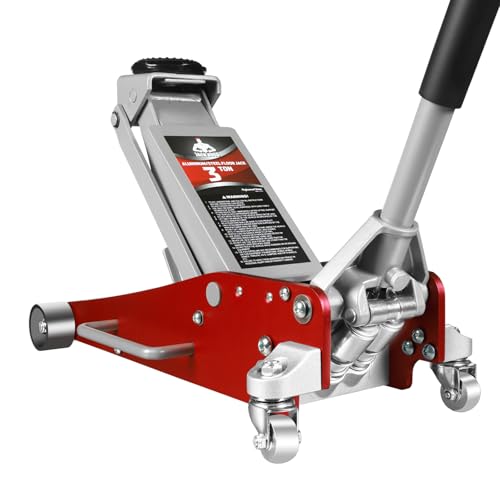
Jack Boss 3-Ton Low Profile Floor Jack
Built with a hybrid aluminum and steel frame, this 3-ton floor jack pairs a low 3-15/16-inch minimum clearance with a dual-piston rapid pump. It serves as a versatile lifting solution for low-slung sedans as well as standard SUVs and minivans.
Pros
- Low-profile 3-15/16-inch minimum lifting clearance
- Fast elevation with dual-piston hydraulic pump
- Hybrid aluminum and steel frame construction
- Protective rubber saddle shields vehicle chassis
- Meets rigorous ANSI/ASME PASE safety standards
Cons
- At 58.5 pounds, it remains relatively heavy to transport
- 18-5/16-inch max height may be limiting for lifted trucks
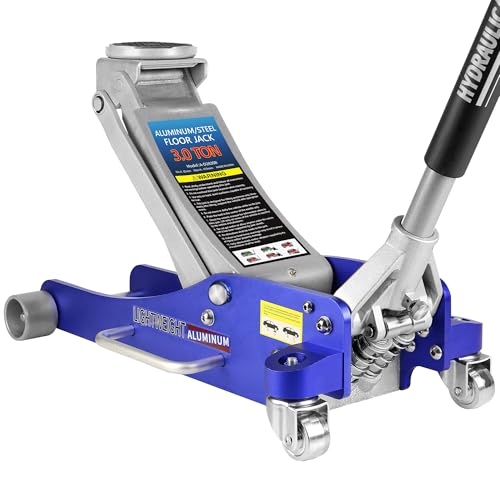
TONEIDER 3-Ton Low Profile Floor Jack
Engineered for low-clearance sports cars and daily drivers, this TONEIDER hybrid jack pairs a 3.35-inch minimum height with a 6,000-pound capacity. Its dual-piston hydraulic pump rapidly lifts vehicles up to 18.5 inches, making it a capable option for home garage maintenance.
Pros
- Low 3.35-inch profile fits sports cars
- Dual-piston system speeds up lifting
- Durable aluminum and steel hybrid build
- Generous 18.5-inch maximum lift height
Cons
- Weighs 61.1 pounds, limiting portability
- Long frame requires significant storage space
AV Steel 2.5-Ton Low Profile Floor Jack
Built specifically for low-clearance sedans and sports cars, this hydraulic jack slides under chassis as low as 3.4 inches. Its 5,000-pound capacity and built-in overload protection provide dependable lifting, though its 14.6-inch maximum reach limits it strictly to passenger cars.
Pros
- Slim 3.4-inch profile fits under low-clearance vehicles
- Sturdy steel frame supports up to 5,000 pounds
- Safety overload valve prevents lifting past capacity
- 360-degree rotating saddle enhances contact stability
- Rear swivel wheels allow smooth repositioning
Cons
- Not designed for trucks, SUVs, or lifted vehicles
- Maximum lift height tops out at 14.6 inches
- Single piston pump requires more strokes to lift
AV Steel 3-Ton Low Profile Floor Jack
Built to clear lowered suspensions and standard passenger cars, this hydraulic steel jack reaches under chassis as low as 3-1/8 inches and extends to nearly 20 inches. A dual-piston pump speeds up lifts, backed by compliance with recognized ANSI/ASME PASE safety standards.
Pros
- Low 3-1/8-inch minimum height fits under low-clearance cars
- Dual-piston pump enables rapid lifting with less effort
- Meets rigorous ANSI/ASME PASE safety standards
- Heavy-duty steel construction ensures solid garage stability
Cons
- All-steel construction makes it considerably heavy to transport
- Long frame requires significant floor space for storage
SATA 3-Ton Aluminum Floor Jack
Designed for versatile garage work, this aluminum floor jack combines a low 3-3/4-inch clearance with a dual-piston pump for rapid vehicle elevation. Its aluminum construction significantly cuts down on overall weight, making positioning around the shop far less strenuous.
Pros
- Low 3-3/4-inch minimum height accommodates low-clearance vehicles
- Dual-piston system reduces physical pumping effort
- Aluminum body provides good portability around the shop
- Controlled release mechanism eliminates sudden drops
Cons
- Long 28.3-inch frame requires substantial storage room
- 19-1/8-inch maximum lift may not suit high-clearance trucks
Maxority 3-Ton Low Profile Floor Jack
The Maxority 3-Ton Low Profile Floor Jack delivers a 6,600-lb rated capacity with an extended-reach chassis and rapid dual-piston hydraulics for residential garage maintenance. Designed for sports cars and passenger vehicles on level concrete without requiring dedicated electrical wiring or permanent anchoring, it is an ideal mobile lifting tool for DIYers who support their vehicles on jack stands for routine service.
Pros
- 6,600-lb (3-ton) rated capacity handles a wide variety of passenger vehicles and sports cars
- Low-profile extended frame provides access beneath lowered vehicles with minimal ground clearance
- Dual-piston rapid pump mechanism minimizes the strokes required to meet the chassis
- High-strength steel construction delivers a sturdy, rigid platform during lifting operations
- Built-in overload protection valve promotes safer hydraulic operation
Cons
- Heavy-gauge steel construction adds physical lifting weight compared to lightweight aluminum racing jacks
- Ships in a random color finish, which may not match specific garage or workshop color schemes
- Requires pairing with appropriately rated mechanical jack stands before performing any under-vehicle maintenance
Frequently Asked Questions
What minimum saddle height is needed for a low profile floor jack?
A minimum saddle height between 2.75 inches and 3.5 inches is required to clear most lowered cars, sports coupes, and low-clearance sedans. Standard trolley jacks often sit at 5 inches or higher, which prevents them from sliding under pinch welds or front subframes. A slim front chassis profile ensures the lifting cup reaches central crossmembers without binding against front splitters or ground effects.
Should you choose a 2-ton or 3-ton rating for home vehicle maintenance?
A 3-ton capacity jack is generally the safer and more versatile choice for most garages in 2026. While a 2-ton unit lifts up to 4,000 pounds and easily handles compact hatchbacks, a 3-ton model supports 6,000 to 6,600 pounds. Because a floor jack only lifts one corner or axle at a time, a 3-ton rating provides a wide safety margin for midsize crossovers, SUVs, and light trucks without straining internal hydraulic valves.
Why is heavy-duty steel preferred over aluminum for a low profile jack?
Heavy-duty steel provides superior structural rigidity and long-term chassis durability under repeated lifting stress. While aluminum frames offer lighter portability for track events, high-carbon steel side plates resist lateral flex and twisting when rolling across pitted garage floors. When servicing workshop tools, sourcing quality floor jack service parts helps maintain internal hydraulic seals, ensuring your steel equipment lasts for decades.
How does a dual-piston pump improve hydraulic lifting efficiency?
A dual-piston pump raises the lift saddle to the vehicle chassis in roughly three to five strokes, cutting pumping effort significantly. Parallel hydraulic pistons displace fluid faster under minimal resistance until the saddle meets the load. Once weight engages the lift arm, the hydraulic system moderates pressure to ensure steady elevation without requiring heavy arm leverage.
How do you purge trapped air from the hydraulic cylinder of the best low profile steel floor jack?
Open the release valve completely by turning the handle counterclockwise, then pump the handle vigorously ten to fifteen times to purge trapped air from the hydraulic chamber. Air bubbles frequently enter the hydraulic oil circuit during shipping or storage, causing spongy strokes or incomplete extension. If pump resistance remains weak, opening the rubber oil fill plug releases remaining air pressure before you top off fluid, much like servicing hydraulic jack valve hardware.
Can you support a vehicle on a low profile steel floor jack during maintenance?
No, you should never rely solely on a hydraulic jack to hold a vehicle elevated during maintenance. Hydraulic jacks use pressurized fluid that can leak past internal seals or drop unexpectedly if a valve fails. Always raise the vehicle with your jack, position mechanical jack stands rated for the load beneath manufacturer pinch welds or frame rails, and lower the car onto the stands before beginning work.
About the author
Peter Nelson is an automotive writer whose published work includes off-road jacks, power tools, vehicle maintenance, and garage equipment. His coverage connects product features with practical applications, helping readers think through equipment choices for everyday repairs, project vehicles, and off-road situations.