
How to Build a Toy Car Ramp out of Wood: Practical Guide for 2026
Learn how to build a toy car ramp out of wood with durable lumber and smart slope design in this November 2026 guide covering planning, builds, and safety.
 By Larry Carley
Updated October 10, 2026


Building a miniature race track or launch ramp in the home workshop offers a fun way to explore mechanical incline geometry and woodworking craft. Learning how to build a toy car ramp out of wood allows makers to create customized slope angles, durable track grooves, and exciting launch runs for diecast vehicles. Whether assembling a multi-level gravity racer or an angled jump platform, choosing stable materials like solid beech or layered plywood ensures smooth rolling performance without structural wobble. Proper planning transforms scrap lumber into an engaging play center while teaching fundamental concepts of elevation, vehicle clearance, and smooth surface transitions.
Makers who spend time working on full-size vehicle projects in home garages often appreciate how scale physics mirrors heavy equipment design. Understanding how friction, wheel tracking, and incline pitch operate on small wood tracks helps hobbyists respect the structural engineering behind professional workshop tools and published garage equipment safety standards. Selecting high-grade lumber, rounding off rough edges, and applying non-toxic water-based finishes creates a safe environment for younger racers while delivering consistent speed. A well-constructed ramp structure provides reliable track alignment, clean vehicle rollouts, and long-lasting durability across hundreds of energetic gravity runs.
| Award | Product | BJL Score About BJL ScoreThe BJL Score is our own rating from 0 to 10, based on performance, design and build, ease of use, and value. It reflects independent research and is never influenced by manufacturers, retailers, or affiliate commissions. Learn more › | |
|---|---|---|---|
|
TOP BRIGHT Wooden Car Ramp Race Track Toy Set
|
8.4/10 | Buy | |
| Best Budget |
 Chivao 12-Piece Wooden Mini Race Car Set for Ramp |
8.6/10 | Buy |
| Best Value |
 Joyreal Wooden Car Ramp Toy |
9.1/10 | Buy |
 GFYYBKJ Wooden Toy Car Jump Ramp and Track Display |
8.3/10 | Buy | |
| Best Overall |
 WSBXBB Wooden Toy Car Jump Ramp and Diecast Race |
9.2/10 | Buy |
 Ranqibo 4-Level Wooden Car Ramp Race Track Toy Set |
8.1/10 | Buy | |
 AmazingJoy Wooden Montessori Car Ramp Toy Set |
8.3/10 | Buy | |
 TOP BRIGHT Car Ramp Toys |
8.8/10 | Buy | |
| Best Premium |
 Ranqibo Wooden Montessori Car Ramp Track |
8.9/10 | Buy |
TOP BRIGHT Wooden Car Ramp Race Track Toy Set
The TOP BRIGHT Wooden Car Ramp Race Track Set is a miniature four-level zig-zag ramp toy designed for toddlers aged 1 to 3, featuring solid wood construction and ASTM-certified safety standards. While not an automotive service ramp for real vehicles, it serves as a fun garage-themed developmental toy for young children of DIY enthusiasts.
Pros
- Constructed from solid wood and BPA-free plastic with smooth, sanded edges for safe play
- Fully certified to U.S. ASTM and European EN71 safety standards, including wheel tensile strength reviews
- Includes four brightly colored, numbered toy cars that promote color and number recognition
- Rooftop parking lot offers built-in storage to keep toy cars organized and prevent lost pieces
- Compact 0.71-pound design is easy to set up and move around the home or play area
Cons
- Strictly a children's toy set and cannot be used for full-scale automotive maintenance or vehicle elevation
- Only accommodates the small included toy cars and is not compatible with larger toy vehicles
- Compact size may feel small for older children outside the 1 to 3 year age range
Chivao 12-Piece Wooden Mini Race Car Set for Ramp
The Chivao 12-piece wooden mini car set provides durable beech wood replacement vehicles for gravity-fed toy ramp tracks. Featuring smooth-rolling wheels and child-safe water-based paint, it is an affordable pick for families and playrooms needing extra track cars.
Pros
- Solid beech wood construction holds up well against repeated drops and track runs
- Smooth-rolling axle design glides easily down miniature wooden incline tracks
- Safe water-based painted finish with vibrant colors and individual vehicle numbers
- Generous 12-piece count ensures plenty of spare vehicles if originals get misplaced
Cons
- Miniature toy dimensions mean these are strictly play items, not automotive shop equipment
- Requires a compatible toy ramp track or smooth tabletop surface for gravity runs
- Small component size requires adult supervision for very young toddlers
Joyreal Wooden Car Ramp Toy
The Joyreal 4-Level Wooden Car Ramp is a tabletop Montessori developmental toy featuring a multi-tier wooden track, two parking lots, and four miniature rolling cars for toddlers aged 1 to 2. It is designed strictly for early childhood motor skill development and is not a drive-on automotive service ramp.
Pros
- Sturdy wooden and plastic construction with smooth, splinter-free rounded edges
- Comes complete with four miniature rolling cars and integrated parking stalls
- Compact 10 x 3.81 x 8.89-inch footprint fits easily on play tables or bedroom shelves
- Engaging multi-level gravity track helps toddlers develop visual tracking and coordination
Cons
- Designed exclusively as a toddler toy and cannot support or elevate full-size automobiles
- Track channels are sized only for the included miniature toy vehicles
- Unsuitable for automotive shop environments, oil changes, or garage maintenance
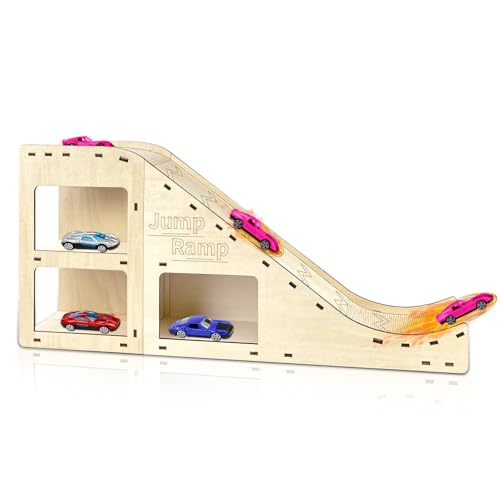
GFYYBKJ Wooden Toy Car Jump Ramp and Track Display
The GFYYBKJ Wooden Toy Car Jump Ramp is a compact plywood launch track and storage stand designed specifically for 1:64 scale miniature vehicles rather than real automobiles. It offers an engaging stunt ramp and organized display solution for young car enthusiasts, hobbyists, and Hot Wheels collectors.
Pros
- Lightweight 0.2-pound plywood structure is simple to assemble, relocate, and store
- Clever dual-purpose layout functions as both an entertaining jump track and a neat vehicle organizer
- Complies with official US CPSC toy safety standards for children ages 3 and up
- Engaging in-depth assembly project for gearhead parents and young automotive fans
Cons
- Strictly a miniature toy track with zero structural capacity for elevating real motor vehicles
- Thin 1/8-inch plywood parts require gentle alignment during assembly to prevent splintering
- Interlocking joints may require wood glue to achieve rigid, wobble-free stability under heavy play
WSBXBB Wooden Toy Car Jump Ramp and Diecast Race
The WSBXBB Toy Car Jump Ramp is a lightweight plywood race track and storage stand designed for miniature diecast vehicles and Hot Wheels collections. It offers an engaging launch incline and organized display slots, making it ideal for young automotive fans and hobbyist garage displays.
Pros
- Serves as both an entertaining jump ramp track and a multi-car organization stand
- Sturdy thick plywood construction provides better rigidity than thin cardboard playsets
- Lightweight footprint makes it easy to move, reposition, or store when not in action
- Offers a creative automotive-themed display for kids and scale-model collectors alike
Cons
- Designed strictly for miniature toy cars and cannot be used for any full-scale automotive maintenance
- Requires careful manual assembly to avoid cracking or splitting the wooden interlocking tabs
- May require supplementary wood glue during assembly to ensure long-term joint durability under enthusiastic play
Ranqibo 4-Level Wooden Car Ramp Race Track Toy Set
The Ranqibo 4-Level Car Ramp Race Track is a wooden toy ramp set featuring four multi-tier tracks, a top parking area, and four miniature cars. It offers engaging tabletop racing play to help young car enthusiasts build fine motor skills, but is strictly a toy and not an automotive service ramp.
Pros
- Engaging four-tier wooden ramp structure provides repeatable rolling fun for young children
- Comes complete with four colorful mini cars and an integrated parking platform
- Lightweight and compact footprint is easy to move, clean, and store
- Helps toddlers and young children develop hand-eye coordination and fine motor skills
Cons
- Strictly a children's toy and completely unsuitable for real vehicle maintenance or lifting
- Wooden track width is limited to miniature toy cars and cannot accommodate larger diecast models
- Lacks weighted base grip or rubber feet for energetic play on slick table surfaces
AmazingJoy Wooden Montessori Car Ramp Toy Set
The AmazingJoy Montessori Car Ramp is a miniature wooden zigzag track toy designed for toddlers aged 18 months and older, featuring six toy vehicles and an activity play mat. It provides zero vehicle weight capacity or automotive lift height, serving as a developmental children's playset rather than garage maintenance equipment.
Pros
- Crafted from natural solid wood with smooth rounded edges and child-safe water-based paint
- Complete playset includes six miniature toy vehicles, a puzzle play mat, and a rooftop garage
- Supports early childhood hand-eye coordination, color recognition, and visual tracking
- Lightweight one-pound structure is easy to transport, set up, and store in small living spaces
Cons
- Delivers zero automotive load capacity and cannot lift or support real passenger vehicles
- Frequently appears in general car ramp search queries despite being strictly a children's toy
- Contains small toy components requiring standard adult supervision for young toddlers
TOP BRIGHT Car Ramp Toys
The TOP BRIGHT Car Ramp Toy is a multi-tier wooden and plastic gravity track set featuring four rolling cars and an integrated top parking lot. Designed for toddlers rather than full-scale automotive garage maintenance, it offers durable educational entertainment for young kids.
Pros
- Durable solid wood and plastic construction reviewed to ASTM and EN71 toy safety standards
- Includes four brightly colored, numbered mini cars with secure tensile-reviewed wheel assemblies
- Integrated rooftop parking lot encourages neat storage and organization after playtime
- Promotes fine motor coordination and early color or number recognition for young children
Cons
- Intended strictly as a toddler toy and cannot support real vehicle elevation or DIY maintenance tasks
- Track channels are sized exclusively for miniature toy cars and cannot fit standard automotive accessories
- Provides no mechanical lift height, axle load capacity, or garage fluid service capability
Ranqibo Wooden Montessori Car Ramp Track
While indexed under automotive vehicle ramp categories, this Ranqibo product is a lightweight wooden Montessori toy race track for toddlers, offering zero Gross Vehicle Weight Rating (GVWR) or automotive service lift. It makes an engaging gift for young children aged 3 and up, but DIY mechanics needing oil change equipment must look elsewhere.
Pros
- Durable solid wood construction finished with child-safe water-based paint
- Includes seven vibrant miniature cars (five single-seaters and two two-seaters) for cooperative toddler play
- Helps young children develop hand-eye coordination, dexterity, and sharing habits
- Lightweight two-pound design makes it easy to move, pack away, and store indoors
Cons
- Not an automotive service ramp and provides zero load capacity for passenger cars, trucks, or SUVs
- Frequently miscategorized in automotive replacement and shop equipment searches, creating confusion for DIY mechanics
- Cannot provide under-car working clearance, vehicle approach angle, or wheel support of any kind
Engineering and Building a Wooden Toy Car Ramp: Incline Geometry, Material Selection, and Workshop Physics
Planning a custom wooden vehicle ramp project begins with an understanding of slope mechanics, kinetic energy, and joinery integrity. Creating a functional track requires calculating how gravity pulls miniature rolling stock down inclined planes without causing vehicles to flip or bind against side rails. While miniature toy ramps focus on maximizing momentum and playful jumps, the underlying physics connects directly to how full-size automotive ramps handle incline slopes and weight distribution. Exploring these structural dynamics ensures your woodworking project delivers consistent entertainment while showcasing the fundamental principles of vehicle elevation.
Designing Track Slope Geometry and Vehicle Clearance Angles
Determining the proper slope angle represents the most critical initial calculation when laying out a wooden toy race track. A gentle descent between fifteen and twenty degrees allows diecast cars to accelerate smoothly while keeping all four wheels planted against the running surface. If the angle becomes too steep, vehicles tend to tumble end-over-end or bottom out their front valences at the transition point where the ramp meets the floor. Crafting a gradual radiused curve at the base helps redirect forward momentum across flat ground, preventing sudden chassis impacts.
Full-size vehicle engineering uses similar geometric principles to calculate bumper clearance before driving onto maintenance ramps. Automotive approach angle is calculated using the formula arctan(Front Ground Clearance / Front Overhang Distance), which defines the maximum incline a vehicle can climb without scraping its front bumper or air dam. While low-profile sports cars require ultra-shallow ramp inclines between 8.5 and 10 degrees to avoid front splitter damage, standard passenger vehicles typically clear 15 to 17 degree slopes. Scaling this geometric awareness down to toy vehicle construction guarantees that front splitters, bumpers, and low-slung chassis navigate each track segment cleanly.
Selecting Durable Lumber and Child-Safe Materials for DIY Ramps
Selecting appropriate wood stock dictates the longevity, safety, and operational smoothness of any handmade track. High-grade Baltic birch plywood or smooth beech hardwood provides an ideal balance of dimensional stability and splinter-free machining. Thin 1/8-inch plywood sheets work exceptionally well for curved transition aprons and jump lips, while thicker half-inch or three-quarter-inch plywood delivers rigid vertical supports. Solid hardwoods like beech resist indentation from metal axles and wheels, maintaining straight tracking over thousands of repeated downhill runs.
Safety considerations must guide every finishing and chemical treatment decision when building toys for children. All surfaces require thorough sanding through progressive grits up to 220-grit paper to eliminate splinters, burrs, and sharp wooden corners. Finishing products should consist exclusively of non-toxic, child-safe, water-based acrylic paints or certified food-safe mineral oils that release zero harmful volatile organic compounds. Commercial toys such as those from TOP BRIGHT and AmazingJoy adhere to stringent ASTM and European EN71 safety standards by pairing natural solid wood with certified non-toxic water-based coatings. Replicating these manufacturing benchmarks in your home workshop ensures the finished project remains completely safe for toddlers and young racers.
Step-by-Step Construction of Zigzag Tracks and Launch Platforms
Constructing a multi-tier zigzag ramp begins with ripping two identical upright support towers from sturdy plywood. Marking matching incline angle dados across both interior upright panels guarantees that each descending track level aligns perfectly without twisting. Cutting shallow dado slots allows horizontal running ramps to slide securely into the frame, creating rigid glue joints that resist lateral twisting forces. Incorporating side retaining lips along each track shelf prevents drifting toy cars from flying off the edges during high-speed descents.
Assembly proceeds by dry-fitting all components before applying non-toxic wood glue along the routed dado channels. Clamping the structure squarely ensures that track slopes remain parallel and drop slots provide adequate clearance for cars to flip between levels. Adding a flat staging platform or rooftop parking deck at the summit gives young operators a convenient holding area to line up vehicles before release. Many builders choose to integrate simple dowel pin pivot gates that drop down to start multi-car drag races simultaneously. Once the adhesive cures fully, rounding the drop edges ensures cars tumble smoothly from upper ramps down to lower decks without catching their bumpers.
Analyzing Pre-Fabricated Wooden Ramps Versus Custom Workshop Builds
Comparing pre-built commercial wooden track sets against custom home workshop builds reveals distinct practical advantages for different situations. Commercial products like the WSBXBB Toy Cars Jump Ramp and GFYYBKJ wooden jump ramp utilize precision laser-cut 1/8-inch plywood that doubles as an integrated storage case for miniature cars. Sets such as the Ranqibo Montessori track feature seven consecutive rainbow ramps accompanied by specialized single-seater and two-seater wooden race cars designed for cooperative social play. Meanwhile, models from Joyreal emphasize soothing pastel palettes, rounded child-safe contours, and built-in parking lots that teach toddlers basic organization.
Custom workshop builds provide unmatched flexibility in track width, total descent length, and custom obstacle integration that commercial kits rarely match. Home crafters can customize track dimensions to accommodate larger vehicle scales or incorporate multi-lane jump gaps engineered to test scale speed and aerodynamic flight. Pre-made sets, however, benefit from standardized quality control, tested wheel retention mechanisms, and verified compliance with US CPSC toy safety regulations. Purchasing commercial replacement vehicles, such as the Chivao 12-piece beech wood mini car pack, offers an economical way to supply durable rolling stock for both custom-built and manufactured wooden tracks.
Structural Scale and Load Rating Physics: From Toy Ramps to Full-Size Service Equipment
Understanding structural rigidity requires analyzing how load-bearing demands increase exponentially when moving from lightweight toys to full-size automotive equipment. A miniature wooden ramp only supports a few ounces of rolling diecast metal, meaning modest wood joinery easily provides adequate structural support. Full-size automotive maintenance ramps, by contrast, must safely bear thousands of pounds of static and dynamic mechanical load. Home mechanics browsing heavy-duty shop lift options quickly recognize that structural calculations demand strict engineering standards and certified load ratings.
Weight rating standards in the automotive service industry follow strict conventions that DIY mechanics must understand completely to avoid catastrophic failures. Manufacturers rate automotive ramp pairs based on Gross Vehicle Weight Rating, abbreviated as GVWR, which assumes the ramps support only one elevated axle representing roughly 50 to 60 percent of the total vehicle curb weight. For example, a heavy-duty ramp set advertised with a 16,000-pound GVW capacity is engineered to support an axle load of 8,000 pounds, which equals 4,000 pounds per individual ramp platform. Treating an advertised vehicle rating as an individual single-ramp capacity creates extreme structural collapse hazards, which is why commercial equipment incorporates a mandatory minimum 2x proof-load safety margin.
Surface Friction, Platform Width, and Track Spillover Dynamics
Traction dynamics between rolling wheels and ramp surfaces dictate whether a vehicle climbs cleanly or experiences unstable side slipping. On miniature wooden tracks, low-friction polished wood surfaces encourage high speeds, while subtle side guide walls prevent toy cars from sliding laterally off the course. When scaling up to full-size vehicle service ramps, surface friction becomes a vital safety mechanism designed to prevent ramp kick-out or vehicle sliding during ascent. Workshop floors with smooth-troweled concrete, sealed polyaspartic coatings, or glossy epoxy finishes present severe slipping risks that demand specialized high-grip rubber friction feet or dedicated floor traction mats.
Platform track width represents another vital compatibility checkpoint that mirrors across both miniature and automotive ramp designs. While a toy car measuring 1.3 inches wide requires at least 1.5 inches of clear lane channel, full-size vehicle tires demand generous platform footprints. Automotive ramps typically offer platform widths between 8 and 12 inches to support standard tire footprints without structural distortion. Performance sports cars and heavy-duty trucks equipped with wide tires exceeding 275mm or 325mm section widths must never overhang the outer ramp edges or press against raised containment lips, as sidewall rollover can damage tire carcasses and induce sudden platform tipping.
Non-Negotiable Redundancy and Safety Protocols in the Garage Workshop
Operating safely within a garage workshop requires establishing strict boundaries between recreational woodworking and heavy automotive lifting operations. When elevating real vehicles for maintenance, relying on drive-on ramps alone without secondary supports represents a dangerous failure of workshop protocol. Automotive drive-on procedures mandate feathering the throttle smoothly, utilizing an external spotter, and feeling the front tires drop securely into the concave platform cradle against the raised forward stop lip. Overshooting the stop lip can cause the vehicle chassis to drop onto suspension arms, floorboards, or rocker panels, resulting in extensive mechanical damage.
Once a vehicle rests securely on elevated ramp platforms, multiple mandatory safety redundancy protocols must take effect before any underbody inspection begins. The technician must set the emergency parking brake firmly, shift manual transmissions into first or reverse gear, and place automatic transmissions securely into Park. Heavy-duty rubber wheel chocks must be wedged tightly behind the grounded tires resting on the shop floor to eliminate any possibility of accidental roll-back. Furthermore, secondary backup jack stands must be positioned beneath factory frame rails or solid pinch weld lifting points to guarantee survival space if a primary ramp experiences structural failure.
Choosing Between Drive-On Service Ramps and Secondary Lifting Equipment
Deciding between drive-on service ramps and hydraulic floor jacking systems depends entirely on the specific maintenance task being performed. Drive-on ramps excel at rapid underbody access for routine engine oil changes, transmission fluid inspections, differential flushes, and skid plate removals because they maintain vehicle suspension loading in minutes. Two-piece modular ramp designs with detachable approach sections offer superior side creeper clearance, allowing mechanics to roll underneath without dodging bulky incline ramps. However, service tasks requiring wheel removal, brake rotor replacement, or suspension component unbolting mandate the use of dedicated hydraulic floor jacks paired with heavy-duty locking jack stands.
Hobbyists setting up serious home repair spaces often evaluate permanent lifting equipment alongside portable ramps. Reviewing installed home shop vehicle lifts illustrates how mechanical locks and overhead clearance provide complete underbody access for comprehensive restoration work. Portable ramps remain the most accessible solution for quick garage servicing, provided users adhere to structural weight limits and material properties. High-density structural foam composites offer rust-free, lightweight handling, whereas welded steel ramps deliver extreme durability despite higher unit weight. Mechanics must avoid leaving vehicles elevated on composite ramps over extended winter storage, as continuous static loading can accelerate polymer creep and induce tire flat-spotting within curved cradles.
Final Assembly Verification, Finishing, and Long-Term Durability
Completing your DIY wooden toy ramp project requires a comprehensive inspection of all joints, running surfaces, and fastening points before introducing rolling stock. Testing track seams with a straightedge ensures no misaligned wood joints snag miniature axles or disrupt smooth vehicle descent. Applying multiple thin coats of child-safe clear satin finish protects the bare lumber against moisture changes, wood warpage, and energetic playtime wear. Allowing the protective finish to cure completely in a well-ventilated workshop guarantees a durable, rock-solid surface that will provide dependable racing entertainment for generations of young drivers.
About the author
Larry Carley is an experienced automotive technical writer and editor with more than four decades of work covering vehicle diagnostics, repair procedures, and automotive technology. His extensive technical writing helps readers understand mechanical systems, maintenance decisions, and the importance of accurate information when working on vehicles.