
Are Hydraulic Bottle Jacks Good? Performance, Safety, and Guide for 2026
Are hydraulic bottle jacks good for heavy vehicles? Review lifting limits, flat tire clearances, and roadside safety guidelines for November 2026.
 By Christian Hazel
Updated October 10, 2026


When a loaded truck or heavy trailer suffers a roadside tire failure, choosing the right lifting equipment determines whether the recovery is smooth or dangerous. Many drivers wonder whether are hydraulic bottle jacks good enough to replace cumbersome rolling floor jacks for roadside emergencies and home maintenance. These compact tools deliver tremendous vertical force by utilizing pressurized fluid within a narrow cylinder body. While their immense lifting capacity makes them standard equipment for commercial haulers and agricultural operators, understanding their specific mechanical limitations remains vital before placing one beneath a vehicle axle.
A standard hydraulic bottle jack excels at raising solid axles, farm machinery, and structural beams where space is tight. However, their small footprint and upright stature mean they cannot match the broad rolling stability of dedicated garage vehicle lifts or full-frame floor jacks. Matching the tool to the vehicle requires evaluating minimum collapsed height, suspension droop, and the actual load resting on each individual axle. Exploring how these tools function helps determine whether a bottle jack fits your specific roadside recovery and garage repair requirements.
| Award | Product | BJL Score About BJL ScoreThe BJL Score is our own rating from 0 to 10, based on performance, design and build, ease of use, and value. It reflects independent research and is never influenced by manufacturers, retailers, or affiliate commissions. Learn more › | |
|---|---|---|---|
| Best Overall |
YELLOW JACKET 4 Ton Welded Bottle Jack
|
9.2/10 | Buy |
| Best Value |
 BIG RED 4-Ton Hydraulic Bottle Jack |
9.1/10 | Buy |
| Best Budget |
 WORKPRO 4-Ton Hydraulic Bottle Jack |
8.6/10 | Buy |
| Best Premium |
 VEVOR 20-Ton Air Hydraulic Bottle Jack |
8.4/10 | Buy |
 BIG RED 10-Ton Welded Hydraulic Bottle Jack |
8.1/10 | Buy | |
 VEVOR 20-Ton Welded Hydraulic Bottle Jack Review |
8.1/10 | Buy | |
 BIG RED 20 Ton Welded Hydraulic Bottle Jack |
8.1/10 | Buy | |
 Pro-Lift 20 Ton Hydraulic Bottle Jack |
7.8/10 | Buy |
YELLOW JACKET 4 Ton Welded Bottle Jack
Delivering an 8,000-pound rated capacity with a 7-3/8-inch to 14-5/16-inch lift range, this YELLOW JACKET 4-ton welded bottle jack pairs compact vertical lifting with horizontal pushing capability. Its all-welded steel reservoir minimizes fluid leak risks, making it an ideal mobile emergency tool for passenger cars, compact SUVs, and light garage maintenance.
Pros
- All-welded steel body resists oil leaks far better than traditional threaded tie-rod assemblies during mobile transit
- Manufacturer-certified for horizontal operation, adding versatility for light mechanical pressing and spreading tasks
- Lightweight 7.05-pound design with an included hard-shell carrying case ensures clean, organized in-vehicle storage
- Effective 7-3/8-inch to 14-5/16-inch lift range provides solid vertical stroke for passenger sedans and compact crossovers
Cons
- 4-ton (8,000-lb) capacity is not suited for commercial chassis, full-size diesel trucks, or heavy fifth-wheel trailers
- 7-3/8-inch collapsed profile may not clear dropped axles on vehicles with low ground clearance or completely shredded flat tires
- Narrow base footprint requires firm, level ground or a broad support block to prevent sinking on gravel or soft asphalt
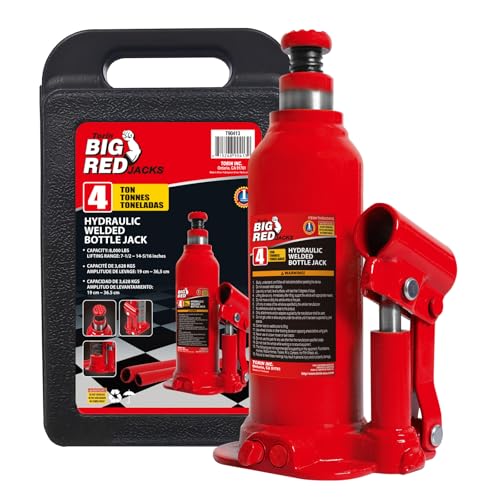
BIG RED 4-Ton Hydraulic Bottle Jack
Built from drop forged alloyed steel with a welded leak-free frame, this compact jack reliably lifts loads up to 8,000 pounds. An adjustable screw-top extension and included blow mold carrying case make it a practical tool for roadside tire changes and garage maintenance.
Pros
- Welded alloy steel build minimizes leak risks
- Screw-top extension offers adaptable starting heights
- Meets ASME safety standards for peace of mind
- Compact 6.22-pound frame stores easily in vehicles
Cons
- Minimum 7.5-inch height does not fit low-clearance cars
- Manual pump operation requires repeated physical effort
WORKPRO 4-Ton Hydraulic Bottle Jack
Built with welded steel and an integrated overload valve, this compact 4-ton bottle jack provides stable hydraulic lifting for garage and roadside repairs. Its dedicated hard case keeps the tool protected and organized for easy trunk storage.
Pros
- Heavy-duty welded steel construction
- Built-in overload safety valve
- Smooth hydraulic action with minimal pumping effort
- Includes dedicated protective storage case
- Quality seals help minimize fluid leakage
Cons
- 4-ton limit restricts use on heavier commercial vehicles
- Manual pump operation required for lifting
VEVOR 20-Ton Air Hydraulic Bottle Jack
Delivering a 20-ton lifting capacity with both pneumatic and manual pumping modes, this all-welded bottle jack offers an adjustable working height from 10.2 to 19.5 inches. Engineered with an integrated extension screw and dual return springs, it provides dependable vertical lifting power for heavy-duty pickups, commercial chassis, RVs, and farm equipment.
Pros
- High 20-ton capacity easily handles heavy pickup axles, commercial chassis, large RVs, and farm machinery
- Dual pneumatic and manual operation provides rapid air-powered lifting in the shop and dependable hand-pump capability in the field
- All-welded body design significantly reduces fluid seepage risks compared to threaded tie-rod assemblies during transit
- Dual heavy-duty retraction springs ensure prompt piston return without manual downward force
- Adjustable 2.6-inch extension screw minimizes dead stroke travel under high-clearance truck frames and axles
Cons
- Dry weight of nearly 30 pounds makes frequent transport and repositioning under low vehicles physically demanding
- Minimum collapsed height of 10.2 inches may not clear dropped axles when tires are completely deflated down to the rim
- Full pneumatic functionality requires access to an external air compressor, limiting rapid-lift capability during remote roadside stops
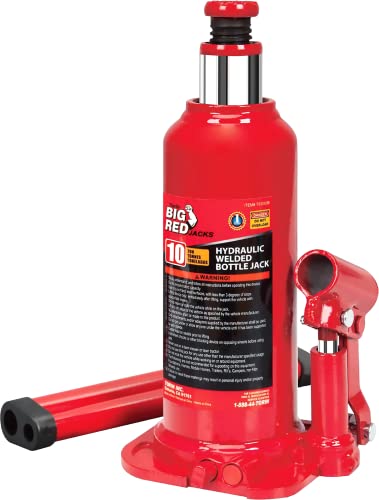
BIG RED 10-Ton Welded Hydraulic Bottle Jack
The BIG RED TAM91003B delivers 10 tons (20,000 lbs) of hydraulic lifting power with an 8-13/16 inch to 17-5/8 inch operating range and an all-welded leak-resistant steel body. Its adjustable extension screw and serrated saddle make it well-suited for heavy pickup axles, trailer maintenance, and structural sill leveling.
Pros
- Drop-forged steel base with all-welded construction resists oil leaks during transport better than threaded tie-rod jacks
- Generous 10-ton capacity easily handles heavy-duty truck axle lifting, equipment trailers, and residential structural leveling
- Adjustable extension screw minimizes wasted hydraulic stroke before contacting the lifting point
- Integrated bypass and overload valves protect internal hydraulic seals against over-extension
Cons
- Minimum collapsed height of 8-13/16 inches may not fit under dropped axles with completely flat tires without prior cribbing
- Compact base footprint requires wide timber or a steel plate when used on soft soil, gravel, or warm asphalt to avoid sinking
- Manual hand pumping requires physical effort and patience when elevating loads near maximum rated capacity
VEVOR 20-Ton Welded Hydraulic Bottle Jack Review
Featuring a welded leak-resistant body and a 20-ton (44,092 lb) capacity, this manual hydraulic bottle jack provides dependable lifting power from an 8.9-inch collapsed height up to 17.1 inches. It is well-suited for heavy-duty pickup axles, loaded trailers, and farm equipment when paired with rated mechanical jack stands.
Pros
- Generous 20-ton lifting capacity easily handles heavy axle loads on trucks, fifth wheels, and farm equipment
- All-welded steel body design resists oil leaks far better than traditional threaded tie-rod jacks during transport
- Adjustable 2.4-inch extension screw bridges frame or axle gaps without sacrificing hydraulic stroke length
- Manageable 16.1-pound total weight makes it convenient to store behind truck seats or in RV utility bays
Cons
- Minimum collapsed height of 8.9 inches may struggle to slide beneath dropped solid axles with a completely flat tire
- Manual hand pumping requires physical effort when approaching high-tonnage loads
- Descent release valve requires careful, gradual feathering to prevent sudden load drops
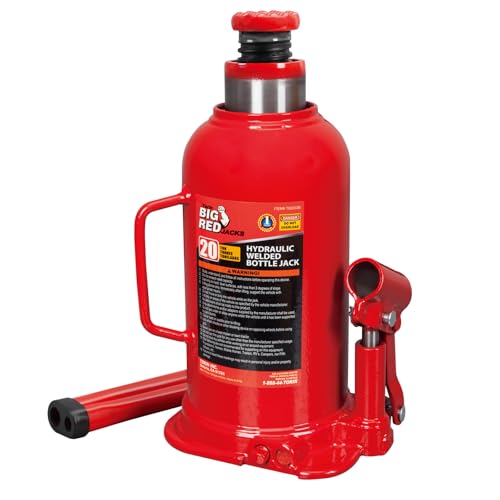
BIG RED 20 Ton Welded Hydraulic Bottle Jack
Featuring a massive 20-ton (40,000 lb) capacity and a 9-7/16-inch to 17-5/8-inch lifting range, this BIG RED welded bottle jack provides heavy vertical power for truck axles, equipment maintenance, and structural leveling. Its inner and outer welded alloy steel construction prevents hydraulic fluid leaks, while an adjustable top screw extends reach without sacrificing stability.
Pros
- Substantial 20-ton (40,000 lb) lifting capacity easily manages heavy truck axles, farm equipment, and house sill leveling
- All-welded inner and outer cylinder construction prevents messy fluid weeping commonly found on threaded tie-rod bottle jacks
- Adjustable screw top extension provides versatile starting heights without exhausting hydraulic stroke
- Integrated overload and bypass safety valves safeguard internal seals against over-extension
- Drop-forged alloyed steel base ensures solid vertical stability on concrete, asphalt, and cribbing
Cons
- Collapsed height of 9-7/16 inches is too tall to clear low-profile vehicles or completely deflated tires on dropped trailer axles
- At 18.1 pounds with no integrated carry handle, transporting the unit between field jobs requires two hands or a toolbox
- Release valve requires slow, fractional turns to prevent sudden descent when lowering maximum rated loads
Pro-Lift 20 Ton Hydraulic Bottle Jack
Delivering up to 20 tons of vertical hydraulic force, the Pro-Lift hydraulic bottle jack features heat-treated critical stress areas and an adjustable extension screw for heavy-duty lifting tasks. Sized for auto, truck, and agricultural equipment maintenance, it includes an integrated carrying handle and a built-in ram bypass valve for dependable workshop utility.
Pros
- Generous 20-ton lifting capacity suitable for heavy commercial truck axles, farm machinery, and equipment trailers
- Integrated carrying handle makes transporting the 22-pound steel unit much more practical across job sites
- Built-in bypass valve helps protect internal hydraulic components from damage caused by ram over-extension
- Adjustable extension screw provides mechanical reach to bridge starting gaps before hydraulic pumping begins
- Constructed in compliance with ANSI/PALD safety and performance standards
Cons
- At 22 pounds, the unit carries noticeable weight when transported for emergency roadside repairs
- Manual hand pumping requires physical effort compared to air-over-hydraulic pneumatic options
- Axle clearance must be checked ahead of time to verify fitment under low-clearance trailers or flat tires
Evaluating Hydraulic Bottle Jacks: Performance, Limitations, and Practical Utility
Hydraulic bottle jacks are exceptionally effective lifting tools for heavy trucks, travel trailers, farm machinery, and commercial vehicles that require concentrated lifting power in a compact form factor. Their mechanical strength allows a relatively small tool to generate between four tons and twenty tons of vertical force with minimal manual physical exertion. However, determining whether a bottle jack is the right tool for your specific application depends on your vehicle ground clearance, suspension travel, and operating environment. Understanding the mechanical realities of these hydraulic cylinders ensures you select equipment that lifts safely without unexpected roadside complications.
The Core Mechanical Advantages of Hydraulic Bottle Jacks
The primary advantage of any hydraulic bottle jack is its remarkable power-to-weight ratio. By applying Pascal’s law of fluid pressure, a small manual hand pump forces hydraulic oil through an internal high-pressure chamber to extend a solid steel piston ram. This configuration allows a compact unit weighing under fifteen pounds to raise four tons, while heavier twenty-ton models remain portable enough to stow in a truck toolbox. The concentrated vertical force makes them far more space-efficient than bulky rolling trolley jacks.
Portability represents another major reason drivers keep bottle jacks in their roadside recovery kits. Unlike wheeled shop jacks that consume immense cargo space and roll uncontrollably in a truck bed, a bottle jack stores upright in tight compartments. Models such as the WORKPRO 4 Ton unit and the BIG RED 4 Ton jack come equipped with blow-molded storage cases that keep the cylinder clean and contained. This compact design allows vehicle owners to carry serious lifting capability without sacrificing valuable luggage or cargo room.
Direct vertical lifting efficiency also minimizes mechanical deflection during heavy operations. A floor jack moves through an arc as its lifting arm swings upward, which can pull the jack chassis toward the vehicle or shift the contact point. A bottle jack pushes strictly upward along a vertical axis, delivering stable thrust when positioned on level ground. When paired with heavy machinery, agricultural equipment, or stationary structural timber beams, this vertical alignment provides predictable lifting control.
Navigating Clearance Limits and the Flat-Tire Dilemma
The most common failure point for prospective bottle jack buyers involves clearance beneath a flat tire rim. A bottle jack that slides effortlessly under an axle at normal ride height may prove completely useless once a tire blows out on the highway. When a tire loses air pressure, the wheel rim drops directly toward the pavement, reducing axle clearance by several inches. If the collapsed height of the jack exceeds this reduced distance, the tool cannot slip beneath the designated lift point.
Comparing collapsed height measurements reveals significant dimensional differences across tonnage ratings. The YELLOW JACKET 4 Ton jack features a collapsed minimum height of 7-3/8 inches, while the BIG RED 4 Ton jack measures 7-1/2 inches when fully lowered. In contrast, higher-capacity options such as the BIG RED 10 Ton model require 8-13/16 inches of initial clearance, and the BIG RED 20 Ton jack stands 9-7/16 inches tall in its fully retracted position. Heavy pneumatic units like the VEVOR Air Hydraulic Bottle Jack require an initial clearance of 10.2 inches.
Drivers must measure the distance from the road surface to their vehicle axle tube while assuming a fully deflated tire profile. For passenger cars and low-slung utility trailers, a bottle jack is rarely the best choice because factory ground clearance is too restricted. Light trucks, three-quarter-ton pickups, and high-clearance travel trailers benefit most from this design, provided the user confirms the collapsed profile fits under a bare rim. Failing to account for this clearance gap leaves operators stranded when an actual roadside emergency occurs.
Stroke Travel, Extension Screws, and Suspension Droop
Suspension droop presents another mechanical challenge that can exhaust a bottle jack before the tire leaves the pavement. When jacking from a vehicle frame rail rather than directly under the axle tube, the suspension springs extend downward as the chassis rises. If the hydraulic piston reaches its maximum stroke before the wheel clears the ground, the jack tops out without completing the lift. Understanding total effective reach prevents this frustrating mechanical scenario.
Total effective lifting range equals the sum of the collapsed height, the hydraulic stroke length, and the extension screw travel. Many manufacturers incorporate heat-treated adjustable screw collars at the top of the piston ram to bridge initial air gaps without consuming hydraulic travel. For instance, the VEVOR Air Hydraulic Bottle Jack includes a 2.6-inch adjustable screw that extends the total range from 10.2 inches up to 19.5 inches. Similarly, the manual VEVOR Hydraulic Bottle Jack utilizes a 2.4-inch extension screw to reach an extended height of 17.1 inches from an initial 8.9-inch profile.
Operators should thread the top collar outward until the saddle pad contacts the vehicle lift point before pumping the handle. This adjustment ensures that every inch of hydraulic piston movement translates directly into vehicle elevation rather than empty stroke. For vehicles with long-travel leaf springs or deep suspension droop, lifting directly beneath the axle tube or leaf spring perch eliminates suspension sag entirely. Choosing the proper lift point maximizes the usable stroke of the hydraulic ram.
Base Stability, Footprint Dimensions, and Tipping Hazards
The narrow base footprint of a bottle jack represents its greatest physical vulnerability during vehicle lifting operations. Unlike rolling floor jacks that distribute vehicle weight across four wide-set steel casters, a bottle jack concentrates the load over a small rectangular steel base plate. On uneven asphalt, gravel road shoulders, or soft dirt, this concentrated ground pressure can cause the jack base to tilt or sink into the ground. A slight tilt at the base quickly creates severe angular force at the top saddle.
Tipping hazards escalate rapidly whenever vehicle wheels are not completely immobilized before pumping begins. Operators must always set the emergency parking brake and place rigid wheel chocks on the wheels remaining in contact with the ground. When working outside a paved garage, placing a heavy hardwood cribbing block or a thick steel spreader plate beneath the jack base distributes ground pressure effectively. This rigid secondary base prevents the jack from punching through soft hot asphalt or settling unevenly into roadside dirt.
Hydraulic bottle jacks are strictly vertical lifting mechanisms that cannot tolerate horizontal side loads. If a vehicle rolls even an inch during the lift, the lateral force can bend the extended piston ram or kick the base out from beneath the axle. Operators investigating permanent shop installations often review heavy-duty vehicle lifting options that provide full structural containment. For roadside tire changes, maintaining absolute vertical alignment remains the ultimate defense against catastrophic tipping.
Axle Contact Security and Saddle Geometry
Most hydraulic bottle jacks feature a serrated circular steel saddle designed to bite into flat frame rails or cast iron suspension components. Units like the BIG RED 20 Ton jack and the Pro-Lift 20 Ton jack utilize heat-treated, grooved saddles to enhance surface grip. However, placing a flat circular saddle against a curved steel axle tube creates a precarious point of contact. The minimal surface area between the flat pad and the round tube increases the risk of slipping under heavy vehicle load.
Thin-walled axle tubes can also suffer structural deformation if immense tonnage concentrates onto a small circular saddle pad. To resolve this danger, many truck and trailer owners pair their bottle jacks with radiused axle cradle adapters that cup the tube securely. An axle saddle cradle distributes the lifting force evenly around the bottom circumference of the axle housing. This cradling action prevents lateral slippage while protecting the axle tube from localized crushing or denting.
When an axle cradle is unavailable, positioning the saddle directly beneath the leaf spring tie plate or U-bolt bracket provides a flat, reinforced lifting point. These factory mounting points are engineered to support full vehicle corner weight without bending. Operators should avoid lifting directly against steering tie rods, aluminum control arms, or thin differential covers. Selecting a rigid, reinforced lift point protects both the vehicle structure and the stability of the hydraulic cylinder.
Welded Cylinder Construction versus Modular Threaded Bases
Hydraulic bottle jacks generally feature either an all-welded steel construction or a modular threaded cast-iron base assembly. Modern high-quality units, such as the BIG RED 4 Ton and VEVOR 20 Ton jacks, utilize inner and outer welded steel structures. Welding the hydraulic reservoir cylinder directly to the drop-forged base plate eliminates external threaded joints and O-ring seams that frequently weep oil. This all-welded design delivers leak-free durability under intense pressure cycles.
Older and cheaper modular designs rely on threaded joints sealed with synthetic rubber O-rings between the cylinder body and the cast base. Over time, seasonal temperature fluctuations and repeated pressure shocks can degrade these internal O-rings, leading to fluid leaks around the base perimeter. Once fluid seeps from the reservoir, the jack loses hydraulic efficiency and risks drawing atmospheric air into the pumping chamber. Welded steel cylinders withstand heavy transport vibration far better than modular threaded assemblies.
Storage orientation also depends heavily on internal cylinder sealing and reservoir plug design. Most standard hydraulic bottle jacks must be stored upright to prevent hydraulic fluid from weeping past the reservoir fill plug. However, specialized models like the YELLOW JACKET 4 Ton jack feature multi-directional welded construction that permits horizontal storage and horizontal pressing. Confirming whether a jack is rated for horizontal placement prevents messy fluid spills inside vehicle toolboxes and storage compartments.
Manual Operation versus Air-Over-Hydraulic Pneumatic Power
Choosing between a manual hydraulic jack and a pneumatic air-over-hydraulic model depends on your working environment and frequency of use. Manual units, such as the Pro-Lift 20 Ton jack or the WORKPRO 4 Ton model, rely entirely on a two-piece slip-fit steel lever handle. The operator strokes the handle manually to actuate the small pumping plunger, building pressure slowly and steadily. This standalone manual operation makes them completely independent of external power sources, making them ideal for remote roadside tire changes.
Air-over-hydraulic units, such as the VEVOR Air Hydraulic Bottle Jack, integrate a pneumatic motor that drives the hydraulic pump using compressed air. Connecting the tool to a standard shop air compressor or service truck air line enables rapid, effortless lifting of massive twenty-ton loads. These hybrid jacks retain a manual pump handle, allowing operators to switch back to hand pumping whenever air lines are unavailable. Commercial fleet mechanics and agricultural operators benefit immensely from this dual-mode lifting capability.
Pneumatic models do carry trade-offs in weight, physical bulk, and storage convenience. The added air motor, air hose whip, and dual return springs increase the overall dimensions and weight of the jack assembly. Commercial operators managing larger facilities frequently compare these heavy portable tools with permanent commercial garage lifting equipment designed for continuous daily duty cycles. For occasional roadside emergency preparedness, a straightforward manual bottle jack remains the lighter, more compact choice.
Tonnage Calculation: Gross Axle Weight Ratings and Safety Margins
A critical mistake many vehicle owners make is calculating bottle jack capacity based on total vehicle curb weight rather than axle load distribution. A vehicle weighing 8,000 pounds does not distribute its weight evenly across all four tires. The front axle often carries sixty percent of the curb weight due to the engine and transmission, while cargo or trailer tongue weight concentrates over the rear axle. Sizing a jack based on overall vehicle weight can leave an individual corner dangerously under-rated.
Operators should always consult the vehicle driver door jamb certification label to locate the Gross Axle Weight Rating (GAWR). Sizing the bottle jack requires selecting a capacity that easily exceeds the GAWR of the heaviest axle, with a mandatory 1.5x to 2x safety margin. For example, a heavy three-quarter-ton truck with a 6,000-pound rear GAWR should not rely on a marginal two-ton jack. Stepping up to a 10-ton model like the BIG RED 10 Ton jack or a 20-ton unit ensures the hydraulic system operates well within its mechanical limits.
Generous tonnage overhead also protects internal hydraulic components from premature seal failure. Operating a hydraulic cylinder near its maximum working load limit forces internal valves and packings to endure extreme hydraulic pressures. High-capacity jacks incorporate safety overload bypass valves, as seen on the WORKPRO 4 Ton and BIG RED 20 Ton models, to prevent the ram from extending beyond safe limits. Maintaining a robust capacity margin provides effortless lifting action and prolongs the service life of internal seals.
Essential Hydraulic Maintenance: Fluid Types and Air Purging
Hydraulic bottle jacks require periodic maintenance to preserve smooth lifting operation and prevent spongy handle response. Over time, rough transport or temperature shifts can cause tiny air bubbles to enter the high-pressure pumping chamber. When air mixes with hydraulic fluid, the piston ram may feel spongy, hesitate under load, or fail to reach its full extended stroke height. Purging this trapped air is a simple operational procedure that restores factory lifting performance.
To bleed trapped air from the hydraulic circuit, turn the needle release valve counterclockwise to open the passage completely. With the valve fully open, pump the handle rapidly through ten to fifteen full strokes to circulate fluid and push aerated oil back into the outer reservoir. Next, pull the rubber oil fill plug from the side of the cylinder to allow the trapped air pressure to vent outward into the atmosphere. Reinstall the rubber plug firmly, turn the release valve clockwise until snug, and verify firm hydraulic resistance.
Replenishing fluid levels requires clean ISO standard hydraulic jack oil, typically ISO VG 22 or ISO VG 32 viscosity grades. Operators must never introduce brake fluid, motor oil, or automatic transmission fluid into a hydraulic bottle jack. Automotive brake fluid is chemically corrosive and destroys nitrile rubber O-rings, while motor oil causes synthetic seals to soften, swell, and fail under pressure. Inspecting fluid levels through the side fill port with the ram fully retracted ensures the internal reservoir remains clean and properly filled.
Operational Safety Protocol: Dynamic Lifting versus Static Holding
The fundamental rule of hydraulic bottle jack operation is recognizing that these tools are strictly dynamic lifting devices, never static load-holding devices. A hydraulic cylinder relies entirely on fluid trapped behind a miniature needle valve and elastomeric seals to sustain pressure. Contaminant debris on a check valve seat or internal bypass weeping can cause the ram to creep downward silently without warning. Operators must never place any part of their body beneath a vehicle supported solely by hydraulic pressure.
Immediately after raising the vehicle axle to the required working clearance, lower the load onto rated mechanical secondary supports. Sturdy steel jack stands meeting ASME PASE standards or solid hardwood cribbing blocks must carry the vehicle weight before any tire removal or underbody maintenance begins. When lowering the load onto the mechanical supports, turn the needle release valve slowly and deliberately. Metering the release valve prevents abrupt drops that could shock-load the jack stands or upset vehicle balance.
Hydraulic bottle jacks remain exceptional lifting tools for drivers and operators who respect their dimensional constraints and operational protocols. Their massive tonnage capacity, compact storage dimensions, and straightforward vertical thrust make them unmatched for solid-axle trucks, trailers, and agricultural recovery. By verifying deflated tire clearances, stabilizing the base plate, and immediately engaging secondary mechanical supports, you can rely on a quality bottle jack for years of dependable heavy-duty service.
About the author
Christian Hazel is an automotive journalist with extensive experience covering four-wheel-drive vehicles, mechanical upgrades, and off-road equipment. His background includes technical reviews, installation features, and project-vehicle coverage, bringing useful context to equipment choices for trucks, Jeeps, and off-road enthusiasts.